Definition Type: Element
Name: key
Namespace: http://oval.mitre.org/XMLSchema/oval-definitions-5#windows
Type: oval-def:EntityObjectStringType
Containing Schema: windows-definitions-schema.xsd
MinOccurs (1)
MaxOccurs (1)
Abstract
Documentation:
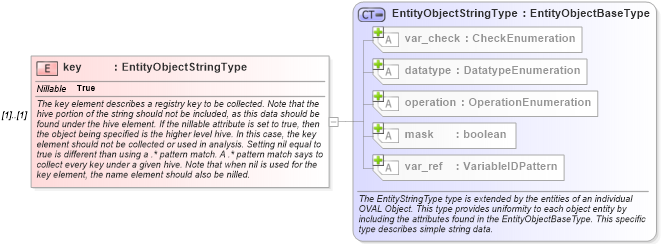
The key element describes a registry key to be collected. Note that the hive portion of the string should not be included, as this data should be found under the hive element. If the nillable attribute is set to true, then the object being specified is the higher level hive. In this case, the key element should not be collected or used in analysis. Setting nil equal to true is different than using a .* pattern match. A .* pattern match says to collect every key under a given hive. Note that when nil is used for the key element, the name element should also be nilled.
Collapse XSD Schema Diagram:
Drilldown into var_ref in schema oval-definitions-schema_xsd Drilldown into mask in schema oval-definitions-schema_xsd Drilldown into operation in schema oval-definitions-schema_xsd Drilldown into datatype in schema oval-definitions-schema_xsd Drilldown into var_check in schema oval-definitions-schema_xsd Drilldown into EntityObjectStringType in schema oval-definitions-schema_xsdXSD Diagram of key in schema windows-definitions-schema_xsd (Open Vulnerability and Assessment Language (OVAL®))
Collapse XSD Schema Code:
<xsd:element name="key" type="oval-def:EntityObjectStringType" nillable="true">
    <xsd:annotation>
        <xsd:documentation>The key element describes a registry key to be collected. Note that the hive portion of the string should not be included, as this data should be found under the hive element. If the nillable attribute is set to true, then the object being specified is the higher level hive. In this case, the key element should not be collected or used in analysis. Setting nil equal to true is different than using a .* pattern match. A .* pattern match says to collect every key under a given hive. Note that when nil is used for the key element, the name element should also be nilled.</xsd:documentation>
        <xsd:appinfo>
            <sch:pattern id="regobjkey" xmlns:sch="http://purl.oclc.org/dsdl/schematron">
                <sch:rule context="win-def:registry_object/win-def:key">
                    <sch:assert test="not(@datatype) or @datatype='string'">
                        <sch:value-of select="../@id" /> - datatype attribute for the key entity of a registry_object should be 'string'</sch:assert>
                    <sch:assert test="not(@xsi:nil='true') or ../win-def:name/@xsi:nil='true'">
                        <sch:value-of select="../@id" /> - name entity must be nil when key is nil</sch:assert>
                </sch:rule>
            </sch:pattern>
        </xsd:appinfo>
    </xsd:annotation>
</xsd:element>
Collapse Child Attributes:
Name Type Default Value Use
datatype oval-def:datatype string Optional
operation oval-def:operation equals Optional
mask oval-def:mask false Optional
var_ref oval-def:var_ref Optional
var_check oval-def:var_check all Optional
Collapse Derivation Tree: