<xsd:element name="lockoutpolicy_state" substitutionGroup="oval-def:state">
    <xsd:annotation>
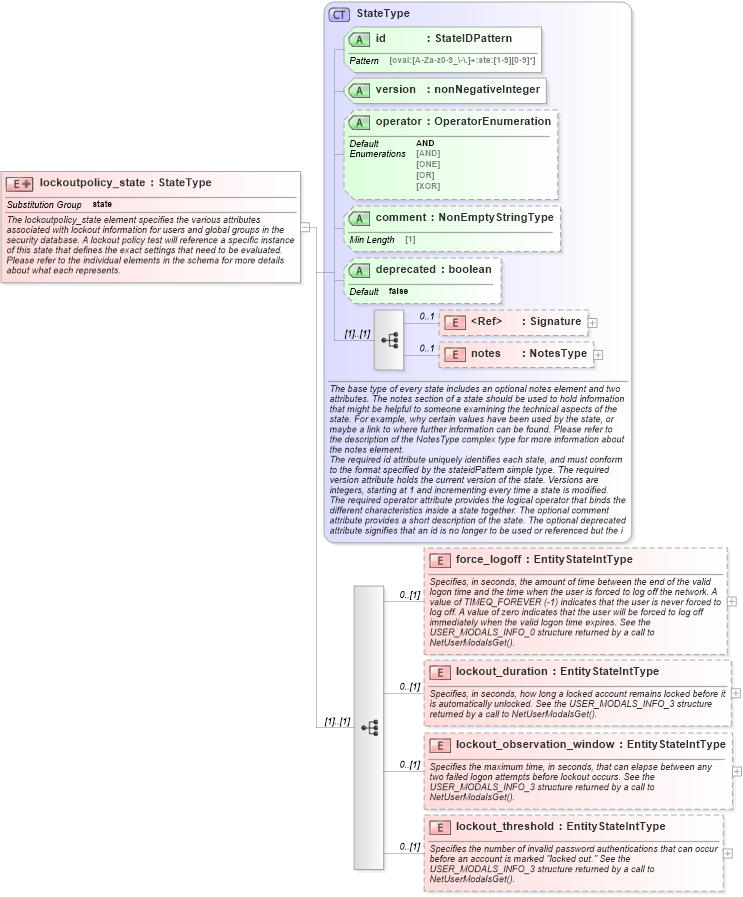
        <xsd:documentation>The lockoutpolicy_state element specifies the various attributes associated with lockout information for users and global groups in the security database. A lockout policy test will reference a specific instance of this state that defines the exact settings that need to be evaluated. Please refer to the individual elements in the schema for more details about what each represents.</xsd:documentation>
    </xsd:annotation>
    <xsd:complexType>
        <xsd:complexContent>
            <xsd:extension base="oval-def:StateType">
                <xsd:sequence>
                    <xsd:element name="force_logoff" type="oval-def:EntityStateIntType" minOccurs="0">
                        <xsd:annotation>
                            <xsd:documentation>Specifies, in seconds, the amount of time between the end of the valid logon time and the time when the user is forced to log off the network. A value of TIMEQ_FOREVER (-1) indicates that the user is never forced to log off. A value of zero indicates that the user will be forced to log off immediately when the valid logon time expires. See the USER_MODALS_INFO_0 structure returned by a call to NetUserModalsGet().</xsd:documentation>
                            <xsd:appinfo>
                                <sch:pattern id="lpsteforce_logoff" xmlns:sch="http://purl.oclc.org/dsdl/schematron">
                                    <sch:rule context="win-def:lockoutpolicy_state/win-def:force_logoff">
                                        <sch:assert test="@datatype='int'">
                                            <sch:value-of select="../@id" /> - datatype attribute for the force_logoff entity of a lockoutpolicy_state should be 'int'</sch:assert>
                                    </sch:rule>
                                </sch:pattern>
                            </xsd:appinfo>
                        </xsd:annotation>
                    </xsd:element>
                    <xsd:element name="lockout_duration" type="oval-def:EntityStateIntType" minOccurs="0">
                        <xsd:annotation>
                            <xsd:documentation>Specifies, in seconds, how long a locked account remains locked before it is automatically unlocked. See the USER_MODALS_INFO_3 structure returned by a call to NetUserModalsGet().</xsd:documentation>
                            <xsd:appinfo>
                                <sch:pattern id="lpstelockout_duration" xmlns:sch="http://purl.oclc.org/dsdl/schematron">
                                    <sch:rule context="win-def:lockoutpolicy_state/win-def:lockout_duration">
                                        <sch:assert test="@datatype='int'">
                                            <sch:value-of select="../@id" /> - datatype attribute for the lockout_duration entity of a lockoutpolicy_state should be 'int'</sch:assert>
                                    </sch:rule>
                                </sch:pattern>
                            </xsd:appinfo>
                        </xsd:annotation>
                    </xsd:element>
                    <xsd:element name="lockout_observation_window" type="oval-def:EntityStateIntType" minOccurs="0">
                        <xsd:annotation>
                            <xsd:documentation>Specifies the maximum time, in seconds, that can elapse between any two failed logon attempts before lockout occurs. See the USER_MODALS_INFO_3 structure returned by a call to NetUserModalsGet().</xsd:documentation>
                            <xsd:appinfo>
                                <sch:pattern id="lpstelockout_observation_window" xmlns:sch="http://purl.oclc.org/dsdl/schematron">
                                    <sch:rule context="win-def:lockoutpolicy_state/win-def:lockout_observation_window">
                                        <sch:assert test="@datatype='int'">
                                            <sch:value-of select="../@id" /> - datatype attribute for the lockout_observation_window entity of a lockoutpolicy_state should be 'int'</sch:assert>
                                    </sch:rule>
                                </sch:pattern>
                            </xsd:appinfo>
                        </xsd:annotation>
                    </xsd:element>
                    <xsd:element name="lockout_threshold" type="oval-def:EntityStateIntType" minOccurs="0">
                        <xsd:annotation>
                            <xsd:documentation>Specifies the number of invalid password authentications that can occur before an account is marked "locked out." See the USER_MODALS_INFO_3 structure returned by a call to NetUserModalsGet().</xsd:documentation>
                            <xsd:appinfo>
                                <sch:pattern id="lpstelockout_threshold" xmlns:sch="http://purl.oclc.org/dsdl/schematron">
                                    <sch:rule context="win-def:lockoutpolicy_state/win-def:lockout_threshold">
                                        <sch:assert test="@datatype='int'">
                                            <sch:value-of select="../@id" /> - datatype attribute for the lockout_threshold entity of a lockoutpolicy_state should be 'int'</sch:assert>
                                    </sch:rule>
                                </sch:pattern>
                            </xsd:appinfo>
                        </xsd:annotation>
                    </xsd:element>
                </xsd:sequence>
            </xsd:extension>
        </xsd:complexContent>
    </xsd:complexType>
</xsd:element>
|
 XSD Schema Diagram: