<xsd:complexType name="ObjectType">
    <xsd:annotation>
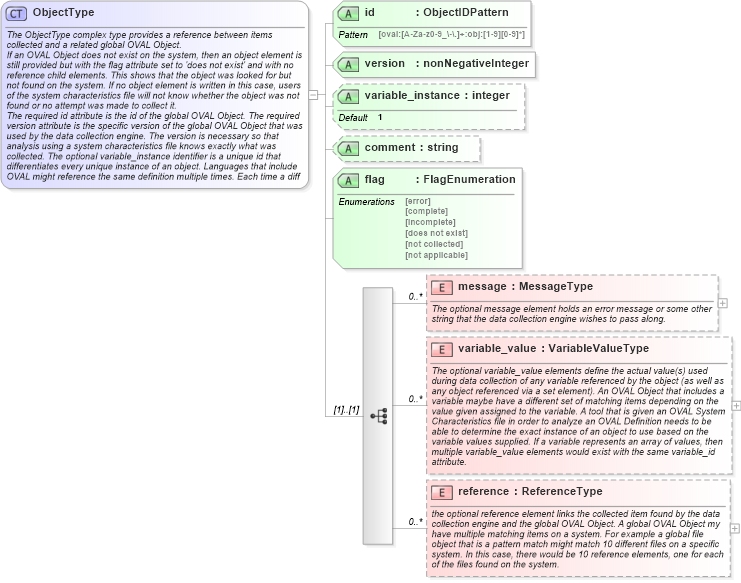
        <xsd:documentation>The ObjectType complex type provides a reference between items collected and a related global OVAL Object.</xsd:documentation>
        <xsd:documentation>If an OVAL Object does not exist on the system, then an object element is still provided but with the flag attribute set to 'does not exist' and with no reference child elements. This shows that the object was looked for but not found on the system. If no object element is written in this case, users of the system characteristics file will not know whether the object was not found or no attempt was made to collect it.</xsd:documentation>
        <xsd:documentation>The required id attribute is the id of the global OVAL Object. The required version attribute is the specific version of the global OVAL Object that was used by the data collection engine. The version is necessary so that analysis using a system characteristics file knows exactly what was collected. The optional variable_instance identifier is a unique id that differentiates every unique instance of an object. Languages that include OVAL might reference the same definition multiple times. Each time a different set of values is supplied for the variables, resulting in multiple instances of an object to be defined by the OVAL System Characteristics file. (definitions that do not use variables can only have one unique instance) The inclusion of a unique instance identifier will allow the OVAL results file to report the correct item associated with an object for each combination of supplied values. The optional comment attribute provides a short description of the object. The required flag attribute holds information regarding the success of the data collection. For example, if there was an error looking for items that match the object specification, then the flag would be 'error'. Please refer to the description of FlagEnumeration for details about the different flag values.</xsd:documentation>
    </xsd:annotation>
    <xsd:sequence>
        <xsd:element name="message" type="oval:MessageType" minOccurs="0" maxOccurs="unbounded">
            <xsd:annotation>
                <xsd:documentation>The optional message element holds an error message or some other string that the data collection engine wishes to pass along.</xsd:documentation>
            </xsd:annotation>
        </xsd:element>
        <xsd:element name="variable_value" type="oval-sc:VariableValueType" minOccurs="0" maxOccurs="unbounded">
            <xsd:annotation>
                <xsd:documentation>The optional variable_value elements define the actual value(s) used during data collection of any variable referenced by the object (as well as any object referenced via a set element). An OVAL Object that includes a variable maybe have a different set of matching items depending on the value given assigned to the variable. A tool that is given an OVAL System Characteristics file in order to analyze an OVAL Definition needs to be able to determine the exact instance of an object to use based on the variable values supplied. If a variable represents an array of values, then multiple variable_value elements would exist with the same variable_id attribute. </xsd:documentation>
            </xsd:annotation>
        </xsd:element>
        <xsd:element name="reference" type="oval-sc:ReferenceType" minOccurs="0" maxOccurs="unbounded">
            <xsd:annotation>
                <xsd:documentation>the optional reference element links the collected item found by the data collection engine and the global OVAL Object. A global OVAL Object my have multiple matching items on a system. For example a global file object that is a pattern match might match 10 different files on a specific system. In this case, there would be 10 reference elements, one for each of the files found on the system.</xsd:documentation>
            </xsd:annotation>
        </xsd:element>
    </xsd:sequence>
    <xsd:attribute name="id" type="oval:ObjectIDPattern" use="required" />
    <xsd:attribute name="version" type="xsd:nonNegativeInteger" use="required" />
    <xsd:attribute name="variable_instance" type="xsd:integer" use="optional" default="1" />
    <xsd:attribute name="comment" type="xsd:string" use="optional" />
    <xsd:attribute name="flag" type="oval-sc:FlagEnumeration" use="required" />
</xsd:complexType>
|
 XSD Schema Diagram: