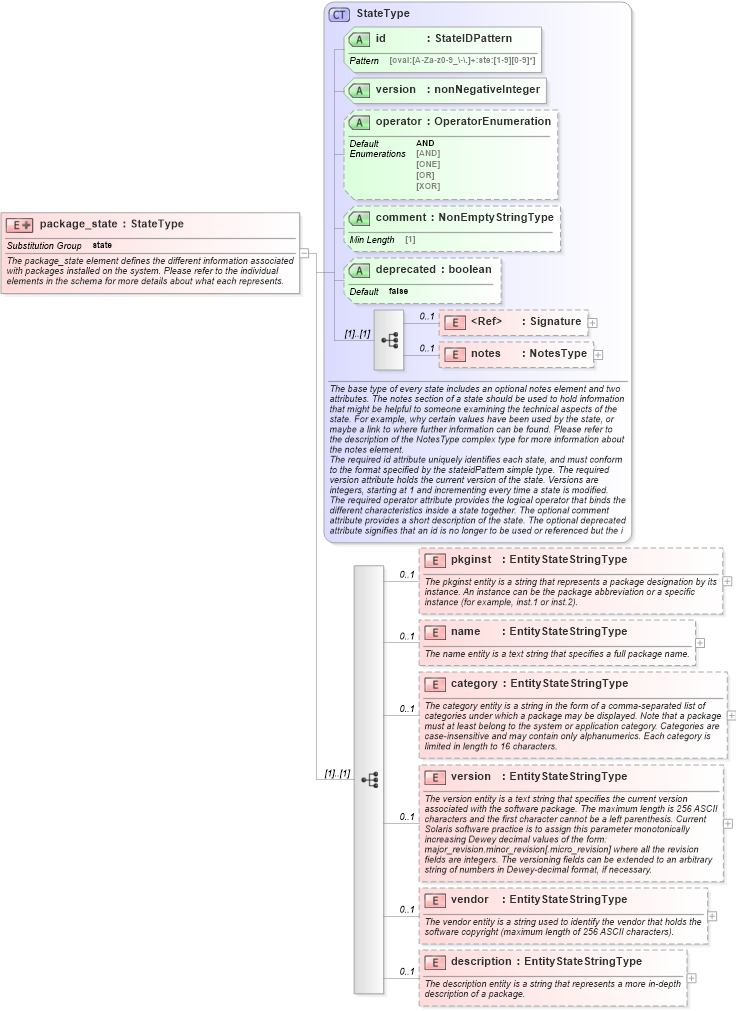
<xsd:element name="package_state" substitutionGroup="oval-def:state">
    <xsd:annotation>
        <xsd:documentation>The package_state element defines the different information associated with packages installed on the system. Please refer to the individual elements in the schema for more details about what each represents.</xsd:documentation>
    </xsd:annotation>
    <xsd:complexType>
        <xsd:complexContent>
            <xsd:extension base="oval-def:StateType">
                <xsd:sequence>
                    <xsd:element name="pkginst" type="oval-def:EntityStateStringType" minOccurs="0" maxOccurs="1">
                        <xsd:annotation>
                            <xsd:documentation>The pkginst entity is a string that represents a package designation by its instance. An instance can be the package abbreviation or a specific instance (for example, inst.1 or inst.2).</xsd:documentation>
                            <xsd:appinfo>
                                <sch:pattern id="packagestepkginst" xmlns:sch="http://purl.oclc.org/dsdl/schematron">
                                    <sch:rule context="sol-def:package_state/sol-def:pkginst">
                                        <sch:assert test="not(@datatype) or @datatype='string'">
                                            <sch:value-of select="../@id" /> - datatype attribute for the pkginst entity of a package_state should be 'string'</sch:assert>
                                    </sch:rule>
                                </sch:pattern>
                            </xsd:appinfo>
                        </xsd:annotation>
                    </xsd:element>
                    <xsd:element name="name" type="oval-def:EntityStateStringType" minOccurs="0" maxOccurs="1">
                        <xsd:annotation>
                            <xsd:documentation>The name entity is a text string that specifies a full package name.</xsd:documentation>
                            <xsd:appinfo>
                                <sch:pattern id="packagestename" xmlns:sch="http://purl.oclc.org/dsdl/schematron">
                                    <sch:rule context="sol-def:package_state/sol-def:name">
                                        <sch:assert test="not(@datatype) or @datatype='string'">
                                            <sch:value-of select="../@id" /> - datatype attribute for the name entity of a package_state should be 'string'</sch:assert>
                                    </sch:rule>
                                </sch:pattern>
                            </xsd:appinfo>
                        </xsd:annotation>
                    </xsd:element>
                    <xsd:element name="category" type="oval-def:EntityStateStringType" minOccurs="0" maxOccurs="1">
                        <xsd:annotation>
                            <xsd:documentation>The category entity is a string in the form of a comma-separated list of categories under which a package may be displayed. Note that a package must at least belong to the system or application category. Categories are case-insensitive and may contain only alphanumerics. Each category is limited in length to 16 characters.</xsd:documentation>
                            <xsd:appinfo>
                                <sch:pattern id="packagestecategory" xmlns:sch="http://purl.oclc.org/dsdl/schematron">
                                    <sch:rule context="sol-def:package_state/sol-def:category">
                                        <sch:assert test="not(@datatype) or @datatype='string'">
                                            <sch:value-of select="../@id" /> - datatype attribute for the category entity of a package_state should be 'string'</sch:assert>
                                    </sch:rule>
                                </sch:pattern>
                            </xsd:appinfo>
                        </xsd:annotation>
                    </xsd:element>
                    <xsd:element name="version" type="oval-def:EntityStateStringType" minOccurs="0" maxOccurs="1">
                        <xsd:annotation>
                            <xsd:documentation>The version entity is a text string that specifies the current version associated with the software package. The maximum length is 256 ASCII characters and the first character cannot be a left parenthesis. Current Solaris software practice is to assign this parameter monotonically increasing Dewey decimal values of the form: major_revision.minor_revision[.micro_revision] where all the revision fields are integers. The versioning fields can be extended to an arbitrary string of numbers in Dewey-decimal format, if necessary.</xsd:documentation>
                            <xsd:appinfo>
                                <sch:pattern id="packagesteversion" xmlns:sch="http://purl.oclc.org/dsdl/schematron">
                                    <sch:rule context="sol-def:package_state/sol-def:version">
                                        <sch:assert test="not(@datatype) or @datatype='string'">
                                            <sch:value-of select="../@id" /> - datatype attribute for the version entity of a package_state should be 'string'</sch:assert>
                                    </sch:rule>
                                </sch:pattern>
                            </xsd:appinfo>
                        </xsd:annotation>
                    </xsd:element>
                    <xsd:element name="vendor" type="oval-def:EntityStateStringType" minOccurs="0" maxOccurs="1">
                        <xsd:annotation>
                            <xsd:documentation>The vendor entity is a string used to identify the vendor that holds the software copyright (maximum length of 256 ASCII characters).</xsd:documentation>
                            <xsd:appinfo>
                                <sch:pattern id="packagestevendor" xmlns:sch="http://purl.oclc.org/dsdl/schematron">
                                    <sch:rule context="sol-def:package_state/sol-def:vendor">
                                        <sch:assert test="not(@datatype) or @datatype='string'">
                                            <sch:value-of select="../@id" /> - datatype attribute for the vendor entity of a package_state should be 'string'</sch:assert>
                                    </sch:rule>
                                </sch:pattern>
                            </xsd:appinfo>
                        </xsd:annotation>
                    </xsd:element>
                    <xsd:element name="description" type="oval-def:EntityStateStringType" minOccurs="0" maxOccurs="1">
                        <xsd:annotation>
                            <xsd:documentation>The description entity is a string that represents a more in-depth description of a package.</xsd:documentation>
                            <xsd:appinfo>
                                <sch:pattern id="packagestedescription" xmlns:sch="http://purl.oclc.org/dsdl/schematron">
                                    <sch:rule context="sol-def:package_state/sol-def:description">
                                        <sch:assert test="not(@datatype) or @datatype='string'">
                                            <sch:value-of select="../@id" /> - datatype attribute for the description entity of a package_state should be 'string'</sch:assert>
                                    </sch:rule>
                                </sch:pattern>
                            </xsd:appinfo>
                        </xsd:annotation>
                    </xsd:element>
                </xsd:sequence>
            </xsd:extension>
        </xsd:complexContent>
    </xsd:complexType>
</xsd:element>
|
 XSD Schema Diagram: