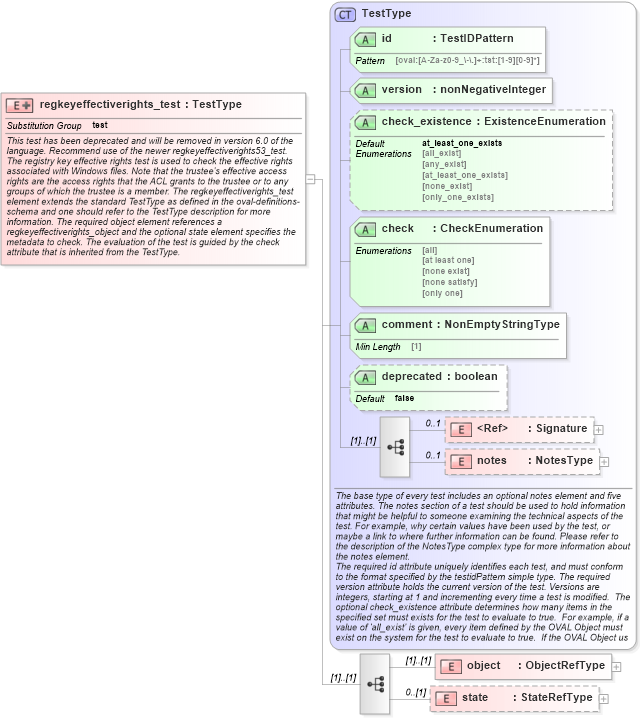
<xsd:element name="regkeyeffectiverights_test" substitutionGroup="oval-def:test">
    <xsd:annotation>
        <xsd:documentation>This test has been deprecated and will be removed in version 6.0 of the language. Recommend use of the newer regkeyeffectiverights53_test.</xsd:documentation>
        <xsd:documentation>The registry key effective rights test is used to check the effective rights associated with Windows files. Note that the trustee's effective access rights are the access rights that the ACL grants to the trustee or to any groups of which the trustee is a member. The regkeyeffectiverights_test element extends the standard TestType as defined in the oval-definitions-schema and one should refer to the TestType description for more information. The required object element references a regkeyeffectiverights_object and the optional state element specifies the metadata to check. The evaluation of the test is guided by the check attribute that is inherited from the TestType.</xsd:documentation>
        <xsd:appinfo>
            <sch:pattern id="rertst" xmlns:sch="http://purl.oclc.org/dsdl/schematron">
                <sch:rule context="win-def:regkeyeffectiverights_test/win-def:object">
                    <sch:assert test="@object_ref=/oval-def:oval_definitions/oval-def:objects/win-def:regkeyeffectiverights_object/@id">
                        <sch:value-of select="../@id" /> - the object child element of a regkeyeffectiverights_test must reference a regkeyeffectiverights_object</sch:assert>
                </sch:rule>
                <sch:rule context="win-def:regkeyeffectiverights_test/win-def:state">
                    <sch:assert test="@state_ref=/oval-def:oval_definitions/oval-def:states/win-def:regkeyeffectiverights_state/@id">
                        <sch:value-of select="../@id" /> - the state child element of a regkeyeffectiverights_test must reference a regkeyeffectiverights_state</sch:assert>
                </sch:rule>
            </sch:pattern>
        </xsd:appinfo>
    </xsd:annotation>
    <xsd:complexType>
        <xsd:complexContent>
            <xsd:extension base="oval-def:TestType">
                <xsd:sequence>
                    <xsd:element name="object" type="oval-def:ObjectRefType" />
                    <xsd:element name="state" type="oval-def:StateRefType" minOccurs="0" />
                </xsd:sequence>
            </xsd:extension>
        </xsd:complexContent>
    </xsd:complexType>
</xsd:element>
|
 XSD Schema Diagram: