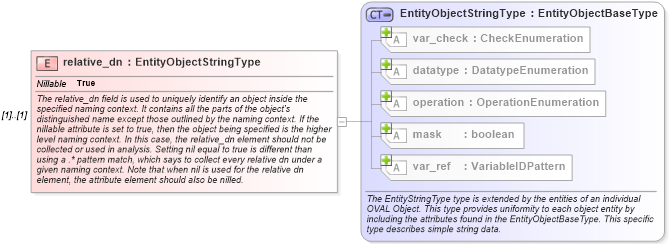
<xsd:element name="relative_dn" type="oval-def:EntityObjectStringType" nillable="true">
    <xsd:annotation>
        <xsd:documentation>The relative_dn field is used to uniquely identify an object inside the specified naming context. It contains all the parts of the object's distinguished name except those outlined by the naming context. If the nillable attribute is set to true, then the object being specified is the higher level naming context. In this case, the relative_dn element should not be collected or used in analysis. Setting nil equal to true is different than using a .* pattern match, which says to collect every relative dn under a given naming context. Note that when nil is used for the relative dn element, the attribute element should also be nilled.</xsd:documentation>
        <xsd:appinfo>
            <sch:pattern id="adobjrelative_dn" xmlns:sch="http://purl.oclc.org/dsdl/schematron">
                <sch:rule context="win-def:activedirectory_object/win-def:relative_dn">
                    <sch:assert test="not(@datatype) or @datatype='string'">
                        <sch:value-of select="../@id" /> - datatype attribute for the relative_dn entity of an activedirectory_object should be 'string'</sch:assert>
                    <sch:assert test="not(@xsi:nil='true') or ../win-def:attribute/@xsi:nil='true'">
                        <sch:value-of select="../@id" /> - attribute entity must be nil when relative_dn is nil</sch:assert>
                </sch:rule>
            </sch:pattern>
        </xsd:appinfo>
    </xsd:annotation>
</xsd:element>
|
 XSD Schema Diagram: