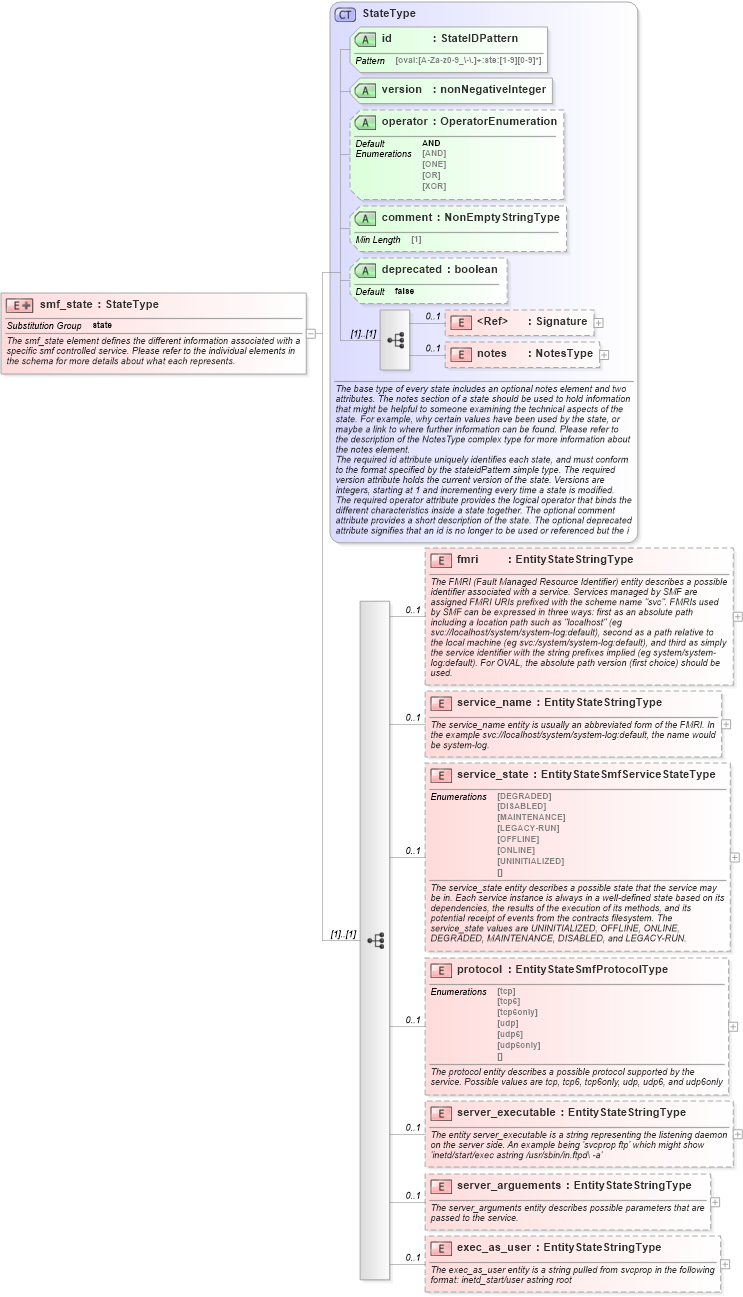
<xsd:element name="smf_state" substitutionGroup="oval-def:state">
    <xsd:annotation>
        <xsd:documentation>The smf_state element defines the different information associated with a specific smf controlled service. Please refer to the individual elements in the schema for more details about what each represents.</xsd:documentation>
    </xsd:annotation>
    <xsd:complexType>
        <xsd:complexContent>
            <xsd:extension base="oval-def:StateType">
                <xsd:sequence>
                    <xsd:element name="fmri" type="oval-def:EntityStateStringType" minOccurs="0" maxOccurs="1">
                        <xsd:annotation>
                            <xsd:documentation>The FMRI (Fault Managed Resource Identifier) entity describes a possible identifier associated with a service. Services managed by SMF are assigned FMRI URIs prefixed with the scheme name "svc". FMRIs used by SMF can be expressed in three ways: first as an absolute path including a location path such as "localhost" (eg svc://localhost/system/system-log:default), second as a path relative to the local machine (eg svc:/system/system-log:default), and third as simply the service identifier with the string prefixes implied (eg system/system-log:default). For OVAL, the absolute path version (first choice) should be used.</xsd:documentation>
                            <xsd:appinfo>
                                <sch:pattern id="fmristebase" xmlns:sch="http://purl.oclc.org/dsdl/schematron">
                                    <sch:rule context="sol-def:smf_state/sol-def:fmri">
                                        <sch:assert test="not(@datatype) or @datatype='string'">
                                            <sch:value-of select="../@id" /> - datatype attribute for the fmri entity of a smf_object should be 'string'</sch:assert>
                                    </sch:rule>
                                </sch:pattern>
                            </xsd:appinfo>
                        </xsd:annotation>
                    </xsd:element>
                    <xsd:element name="service_name" type="oval-def:EntityStateStringType" minOccurs="0" maxOccurs="1">
                        <xsd:annotation>
                            <xsd:documentation>The service_name entity is usually an abbreviated form of the FMRI. In the example svc://localhost/system/system-log:default, the name would be system-log.</xsd:documentation>
                            <xsd:appinfo>
                                <sch:pattern id="srvnamestebase" xmlns:sch="http://purl.oclc.org/dsdl/schematron">
                                    <sch:rule context="sol-def:smf_state/sol-def:service_name">
                                        <sch:assert test="not(@datatype) or @datatype='string'">
                                            <sch:value-of select="../@id" /> - datatype attribute for the service_name entity of a smf_object should be 'string'</sch:assert>
                                    </sch:rule>
                                </sch:pattern>
                            </xsd:appinfo>
                        </xsd:annotation>
                    </xsd:element>
                    <xsd:element name="service_state" type="sol-def:EntityStateSmfServiceStateType" minOccurs="0" maxOccurs="1">
                        <xsd:annotation>
                            <xsd:documentation>The service_state entity describes a possible state that the service may be in. Each service instance is always in a well-defined state based on its dependencies, the results of the execution of its methods, and its potential receipt of events from the contracts filesystem. The service_state values are UNINITIALIZED, OFFLINE, ONLINE, DEGRADED, MAINTENANCE, DISABLED, and LEGACY-RUN.</xsd:documentation>
                            <xsd:appinfo>
                                <sch:pattern id="srvstatestebase" xmlns:sch="http://purl.oclc.org/dsdl/schematron">
                                    <sch:rule context="sol-def:smf_state/sol-def:service_state">
                                        <sch:assert test="not(@datatype) or @datatype='string'">
                                            <sch:value-of select="../@id" /> - datatype attribute for the service_state entity of a smf_object should be 'string'</sch:assert>
                                    </sch:rule>
                                </sch:pattern>
                            </xsd:appinfo>
                        </xsd:annotation>
                    </xsd:element>
                    <xsd:element name="protocol" type="sol-def:EntityStateSmfProtocolType" minOccurs="0" maxOccurs="1">
                        <xsd:annotation>
                            <xsd:documentation>The protocol entity describes a possible protocol supported by the service. Possible values are tcp, tcp6, tcp6only, udp, udp6, and udp6only</xsd:documentation>
                            <xsd:appinfo>
                                <sch:pattern id="protocolstebase" xmlns:sch="http://purl.oclc.org/dsdl/schematron">
                                    <sch:rule context="sol-def:smf_state/sol-def:protocol">
                                        <sch:assert test="not(@datatype) or @datatype='string'">
                                            <sch:value-of select="../@id" /> - datatype attribute for the protocol entity of a smf_object should be 'string'</sch:assert>
                                    </sch:rule>
                                </sch:pattern>
                            </xsd:appinfo>
                        </xsd:annotation>
                    </xsd:element>
                    <xsd:element name="server_executable" type="oval-def:EntityStateStringType" minOccurs="0" maxOccurs="1">
                        <xsd:annotation>
                            <xsd:documentation>The entity server_executable is a string representing the listening daemon on the server side. An example being 'svcprop ftp' which might show 'inetd/start/exec astring /usr/sbin/in.ftpd\ -a'</xsd:documentation>
                            <xsd:appinfo>
                                <sch:pattern id="srvexestebase" xmlns:sch="http://purl.oclc.org/dsdl/schematron">
                                    <sch:rule context="sol-def:smf_state/sol-def:server_executable">
                                        <sch:assert test="not(@datatype) or @datatype='string'">
                                            <sch:value-of select="../@id" /> - datatype attribute for the server_executable entity of a smf_object should be 'string'</sch:assert>
                                    </sch:rule>
                                </sch:pattern>
                            </xsd:appinfo>
                        </xsd:annotation>
                    </xsd:element>
                    <xsd:element name="server_arguements" type="oval-def:EntityStateStringType" minOccurs="0" maxOccurs="1">
                        <xsd:annotation>
                            <xsd:documentation>The server_arguments entity describes possible parameters that are passed to the service.</xsd:documentation>
                            <xsd:appinfo>
                                <sch:pattern id="srvargsstebase" xmlns:sch="http://purl.oclc.org/dsdl/schematron">
                                    <sch:rule context="sol-def:smf_state/sol-def:server_arguements">
                                        <sch:assert test="not(@datatype) or @datatype='string'">
                                            <sch:value-of select="../@id" /> - datatype attribute for the server_arguements entity of a smf_object should be 'string'</sch:assert>
                                    </sch:rule>
                                </sch:pattern>
                            </xsd:appinfo>
                        </xsd:annotation>
                    </xsd:element>
                    <xsd:element name="exec_as_user" type="oval-def:EntityStateStringType" minOccurs="0" maxOccurs="1">
                        <xsd:annotation>
                            <xsd:documentation>The exec_as_user entity is a string pulled from svcprop in the following format: inetd_start/user astring root</xsd:documentation>
                            <xsd:appinfo>
                                <sch:pattern id="execasuserstebase" xmlns:sch="http://purl.oclc.org/dsdl/schematron">
                                    <sch:rule context="sol-def:smf_state/sol-def:exec_as_user">
                                        <sch:assert test="not(@datatype) or @datatype='string'">
                                            <sch:value-of select="../@id" /> - datatype attribute for the exec_as_user entity of a smf_object should be 'string'</sch:assert>
                                    </sch:rule>
                                </sch:pattern>
                            </xsd:appinfo>
                        </xsd:annotation>
                    </xsd:element>
                </xsd:sequence>
            </xsd:extension>
        </xsd:complexContent>
    </xsd:complexType>
</xsd:element>
|
 XSD Schema Diagram: