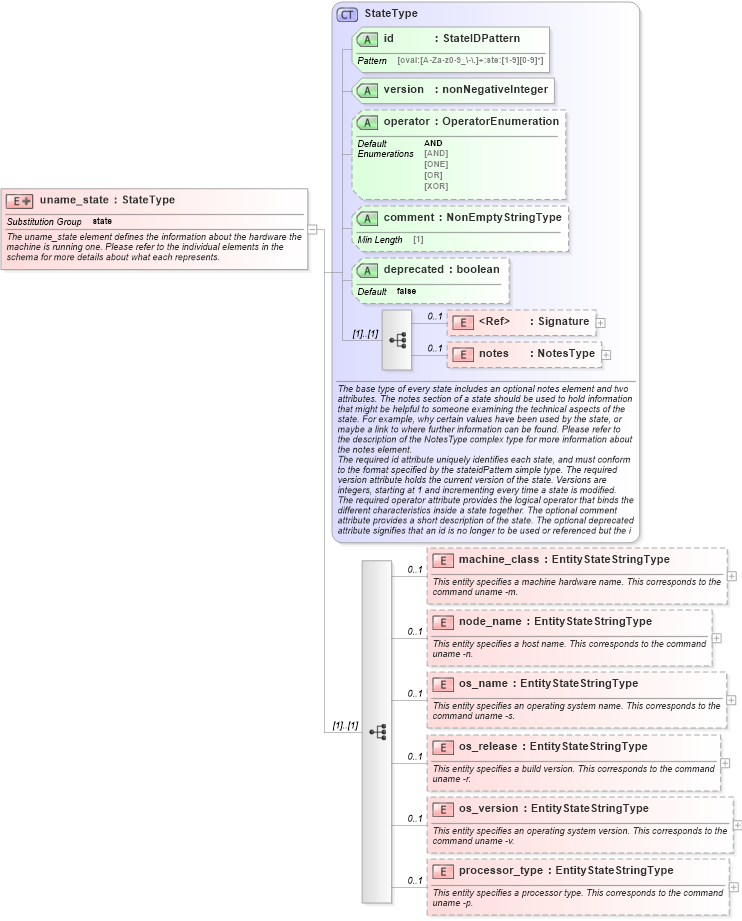
<xsd:element name="uname_state" substitutionGroup="oval-def:state">
    <xsd:annotation>
        <xsd:documentation>The uname_state element defines the information about the hardware the machine is running one. Please refer to the individual elements in the schema for more details about what each represents.</xsd:documentation>
    </xsd:annotation>
    <xsd:complexType>
        <xsd:complexContent>
            <xsd:extension base="oval-def:StateType">
                <xsd:sequence>
                    <xsd:element name="machine_class" type="oval-def:EntityStateStringType" minOccurs="0" maxOccurs="1">
                        <xsd:annotation>
                            <xsd:documentation>This entity specifies a machine hardware name. This corresponds to the command uname -m.</xsd:documentation>
                            <xsd:appinfo>
                                <sch:pattern id="unamestemachine_class" xmlns:sch="http://purl.oclc.org/dsdl/schematron">
                                    <sch:rule context="unix-def:uname_state/unix-def:machine_class">
                                        <sch:assert test="not(@datatype) or @datatype='string'">
                                            <sch:value-of select="../@id" /> - datatype attribute for the machine_class entity of a uname_state should be 'string'</sch:assert>
                                    </sch:rule>
                                </sch:pattern>
                            </xsd:appinfo>
                        </xsd:annotation>
                    </xsd:element>
                    <xsd:element name="node_name" type="oval-def:EntityStateStringType" minOccurs="0" maxOccurs="1">
                        <xsd:annotation>
                            <xsd:documentation>This entity specifies a host name. This corresponds to the command uname -n.</xsd:documentation>
                            <xsd:appinfo>
                                <sch:pattern id="unamestenode_name" xmlns:sch="http://purl.oclc.org/dsdl/schematron">
                                    <sch:rule context="unix-def:uname_state/unix-def:node_name">
                                        <sch:assert test="not(@datatype) or @datatype='string'">
                                            <sch:value-of select="../@id" /> - datatype attribute for the node_name entity of a uname_state should be 'string'</sch:assert>
                                    </sch:rule>
                                </sch:pattern>
                            </xsd:appinfo>
                        </xsd:annotation>
                    </xsd:element>
                    <xsd:element name="os_name" type="oval-def:EntityStateStringType" minOccurs="0" maxOccurs="1">
                        <xsd:annotation>
                            <xsd:documentation>This entity specifies an operating system name. This corresponds to the command uname -s.</xsd:documentation>
                            <xsd:appinfo>
                                <sch:pattern id="unamesteos_name" xmlns:sch="http://purl.oclc.org/dsdl/schematron">
                                    <sch:rule context="unix-def:uname_state/unix-def:os_name">
                                        <sch:assert test="not(@datatype) or @datatype='string'">
                                            <sch:value-of select="../@id" /> - datatype attribute for the os_name entity of a uname_state should be 'string'</sch:assert>
                                    </sch:rule>
                                </sch:pattern>
                            </xsd:appinfo>
                        </xsd:annotation>
                    </xsd:element>
                    <xsd:element name="os_release" type="oval-def:EntityStateStringType" minOccurs="0" maxOccurs="1">
                        <xsd:annotation>
                            <xsd:documentation>This entity specifies a build version. This corresponds to the command uname -r.</xsd:documentation>
                            <xsd:appinfo>
                                <sch:pattern id="unamesteos_release" xmlns:sch="http://purl.oclc.org/dsdl/schematron">
                                    <sch:rule context="unix-def:uname_state/unix-def:os_release">
                                        <sch:assert test="not(@datatype) or @datatype='string'">
                                            <sch:value-of select="../@id" /> - datatype attribute for the os_release entity of a uname_state should be 'string'</sch:assert>
                                    </sch:rule>
                                </sch:pattern>
                            </xsd:appinfo>
                        </xsd:annotation>
                    </xsd:element>
                    <xsd:element name="os_version" type="oval-def:EntityStateStringType" minOccurs="0" maxOccurs="1">
                        <xsd:annotation>
                            <xsd:documentation>This entity specifies an operating system version. This corresponds to the command uname -v.</xsd:documentation>
                            <xsd:appinfo>
                                <sch:pattern id="unamesteos_version" xmlns:sch="http://purl.oclc.org/dsdl/schematron">
                                    <sch:rule context="unix-def:uname_state/unix-def:os_version">
                                        <sch:assert test="not(@datatype) or @datatype='string'">
                                            <sch:value-of select="../@id" /> - datatype attribute for the os_version entity of a uname_state should be 'string'</sch:assert>
                                    </sch:rule>
                                </sch:pattern>
                            </xsd:appinfo>
                        </xsd:annotation>
                    </xsd:element>
                    <xsd:element name="processor_type" type="oval-def:EntityStateStringType" minOccurs="0" maxOccurs="1">
                        <xsd:annotation>
                            <xsd:documentation>This entity specifies a processor type. This corresponds to the command uname -p.</xsd:documentation>
                            <xsd:appinfo>
                                <sch:pattern id="unamesteprocessor_type" xmlns:sch="http://purl.oclc.org/dsdl/schematron">
                                    <sch:rule context="unix-def:uname_state/unix-def:processor_type">
                                        <sch:assert test="not(@datatype) or @datatype='string'">
                                            <sch:value-of select="../@id" /> - datatype attribute for the processor_type entity of a uname_state should be 'string'</sch:assert>
                                    </sch:rule>
                                </sch:pattern>
                            </xsd:appinfo>
                        </xsd:annotation>
                    </xsd:element>
                </xsd:sequence>
            </xsd:extension>
        </xsd:complexContent>
    </xsd:complexType>
</xsd:element>
|
 XSD Schema Diagram: