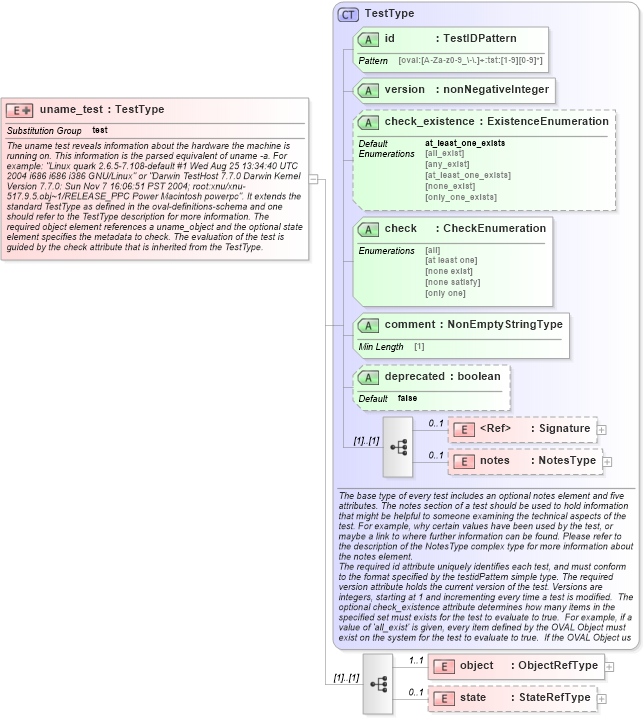
<xsd:element name="uname_test" substitutionGroup="oval-def:test">
    <xsd:annotation>
        <xsd:documentation>The uname test reveals information about the hardware the machine is running on. This information is the parsed equivalent of uname -a. For example: "Linux quark 2.6.5-7.108-default #1 Wed Aug 25 13:34:40 UTC 2004 i686 i686 i386 GNU/Linux" or "Darwin TestHost 7.7.0 Darwin Kernel Version 7.7.0: Sun Nov 7 16:06:51 PST 2004; root:xnu/xnu-517.9.5.obj~1/RELEASE_PPC Power Macintosh powerpc". It extends the standard TestType as defined in the oval-definitions-schema and one should refer to the TestType description for more information. The required object element references a uname_object and the optional state element specifies the metadata to check. The evaluation of the test is guided by the check attribute that is inherited from the TestType.</xsd:documentation>
    </xsd:annotation>
    <xsd:complexType>
        <xsd:complexContent>
            <xsd:extension base="oval-def:TestType">
                <xsd:sequence>
                    <xsd:element name="object" type="oval-def:ObjectRefType" minOccurs="1" maxOccurs="1" />
                    <xsd:element name="state" type="oval-def:StateRefType" minOccurs="0" maxOccurs="1" />
                </xsd:sequence>
            </xsd:extension>
        </xsd:complexContent>
    </xsd:complexType>
</xsd:element>
|
 XSD Schema Diagram: