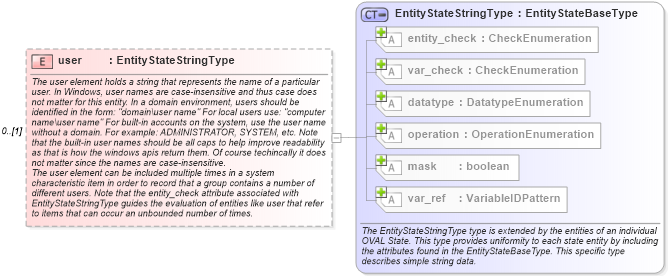
<xsd:element name="user" type="oval-def:EntityStateStringType" minOccurs="0">
    <xsd:annotation>
        <xsd:documentation>The user element holds a string that represents the name of a particular user. In Windows, user names are case-insensitive and thus case does not matter for this entity. In a domain environment, users should be identified in the form: "domain\user name" For local users use: "computer name\user name" For built-in accounts on the system, use the user name without a domain. For example: ADMINISTRATOR, SYSTEM, etc. Note that the built-in user names should be all caps to help improve readability as that is how the windows apis return them. Of course techincally it does not matter since the names are case-insensitive.</xsd:documentation>
        <xsd:documentation>The user element can be included multiple times in a system characteristic item in order to record that a group contains a number of different users. Note that the entity_check attribute associated with EntityStateStringType guides the evaluation of entities like user that refer to items that can occur an unbounded number of times.</xsd:documentation>
        <xsd:appinfo>
            <sch:pattern id="groupsteuser" xmlns:sch="http://purl.oclc.org/dsdl/schematron">
                <sch:rule context="win-def:group_state/win-def:user">
                    <sch:assert test="not(@datatype) or @datatype='string'">
                        <sch:value-of select="../@id" /> - datatype attribute for the user entity of a group_state should be 'string'</sch:assert>
                </sch:rule>
            </sch:pattern>
        </xsd:appinfo>
    </xsd:annotation>
</xsd:element>
|
 XSD Schema Diagram: