Definition Type: Element
Name: user
Namespace: http://oval.mitre.org/XMLSchema/oval-definitions-5#windows
Type: oval-def:EntityObjectStringType
Containing Schema: windows-definitions-schema.xsd
MinOccurs (1)
MaxOccurs (1)
Abstract
Documentation:
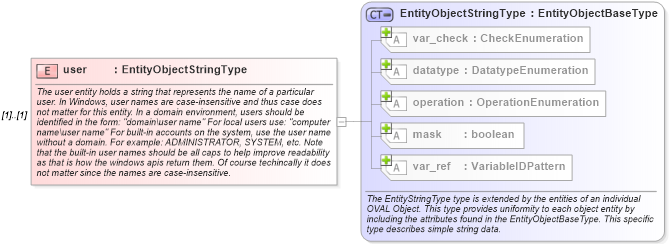
The user entity holds a string that represents the name of a particular user. In Windows, user names are case-insensitive and thus case does not matter for this entity. In a domain environment, users should be identified in the form: "domain\user name" For local users use: "computer name\user name" For built-in accounts on the system, use the user name without a domain. For example: ADMINISTRATOR, SYSTEM, etc. Note that the built-in user names should be all caps to help improve readability as that is how the windows apis return them. Of course techincally it does not matter since the names are case-insensitive.
Collapse XSD Schema Diagram:
Drilldown into var_ref in schema oval-definitions-schema_xsd Drilldown into mask in schema oval-definitions-schema_xsd Drilldown into operation in schema oval-definitions-schema_xsd Drilldown into datatype in schema oval-definitions-schema_xsd Drilldown into var_check in schema oval-definitions-schema_xsd Drilldown into EntityObjectStringType in schema oval-definitions-schema_xsdXSD Diagram of user in schema windows-definitions-schema_xsd (Open Vulnerability and Assessment Language (OVAL®))
Collapse XSD Schema Code:
<xsd:element name="user" type="oval-def:EntityObjectStringType">
    <xsd:annotation>
        <xsd:documentation>The user entity holds a string that represents the name of a particular user. In Windows, user names are case-insensitive and thus case does not matter for this entity. In a domain environment, users should be identified in the form: "domain\user name" For local users use: "computer name\user name" For built-in accounts on the system, use the user name without a domain. For example: ADMINISTRATOR, SYSTEM, etc. Note that the built-in user names should be all caps to help improve readability as that is how the windows apis return them. Of course techincally it does not matter since the names are case-insensitive.</xsd:documentation>
        <xsd:appinfo>
            <sch:pattern id="userobjuser" xmlns:sch="http://purl.oclc.org/dsdl/schematron">
                <sch:rule context="win-def:user_object/win-def:user">
                    <sch:assert test="not(@datatype) or @datatype='string'">
                        <sch:value-of select="../@id" /> - datatype attribute for the user entity of a user_object should be 'string'</sch:assert>
                </sch:rule>
            </sch:pattern>
        </xsd:appinfo>
    </xsd:annotation>
</xsd:element>
Collapse Child Attributes:
Name Type Default Value Use
datatype oval-def:datatype string Optional
operation oval-def:operation equals Optional
mask oval-def:mask false Optional
var_ref oval-def:var_ref Optional
var_check oval-def:var_check all Optional
Collapse Derivation Tree: