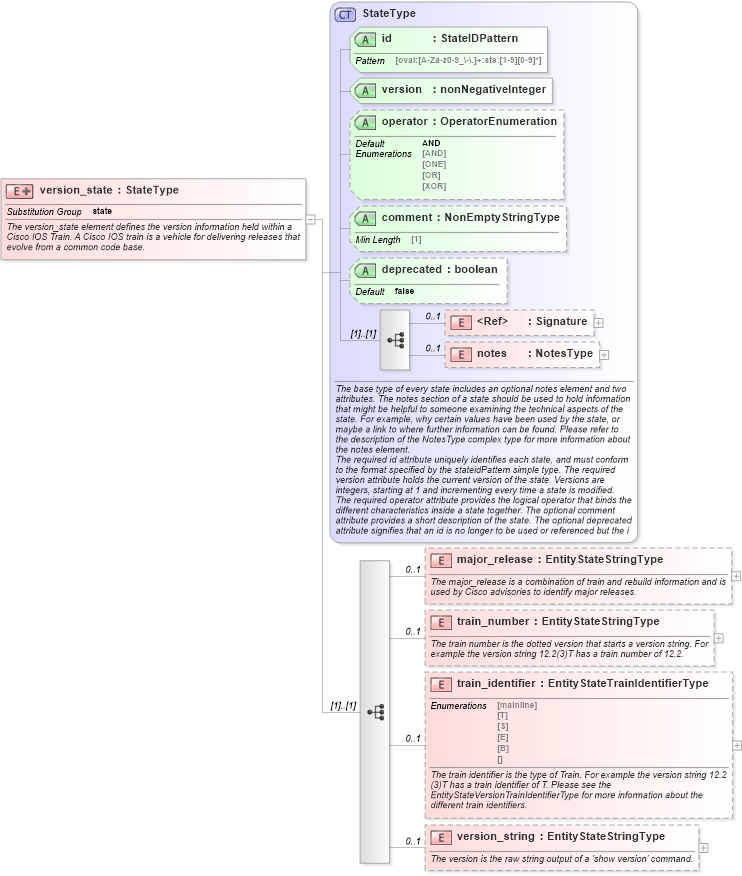
<xsd:element name="version_state" substitutionGroup="oval-def:state">
    <xsd:annotation>
        <xsd:documentation>The version_state element defines the version information held within a Cisco IOS Train. A Cisco IOS train is a vehicle for delivering releases that evolve from a common code base.</xsd:documentation>
    </xsd:annotation>
    <xsd:complexType>
        <xsd:complexContent>
            <xsd:extension base="oval-def:StateType">
                <xsd:sequence>
                    <xsd:element name="major_release" type="oval-def:EntityStateStringType" minOccurs="0" maxOccurs="1">
                        <xsd:annotation>
                            <xsd:documentation>The major_release is a combination of train and rebuild information and is used by Cisco advisories to identify major releases.</xsd:documentation>
                            <xsd:appinfo>
                                <sch:pattern id="iosverstemajor_release" xmlns:sch="http://purl.oclc.org/dsdl/schematron">
                                    <sch:rule context="ios-def:version_state/ios-def:major_release">
                                        <sch:assert test="not(@datatype) or @datatype='string'">
                                            <sch:value-of select="../@id" /> - datatype attribute for the major_release entity of a version_state should be 'string'</sch:assert>
                                    </sch:rule>
                                </sch:pattern>
                            </xsd:appinfo>
                        </xsd:annotation>
                    </xsd:element>
                    <xsd:element name="train_number" type="oval-def:EntityStateStringType" minOccurs="0" maxOccurs="1">
                        <xsd:annotation>
                            <xsd:documentation>The train number is the dotted version that starts a version string. For example the version string 12.2(3)T has a train number of 12.2.</xsd:documentation>
                            <xsd:appinfo>
                                <sch:pattern id="iosverstetrain_number" xmlns:sch="http://purl.oclc.org/dsdl/schematron">
                                    <sch:rule context="ios-def:version_state/ios-def:train_number">
                                        <sch:assert test="not(@datatype) or @datatype='string'">
                                            <sch:value-of select="../@id" /> - datatype attribute for the train_number entity of a version_state should be 'string'</sch:assert>
                                    </sch:rule>
                                </sch:pattern>
                            </xsd:appinfo>
                        </xsd:annotation>
                    </xsd:element>
                    <xsd:element name="train_identifier" type="ios-def:EntityStateTrainIdentifierType" minOccurs="0" maxOccurs="1">
                        <xsd:annotation>
                            <xsd:documentation>The train identifier is the type of Train. For example the version string 12.2(3)T has a train identifier of T. Please see the EntityStateVersionTrainIdentifierType for more information about the different train identifiers.</xsd:documentation>
                            <xsd:appinfo>
                                <sch:pattern id="iosverstetrain_identifier" xmlns:sch="http://purl.oclc.org/dsdl/schematron">
                                    <sch:rule context="ios-def:version_state/ios-def:train_identifier">
                                        <sch:assert test="not(@datatype) or @datatype='string'">
                                            <sch:value-of select="../@id" /> - datatype attribute for the train_identifier entity of a version_state should be 'string'</sch:assert>
                                    </sch:rule>
                                </sch:pattern>
                            </xsd:appinfo>
                        </xsd:annotation>
                    </xsd:element>
                    <xsd:element name="version_string" type="oval-def:EntityStateStringType" minOccurs="0" maxOccurs="1">
                        <xsd:annotation>
                            <xsd:documentation>The version is the raw string output of a 'show version' command.</xsd:documentation>
                            <xsd:appinfo>
                                <sch:pattern id="iosversteversion_string" xmlns:sch="http://purl.oclc.org/dsdl/schematron">
                                    <sch:rule context="ios-def:version_state/ios-def:version_string">
                                        <sch:assert test="not(@datatype) or @datatype='ios_version'">
                                            <sch:value-of select="../@id" /> - datatype attribute for the version_string entity of a version_state should be 'ios_version'</sch:assert>
                                    </sch:rule>
                                </sch:pattern>
                            </xsd:appinfo>
                        </xsd:annotation>
                    </xsd:element>
                </xsd:sequence>
            </xsd:extension>
        </xsd:complexContent>
    </xsd:complexType>
</xsd:element>
|
 XSD Schema Diagram: