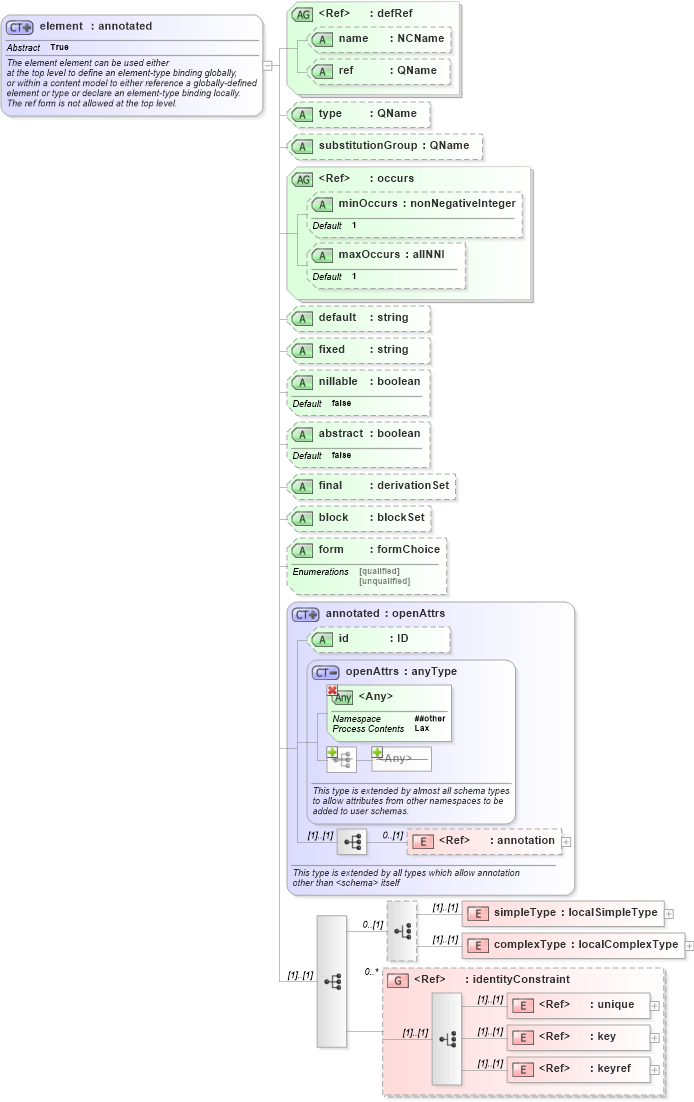
<xs:complexType name="element" abstract="true">
    <xs:annotation>
        <xs:documentation>
   The element element can be used either
   at the top level to define an element-type binding globally,
   or within a content model to either reference a globally-defined
   element or type or declare an element-type binding locally.
   The ref form is not allowed at the top level.</xs:documentation>
    </xs:annotation>
    <xs:complexContent>
        <xs:extension base="xs:annotated">
            <xs:sequence>
                <xs:choice minOccurs="0">
                    <xs:element name="simpleType" type="xs:localSimpleType" />
                    <xs:element name="complexType" type="xs:localComplexType" />
                </xs:choice>
                <xs:group ref="xs:identityConstraint" minOccurs="0" maxOccurs="unbounded" />
            </xs:sequence>
            <xs:attributeGroup ref="xs:defRef" />
            <xs:attribute name="type" type="xs:QName" />
            <xs:attribute name="substitutionGroup" type="xs:QName" />
            <xs:attributeGroup ref="xs:occurs" />
            <xs:attribute name="default" type="xs:string" />
            <xs:attribute name="fixed" type="xs:string" />
            <xs:attribute name="nillable" type="xs:boolean" use="optional" default="false" />
            <xs:attribute name="abstract" type="xs:boolean" use="optional" default="false" />
            <xs:attribute name="final" type="xs:derivationSet" />
            <xs:attribute name="block" type="xs:blockSet" />
            <xs:attribute name="form" type="xs:formChoice" />
        </xs:extension>
    </xs:complexContent>
</xs:complexType>
|
 XSD Schema Diagram: