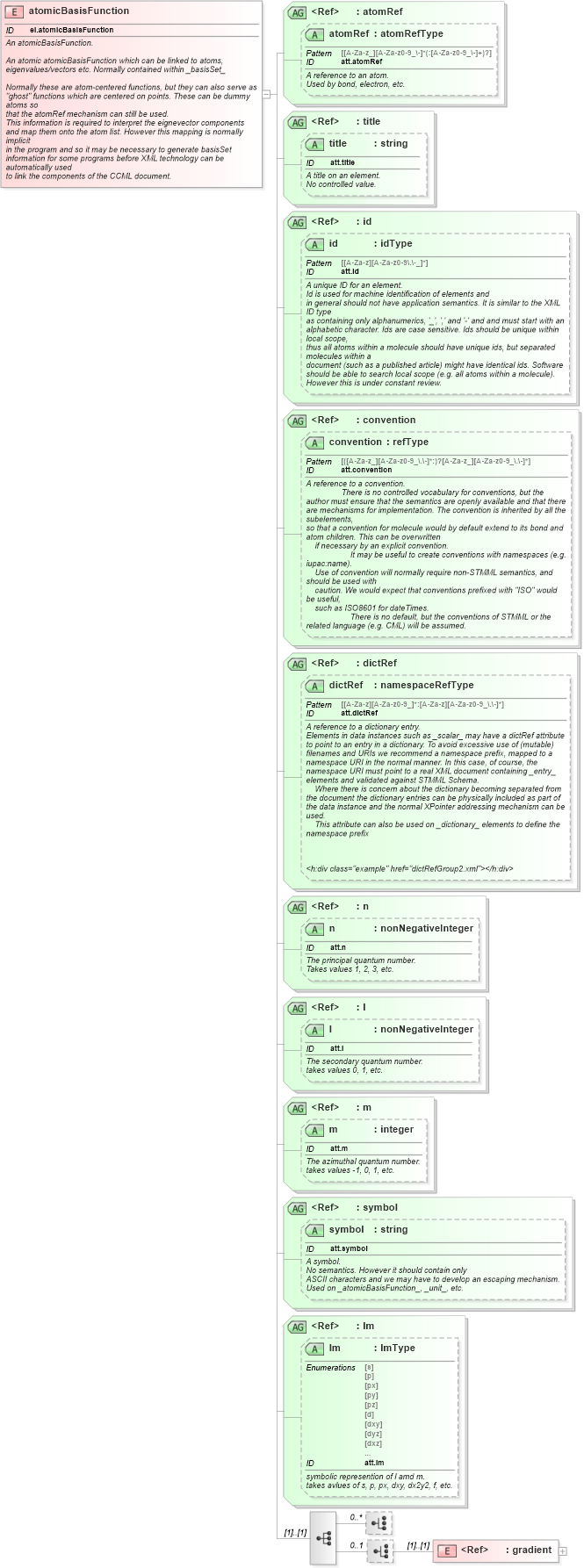
<xsd:element name="atomicBasisFunction" id="el.atomicBasisFunction">
    <xsd:annotation>
        <xsd:documentation>
            <h:div class="summary" xmlns:h="http://www.w3.org/1999/xhtml">An atomicBasisFunction.</h:div>
            <h:div class="description" xmlns:h="http://www.w3.org/1999/xhtml">
                <h:p>An atomic atomicBasisFunction which can be linked to atoms,
                eigenvalues/vectors etc. Normally contained within _basisSet_
                </h:p>
                <h:p>Normally these are atom-centered functions, but they can also serve as
                "ghost" functions which are centered on points. These can be dummy atoms so
                that the atomRef mechanism can still be used.</h:p>
                <h:p>This information is required to interpret the eignevector components
                and map them onto the atom list. However this mapping is normally implicit
                in the program and so it may be necessary to generate <h:tt>basisSet</h:tt>
                information for some programs before XML technology can be automatically used
                to link the components of the CCML document.</h:p>
            </h:div>
            <h:div class="example" href="atomicBasisFunction1.xml" xmlns:h="http://www.w3.org/1999/xhtml" />
        </xsd:documentation>
    </xsd:annotation>
    <xsd:complexType>
        <xsd:sequence>
            <xsd:choice minOccurs="0" maxOccurs="unbounded" />
            <xsd:choice minOccurs="0" maxOccurs="1">
                <xsd:element ref="gradient" />
            </xsd:choice>
        </xsd:sequence>
        <xsd:attributeGroup ref="atomRef">
            <xsd:annotation>
                <xsd:documentation>
                    <h:div class="specific" xmlns:h="http://www.w3.org/1999/xhtml">The atom owning this atomicBasisFunction.
                    This reference is required to tie the reported eigenvector components to
                    the list of atoms.</h:div>
                </xsd:documentation>
            </xsd:annotation>
        </xsd:attributeGroup>
        <xsd:attributeGroup ref="title" />
        <xsd:attributeGroup ref="id" />
        <xsd:attributeGroup ref="convention" />
        <xsd:attributeGroup ref="dictRef" />
        <xsd:attributeGroup ref="n" />
        <xsd:attributeGroup ref="l" />
        <xsd:attributeGroup ref="m">
            <xsd:annotation>
                <xsd:documentation>
                    <h:div class="specific" xmlns:h="http://www.w3.org/1999/xhtml">This is provided for completeness but we do not see
                    it being widely used and the symbolic representation (lm) is more valuable.</h:div>
                </xsd:documentation>
            </xsd:annotation>
        </xsd:attributeGroup>
        <xsd:attributeGroup ref="symbol">
            <xsd:annotation>
                <xsd:documentation>
                    <h:div class="specific" xmlns:h="http://www.w3.org/1999/xhtml">This is a local annotation of the ABF and unlikely to
                    be enumeratable. Thus a split s-orbital could have 3 ABFs with "s", "s'", "s''"
                    but they would all have lm="s".</h:div>
                </xsd:documentation>
            </xsd:annotation>
        </xsd:attributeGroup>
        <xsd:attributeGroup ref="lm">
            <xsd:annotation>
                <xsd:documentation>
                    <h:div class="specific" xmlns:h="http://www.w3.org/1999/xhtml">This is a "standard" representation of the ABF, but
                    not enumerated until we decide whether it can be formalised. Examples are "px",
                    "dxy", etc. Note that d-orbitals and higher may be represented with redundant
                    ABFs, e.g. 6 d-orbitals. The more standard the representation, the more useful
                    this will be for searching.</h:div>
                </xsd:documentation>
            </xsd:annotation>
        </xsd:attributeGroup>
    </xsd:complexType>
</xsd:element>
|
 XSD Schema Diagram: