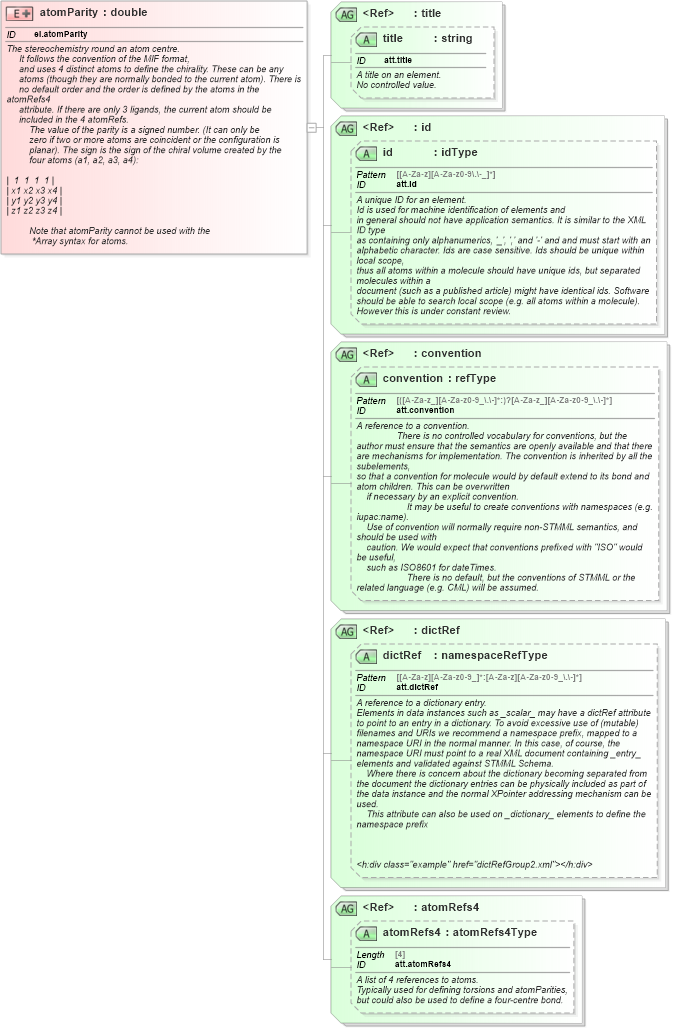
<xsd:element name="atomParity" id="el.atomParity">
    <xsd:annotation>
        <xsd:documentation>
            <h:div class="summary" xmlns:h="http://www.w3.org/1999/xhtml">The stereochemistry round an atom centre.</h:div>
            <h:div class="description" xmlns:h="http://www.w3.org/1999/xhtml">It follows the convention of the MIF format,
            and uses 4 distinct atoms to define the chirality. These can be any
            atoms (though they are normally bonded to the current atom). There is
            no default order and the order is defined by the atoms in the atomRefs4
            attribute. If there are only 3 ligands, the current atom should be
            included in the 4 atomRefs.
                <h:p>The value of the parity is a signed number. (It can only be
                zero if two or more atoms are coincident or the configuration is
                planar). The sign is the sign of the chiral volume created by the
                four atoms (a1, a2, a3, a4):</h:p>
                <h:pre>
       |  1  1  1  1 |
       | x1 x2 x3 x4 |
       | y1 y2 y3 y4 |
       | z1 z2 z3 z4 |
        </h:pre>
                <h:p>Note that <h:tt>atomParity</h:tt> cannot be used with the
                 *Array syntax for atoms.</h:p>
            </h:div>
            <h:div class="example" href="atomParity1.xml" xmlns:h="http://www.w3.org/1999/xhtml" />
        </xsd:documentation>
    </xsd:annotation>
    <xsd:complexType>
        <xsd:simpleContent>
            <xsd:extension base="xsd:double">
                <xsd:attributeGroup ref="title" />
                <xsd:attributeGroup ref="id" />
                <xsd:attributeGroup ref="convention" />
                <xsd:attributeGroup ref="dictRef" />
                <xsd:attributeGroup ref="atomRefs4" />
            </xsd:extension>
        </xsd:simpleContent>
    </xsd:complexType>
</xsd:element>
|
 XSD Schema Diagram: