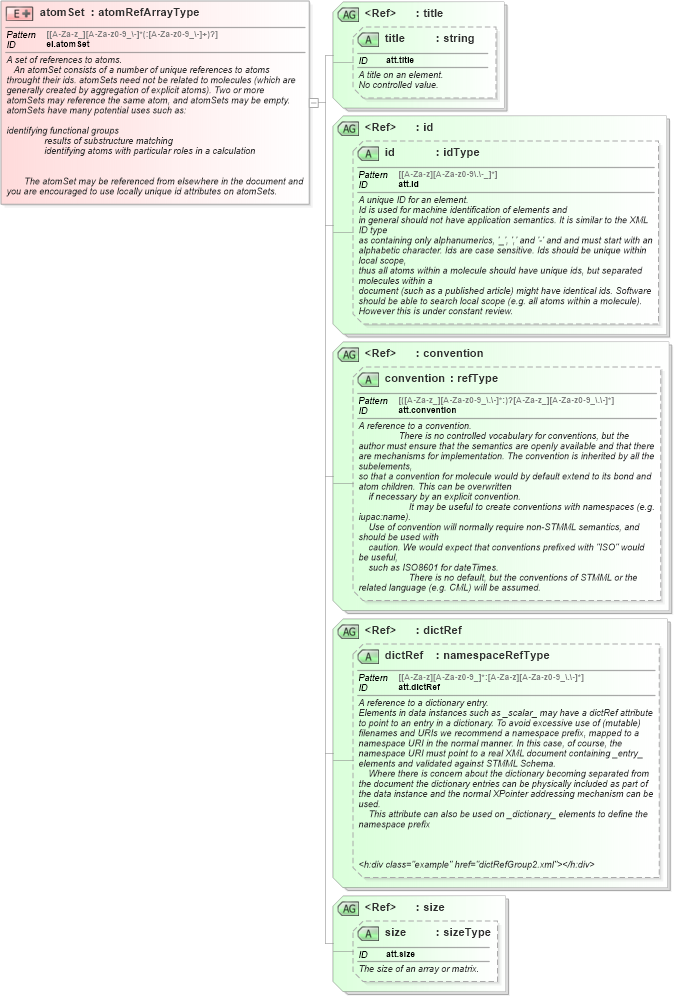
<xsd:element name="atomSet" id="el.atomSet">
    <xsd:annotation>
        <xsd:documentation>
            <h:div class="summary" xmlns:h="http://www.w3.org/1999/xhtml">A set of references to atoms.</h:div>
            <h:div class="description" xmlns:h="http://www.w3.org/1999/xhtml">An atomSet consists of a number of unique references to atoms throught their ids. atomSets need not be related to molecules (which are generally created by aggregation of explicit atoms). Two or more atomSets may reference the same atom, and atomSets may be empty.
         <h:p>atomSets have many potential uses such as:
         <h:ul><h:li>identifying functional groups</h:li>
                        <h:li>results of substructure matching</h:li>
                        <h:li>identifying atoms with particular roles in a calculation</h:li>
                    </h:ul>
                </h:p>
                <h:p>The atomSet may be referenced from elsewhere in the document and you are encouraged to use locally unique id attributes on atomSets.
         </h:p>
            </h:div>
            <h:div class="example" href="atomSet1.xml" xmlns:h="http://www.w3.org/1999/xhtml" />
        </xsd:documentation>
    </xsd:annotation>
    <xsd:complexType>
        <xsd:simpleContent>
            <xsd:extension base="atomRefArrayType">
                <xsd:attributeGroup ref="title" />
                <xsd:attributeGroup ref="id" />
                <xsd:attributeGroup ref="convention" />
                <xsd:attributeGroup ref="dictRef" />
                <xsd:attributeGroup ref="size" />
            </xsd:extension>
        </xsd:simpleContent>
    </xsd:complexType>
</xsd:element>
|
 XSD Schema Diagram: