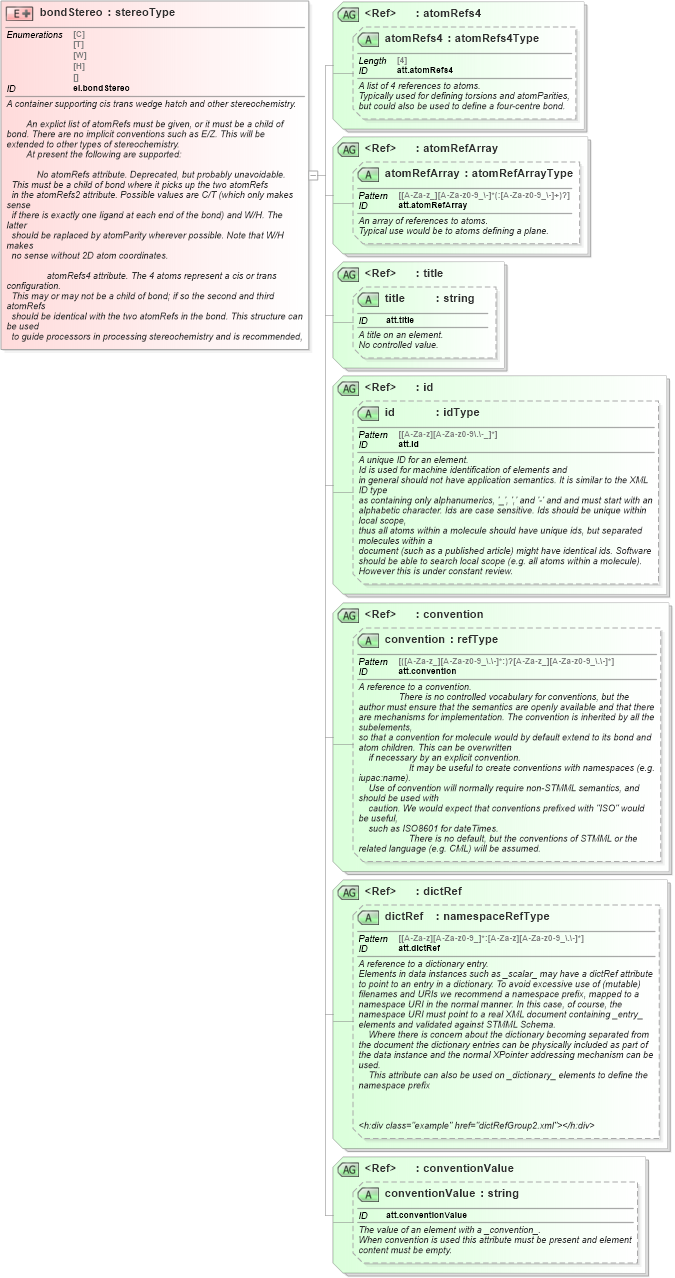
<xsd:element name="bondStereo" id="el.bondStereo">
    <xsd:annotation>
        <xsd:documentation>
            <h:div class="summary" xmlns:h="http://www.w3.org/1999/xhtml">A container supporting cis trans wedge hatch and other stereochemistry.</h:div>
            <h:div class="description" xmlns:h="http://www.w3.org/1999/xhtml">
                <h:p>An explict list of atomRefs must be given, or it must be a child of <h:tt>bond</h:tt>. There are no implicit conventions such as E/Z. This will be extended to other types of stereochemistry.</h:p>
                <h:p>At present the following are supported:</h:p>
                <h:ul>
                    <h:li>No atomRefs attribute. <h:b>Deprecated, but probably unavoidable</h:b>.
          This must be a child of <h:tt>bond</h:tt> where it picks up the two atomRefs
          in the <h:tt>atomRefs2</h:tt> attribute. Possible values are C/T (which only makes sense
          if there is exactly one ligand at each end of the bond) and W/H. The latter
          should be raplaced by <h:tt>atomParity</h:tt> wherever possible. Note that W/H makes
          no sense without 2D atom coordinates.</h:li>
                    <h:li>
                        <h:b>atomRefs4 attribute</h:b>. The 4 atoms represent a cis or trans configuration.
          This may or may not be a child of <h:tt>bond</h:tt>; if so the second and third atomRefs
          should be identical with the two atomRefs in the bond. This structure can be used
          to guide processors in processing stereochemistry and is recommended, since there is
          general agreement on the semantics. The semantics of <h:tt>bondStereo</h:tt> not related to
          bonds is less clear (e.g. cumulenes, substituted ring nuclei) etc.It is
          currently an error to have more than one <h:tt>bondStereo</h:tt> referring to the same ordered
          4-atom list</h:li>
                    <h:li>
                        <h:b>atomRefs attribute</h:b>. There are other stereochemical conventions such as cis/trans
          for metal complexes which require a variable number of reference atoms. This allows
          users to create their own - at present we do not see CML creating exhaustive tables.
          For example cis/trans square-planar complexes might require 4 (or 5) atoms for their
          definition, octahedral 6 or 7, etc. In principle this is very powerful and could
          supplement or replace the use of <h:i>cis-</h:i>, <h:i>mer-</h:i>, etc.</h:li>
                </h:ul>
                <h:p>the <h:tt>atomRefs</h:tt> and <h:tt>atomRefs4</h:tt> attributes cannot be used
        simultaneously.</h:p>
            </h:div>
            <h:div class="example" href="bondStereo1.xml" xmlns:h="http://www.w3.org/1999/xhtml" />
        </xsd:documentation>
    </xsd:annotation>
    <xsd:complexType>
        <xsd:simpleContent>
            <xsd:extension base="stereoType">
                <xsd:attributeGroup ref="atomRefs4" />
                <xsd:attributeGroup ref="atomRefArray" />
                <xsd:attributeGroup ref="title" />
                <xsd:attributeGroup ref="id" />
                <xsd:attributeGroup ref="convention" />
                <xsd:attributeGroup ref="dictRef" />
                <xsd:attributeGroup ref="conventionValue" />
            </xsd:extension>
        </xsd:simpleContent>
    </xsd:complexType>
</xsd:element>
|
 XSD Schema Diagram: