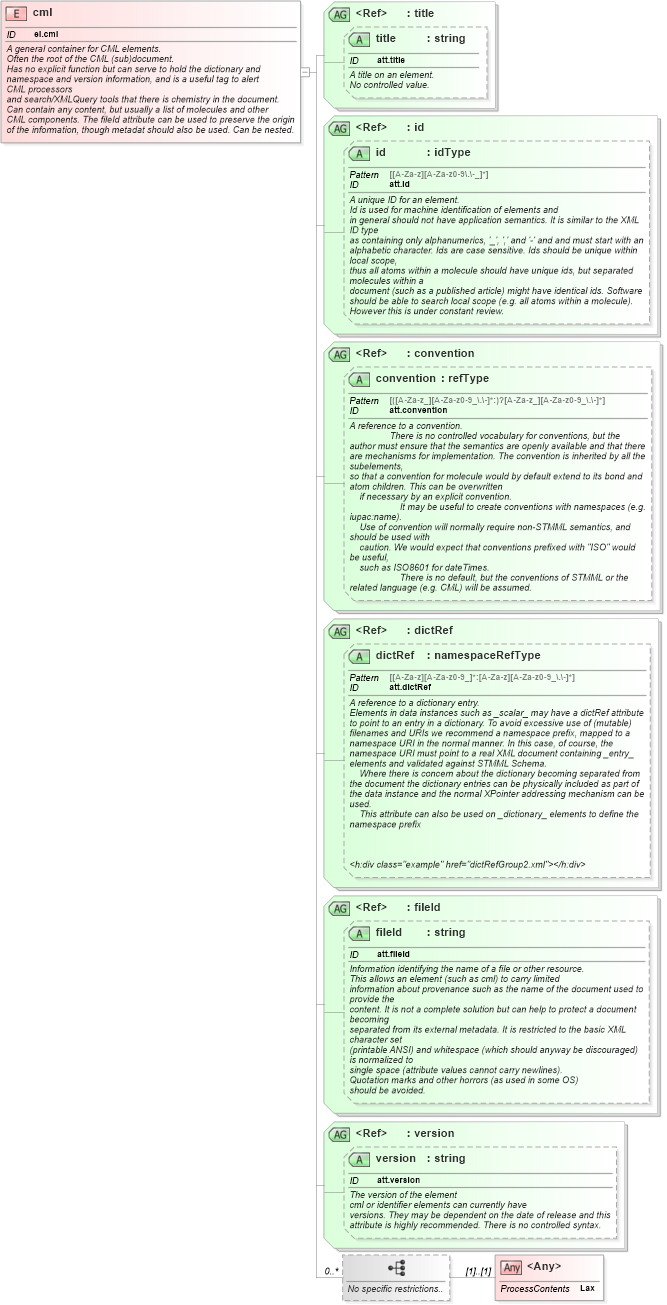
<xsd:element name="cml" id="el.cml">
    <xsd:annotation>
        <xsd:documentation>
            <h:div class="summary" xmlns:h="http://www.w3.org/1999/xhtml">A general container for CML elements.</h:div>
            <h:div class="description" xmlns:h="http://www.w3.org/1999/xhtml">Often the root of the CML (sub)document.
            Has no explicit function but can serve to hold the dictionary and
            namespace and version information, and is a useful tag to alert
            CML processors
            and search/XMLQuery tools that there is chemistry in the document.
            Can contain any content, but usually a list of molecules and other
            CML components. The fileId attribute can be used to preserve the origin
            of the information, though metadat should also be used. Can be nested.</h:div>
            <h:div class="example" href="cml1.xml" xmlns:h="http://www.w3.org/1999/xhtml" />
        </xsd:documentation>
    </xsd:annotation>
    <xsd:complexType>
        <xsd:sequence minOccurs="0" maxOccurs="unbounded">
            <xsd:annotation>
                <xsd:documentation>
                    <h:div class="description" xmlns:h="http://www.w3.org/1999/xhtml">No specific restrictions..</h:div>
                </xsd:documentation>
            </xsd:annotation>
            <xsd:any processContents="lax" />
        </xsd:sequence>
        <xsd:attributeGroup ref="title" />
        <xsd:attributeGroup ref="id" />
        <xsd:attributeGroup ref="convention" />
        <xsd:attributeGroup ref="dictRef" />
        <xsd:attributeGroup ref="fileId" />
        <xsd:attributeGroup ref="version" />
    </xsd:complexType>
</xsd:element>
|
 XSD Schema Diagram: