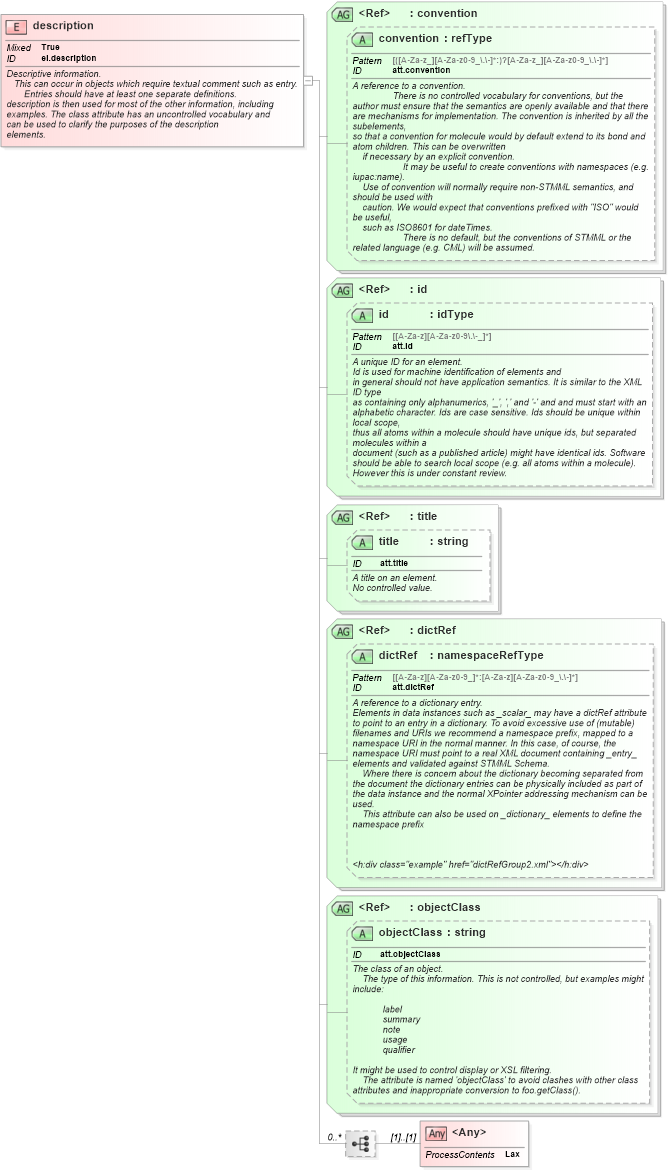
<xsd:element name="description" id="el.description">
    <xsd:annotation>
        <xsd:documentation>
            <h:div class="summary" xmlns:h="http://www.w3.org/1999/xhtml">Descriptive information.</h:div>
            <h:div class="description" xmlns:h="http://www.w3.org/1999/xhtml">This can occur in objects which require textual comment such as entry.
                <h:p>Entries should have at least one separate <h:a href="el.definition">definition</h:a>s.
         <h:tt>description</h:tt> is then used for most of the other information, including
         examples. The <h:tt>class</h:tt> attribute has an uncontrolled vocabulary and
         can be used to clarify the purposes of the <h:tt>description</h:tt>
         elements.</h:p>
            </h:div>
            <h:div class="example" href="description1.xml" xmlns:h="http://www.w3.org/1999/xhtml" />
        </xsd:documentation>
    </xsd:annotation>
    <xsd:complexType mixed="true">
        <xsd:sequence minOccurs="0" maxOccurs="unbounded">
            <xsd:any processContents="lax" />
        </xsd:sequence>
        <xsd:attributeGroup ref="convention" />
        <xsd:attributeGroup ref="id" />
        <xsd:attributeGroup ref="title" />
        <xsd:attributeGroup ref="dictRef" />
        <xsd:attributeGroup ref="objectClass" />
    </xsd:complexType>
</xsd:element>
|
 XSD Schema Diagram: