<xsd:element name="latticeVector" id="el.latticeVector">
    <xsd:annotation>
        <xsd:documentation>
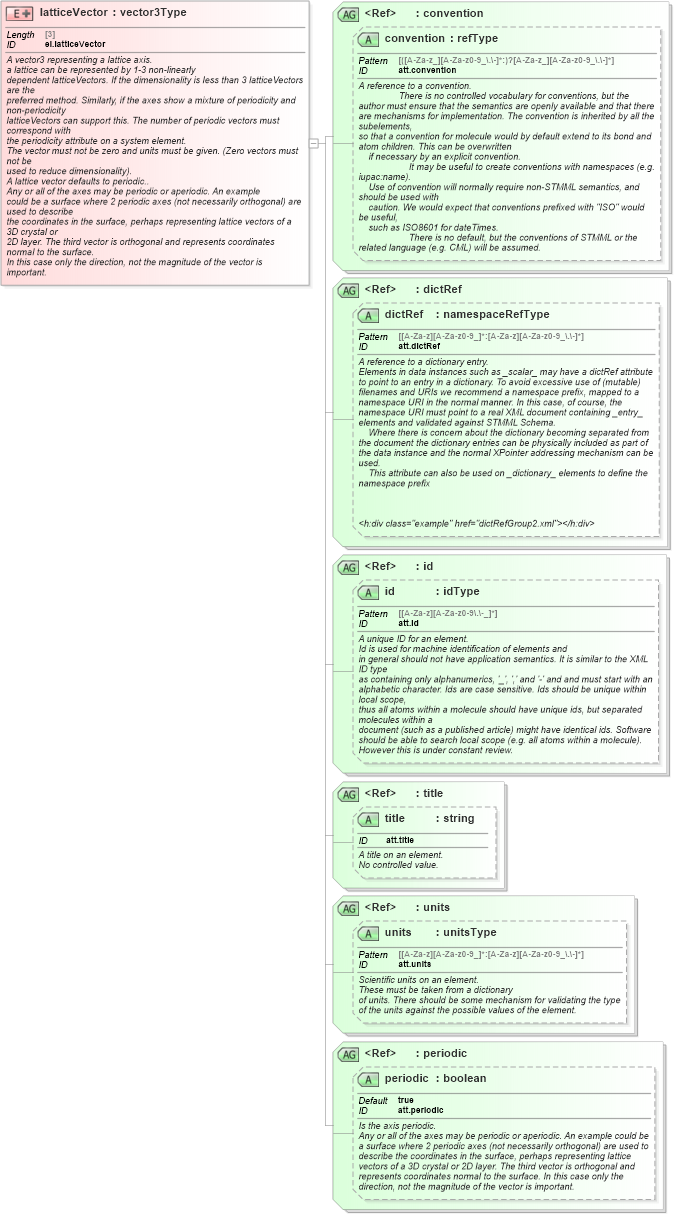
            <h:div class="summary" xmlns:h="http://www.w3.org/1999/xhtml">A vector3 representing a lattice axis.</h:div>
            <h:div class="description" xmlns:h="http://www.w3.org/1999/xhtml">a <h:tt>lattice</h:tt> can be represented by 1-3 non-linearly
            dependent latticeVectors. If the dimensionality is less than 3 latticeVectors are the
            preferred method. Similarly, if the axes show a mixture of periodicity and non-periodicity
            latticeVectors can support this. The number of periodic vectors must correspond with
            the periodicity attribute on a <h:tt>system</h:tt> element.
            <h:p>The vector must not be zero and units must be given. (Zero vectors must not be
            used to reduce dimensionality). </h:p>
                <h:p>A lattice vector defaults to periodic.</h:p>.</h:div>
            <h:div class="description" xmlns:h="http://www.w3.org/1999/xhtml">Any or all of the axes may be periodic or aperiodic. An example
            could be a surface where 2 periodic axes (not necessarily orthogonal) are used to describe
            the coordinates in the surface, perhaps representing lattice vectors of a 3D crystal or
            2D layer. The third vector is orthogonal and represents coordinates normal to the surface.
            In this case only the direction, not the magnitude of the vector is important.</h:div>
            <h:div class="example" href="latticeVector1.xml" xmlns:h="http://www.w3.org/1999/xhtml" />
        </xsd:documentation>
    </xsd:annotation>
    <xsd:complexType>
        <xsd:simpleContent>
            <xsd:extension base="vector3Type">
                <xsd:attributeGroup ref="convention" />
                <xsd:attributeGroup ref="dictRef" />
                <xsd:attributeGroup ref="id" />
                <xsd:attributeGroup ref="title" />
                <xsd:attributeGroup ref="units" />
                <xsd:attributeGroup ref="periodic" />
            </xsd:extension>
        </xsd:simpleContent>
    </xsd:complexType>
</xsd:element>
|
 XSD Schema Diagram: