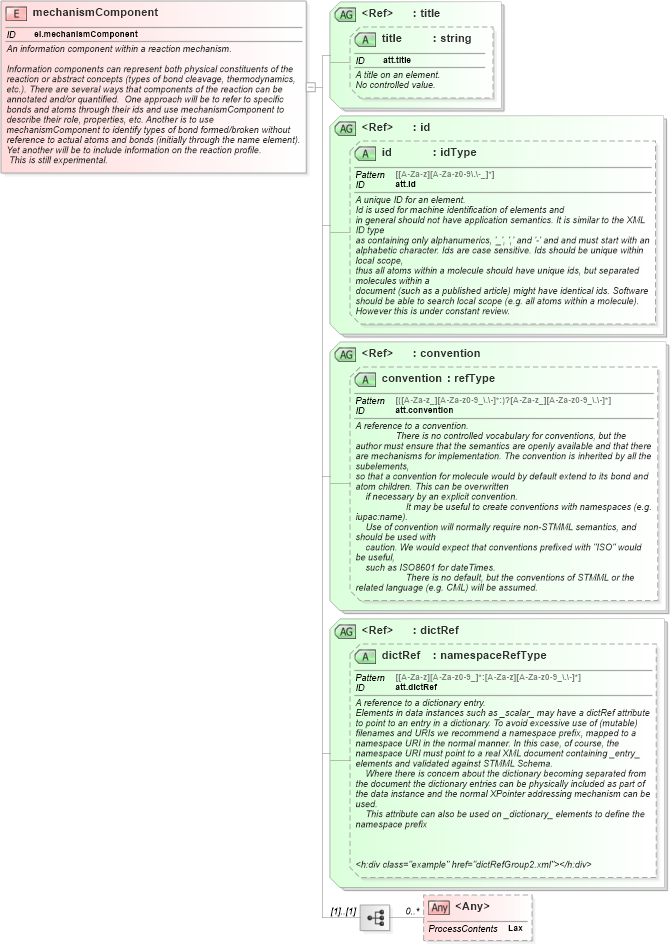
<xsd:element name="mechanismComponent" id="el.mechanismComponent">
    <xsd:annotation>
        <xsd:documentation>
            <h:div class="summary" xmlns:h="http://www.w3.org/1999/xhtml">An information component within a reaction mechanism.</h:div>
            <h:div class="description" xmlns:h="http://www.w3.org/1999/xhtml">
                <h:p>Information components can represent both physical constituents of the reaction or abstract concepts (types of bond cleavage, thermodynamics, etc.). There are several ways that components of the reaction can be annotated and/or quantified.  One approach will be to refer to specific bonds and atoms through their ids and use mechanismComponent to describe their role, properties, etc. Another is to use mechanismComponent to identify types of bond formed/broken without reference to actual atoms and bonds (initially through the <h:tt>name</h:tt> element). Yet another will be to include information on the reaction profile.</h:p>
                <h:p> This is still experimental.</h:p>
            </h:div>
            <h:div class="example" href="mechanismComponent1.xml" xmlns:h="http://www.w3.org/1999/xhtml" />
        </xsd:documentation>
    </xsd:annotation>
    <xsd:complexType>
        <xsd:sequence>
            <xsd:any processContents="lax" minOccurs="0" maxOccurs="unbounded" />
        </xsd:sequence>
        <xsd:attributeGroup ref="title" />
        <xsd:attributeGroup ref="id" />
        <xsd:attributeGroup ref="convention" />
        <xsd:attributeGroup ref="dictRef" />
    </xsd:complexType>
</xsd:element>
|
 XSD Schema Diagram: