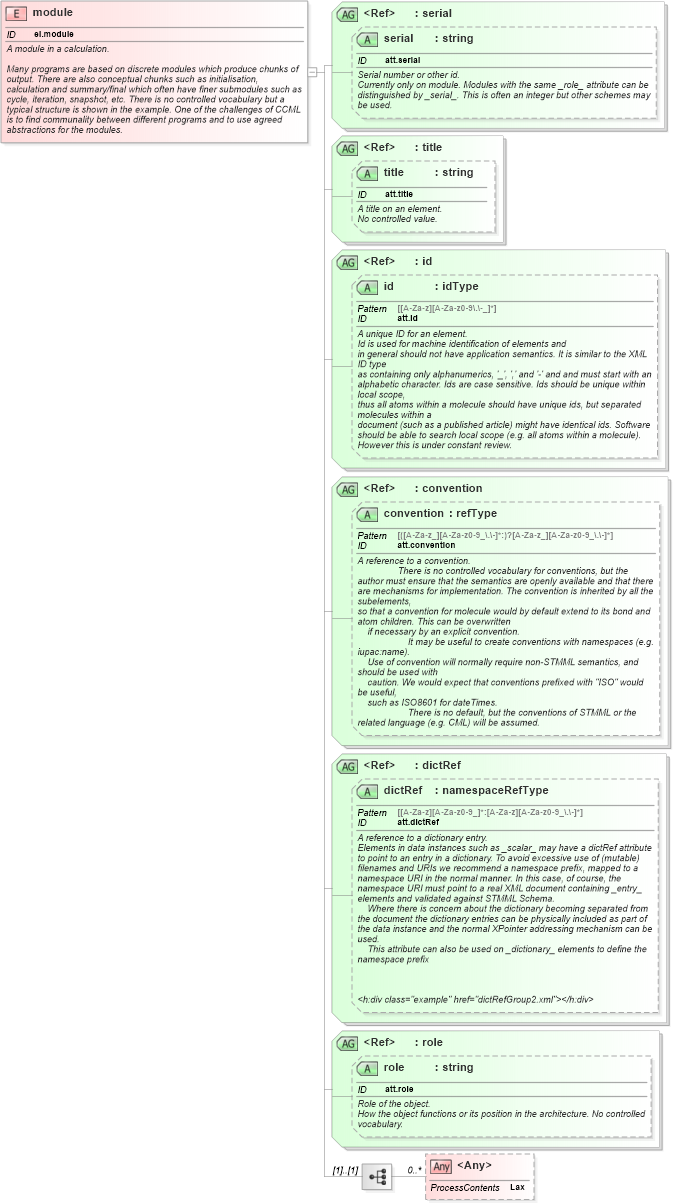
<xsd:element name="module" id="el.module">
    <xsd:annotation>
        <xsd:documentation>
            <h:div class="summary" xmlns:h="http://www.w3.org/1999/xhtml">A module in a calculation.</h:div>
            <h:div class="description" xmlns:h="http://www.w3.org/1999/xhtml">
                <h:p>Many programs are based on discrete modules which produce chunks of output. There are also conceptual chunks such as initialisation, calculation and summary/final which often have finer submodules such as cycle, iteration, snapshot, etc. There is no controlled vocabulary but a typical structure is shown in the example. One of the challenges of CCML is to find communality between different programs and to use agreed abstractions for the modules.
        </h:p>
            </h:div>
            <h:div class="example" href="module1.xml" xmlns:h="http://www.w3.org/1999/xhtml" />
        </xsd:documentation>
    </xsd:annotation>
    <xsd:complexType>
        <xsd:sequence>
            <xsd:any minOccurs="0" maxOccurs="unbounded" processContents="lax" />
        </xsd:sequence>
        <xsd:attributeGroup ref="serial" />
        <xsd:attributeGroup ref="title" />
        <xsd:attributeGroup ref="id" />
        <xsd:attributeGroup ref="convention" />
        <xsd:attributeGroup ref="dictRef" />
        <xsd:attributeGroup ref="role">
            <xsd:annotation>
                <xsd:documentation>
                    <h:div class="specific" xmlns:h="http://www.w3.org/1999/xhtml">The module can have a program-specific name through its title or dictRef (e.g. "MINIM", "l201") and a generic role ("dynamicsCalculation", "equilibration", etc.). In general role will be controlled by CCML.</h:div>
                </xsd:documentation>
            </xsd:annotation>
        </xsd:attributeGroup>
    </xsd:complexType>
</xsd:element>
|
 XSD Schema Diagram: