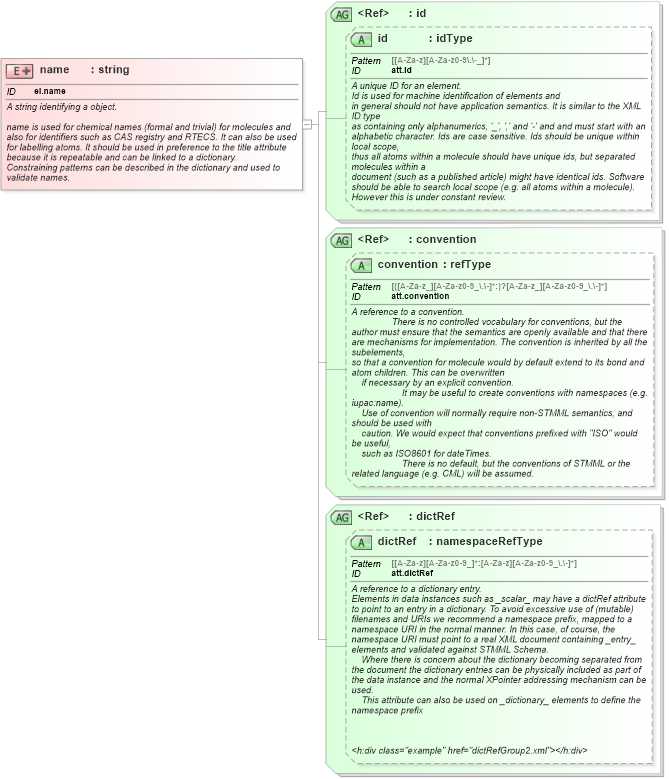
<xsd:element name="name" id="el.name">
    <xsd:annotation>
        <xsd:documentation>
            <h:div class="summary" xmlns:h="http://www.w3.org/1999/xhtml">A string identifying a object.</h:div>
            <h:div class="description" xmlns:h="http://www.w3.org/1999/xhtml">
                <h:tt>name</h:tt> is used for chemical names (formal and trivial) for molecules and also for identifiers such as CAS registry and RTECS. It can also be used for labelling atoms. It should be used in preference to the <h:tt>title</h:tt> attribute because it is repeatable and can be linked to a dictionary.
                    <h:p>Constraining patterns can be described in the dictionary and used to validate <h:tt>name</h:tt>s.</h:p>
            </h:div>
            <h:div class="example" href="name1.xml" xmlns:h="http://www.w3.org/1999/xhtml" />
        </xsd:documentation>
    </xsd:annotation>
    <xsd:complexType>
        <xsd:simpleContent>
            <xsd:extension base="xsd:string">
                <xsd:attributeGroup ref="id" />
                <xsd:attributeGroup ref="convention" />
                <xsd:attributeGroup ref="dictRef" />
            </xsd:extension>
        </xsd:simpleContent>
    </xsd:complexType>
</xsd:element>
|
 XSD Schema Diagram: