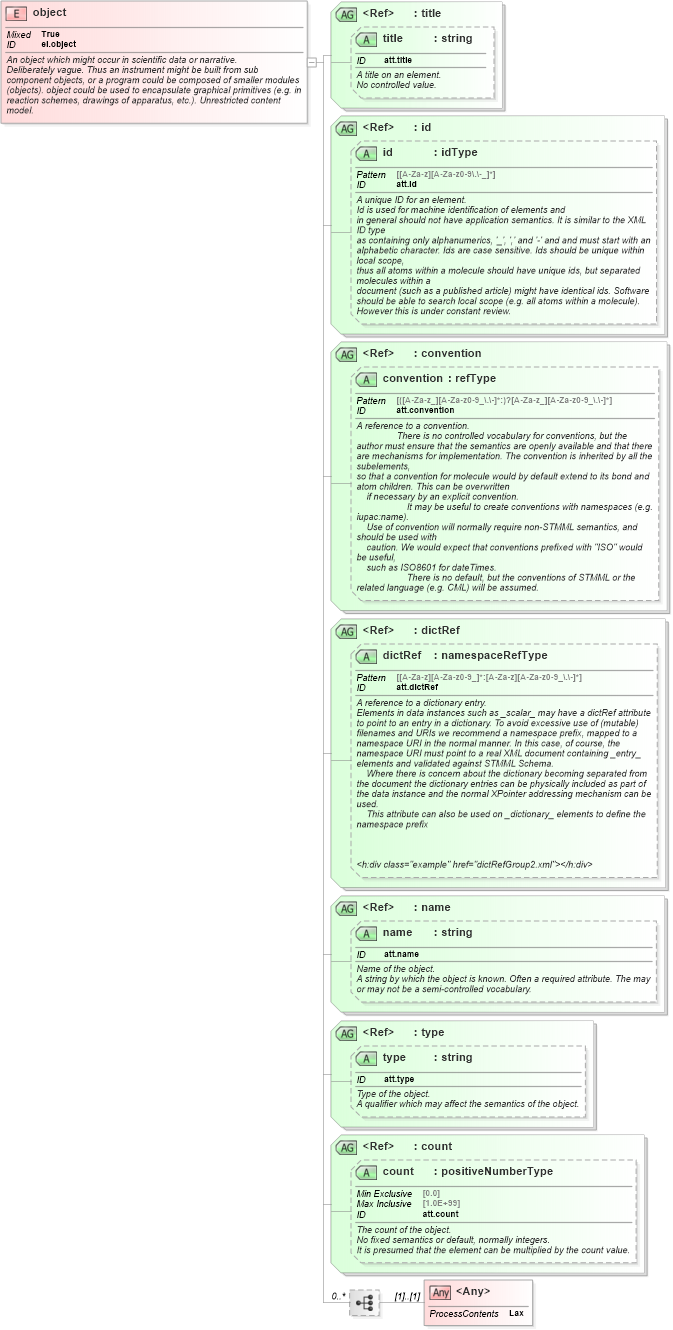
<xsd:element name="object" id="el.object">
    <xsd:annotation>
        <xsd:documentation>
            <h:div class="summary" xmlns:h="http://www.w3.org/1999/xhtml">An object which might occur in scientific data or narrative.</h:div>
            <h:div class="description" xmlns:h="http://www.w3.org/1999/xhtml">Deliberately vague. Thus an instrument might be built from sub component objects, or a program could be composed of smaller modules (objects). <h:tt>object</h:tt> could be used to encapsulate graphical primitives (e.g. in reaction schemes, drawings of apparatus, etc.). Unrestricted content model.</h:div>
            <h:div class="example" href="object1.xml" xmlns:h="http://www.w3.org/1999/xhtml" />
        </xsd:documentation>
    </xsd:annotation>
    <xsd:complexType mixed="true">
        <xsd:sequence minOccurs="0" maxOccurs="unbounded">
            <xsd:any processContents="lax" />
        </xsd:sequence>
        <xsd:attributeGroup ref="title" />
        <xsd:attributeGroup ref="id" />
        <xsd:attributeGroup ref="convention" />
        <xsd:attributeGroup ref="dictRef" />
        <xsd:attributeGroup ref="name" />
        <xsd:attributeGroup ref="type" />
        <xsd:attributeGroup ref="count" />
    </xsd:complexType>
</xsd:element>
|
 XSD Schema Diagram: