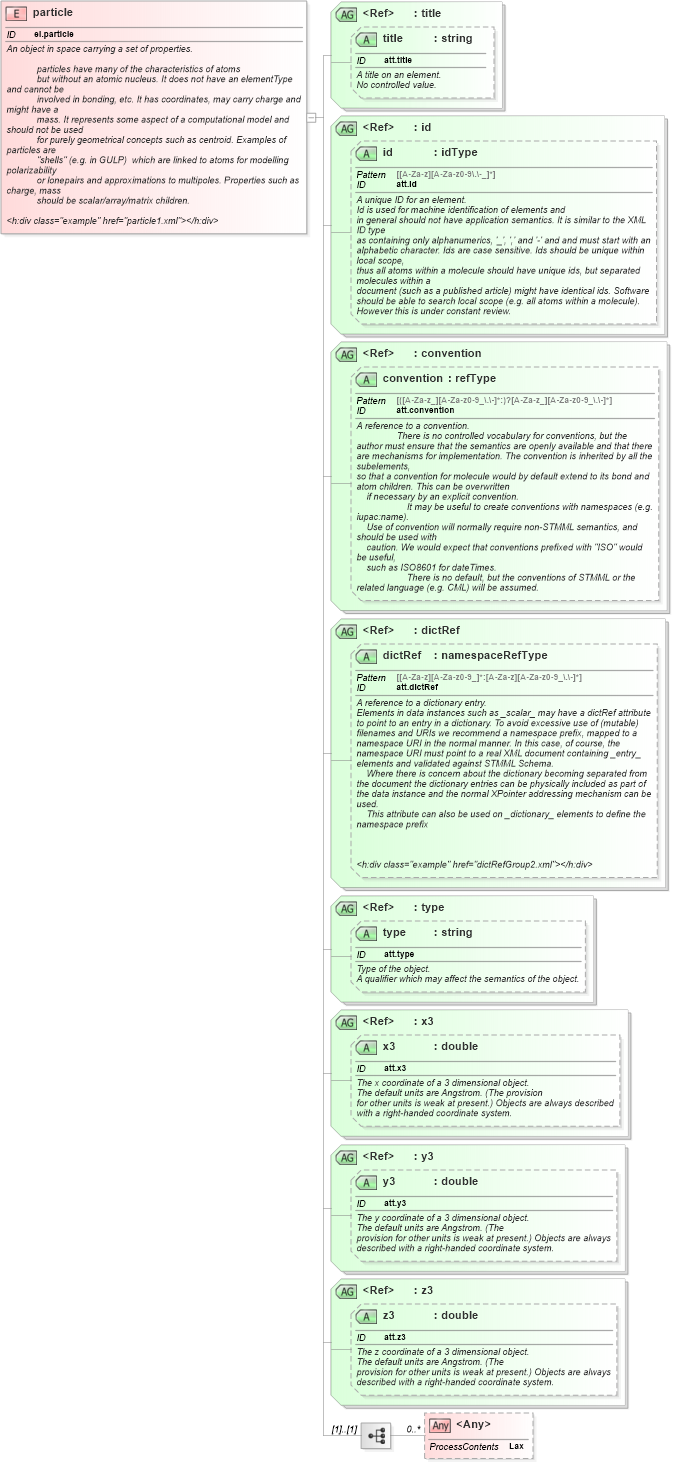
<xsd:element name="particle" id="el.particle">
    <xsd:annotation>
        <xsd:documentation>
            <h:div class="summary" xmlns:h="http://www.w3.org/1999/xhtml">An object in space carrying a set of properties.</h:div>
            <h:div class="description" xmlns:h="http://www.w3.org/1999/xhtml">
                <h:tt>particles</h:tt> have many of the characteristics of <h:tt>atom</h:tt>s
                    but without an atomic nucleus. It does not have an elementType and cannot be
                    involved in bonding, etc. It has coordinates, may carry charge and might have a
                    mass. It represents some aspect of a computational model and should not be used
                    for purely geometrical concepts such as centroid. Examples of particles are
                    "shells" (e.g. in GULP)  which are linked to atoms for modelling polarizability
                    or lonepairs and approximations to multipoles. Properties such as charge, mass
                    should be scalar/array/matrix children.</h:div>
            <!--
        <h:div class="example" href="particle1.xml"></h:div>
        -->
        </xsd:documentation>
    </xsd:annotation>
    <xsd:complexType>
        <xsd:sequence>
            <xsd:any minOccurs="0" maxOccurs="unbounded" processContents="lax" />
        </xsd:sequence>
        <xsd:attributeGroup ref="title" />
        <xsd:attributeGroup ref="id" />
        <xsd:attributeGroup ref="convention" />
        <xsd:attributeGroup ref="dictRef" />
        <xsd:attributeGroup ref="type">
            <xsd:annotation>
                <xsd:documentation>
                    <h:div class="specific" xmlns:h="http://www.w3.org/1999/xhtml">Used in a similar manner to <h:tt>atomType</h:tt>. Examples
                    might be "lonePair", "polarizable Oxygen", etc.</h:div>
                </xsd:documentation>
            </xsd:annotation>
        </xsd:attributeGroup>
        <xsd:attributeGroup ref="x3" />
        <xsd:attributeGroup ref="y3" />
        <xsd:attributeGroup ref="z3" />
    </xsd:complexType>
</xsd:element>
|
 XSD Schema Diagram: