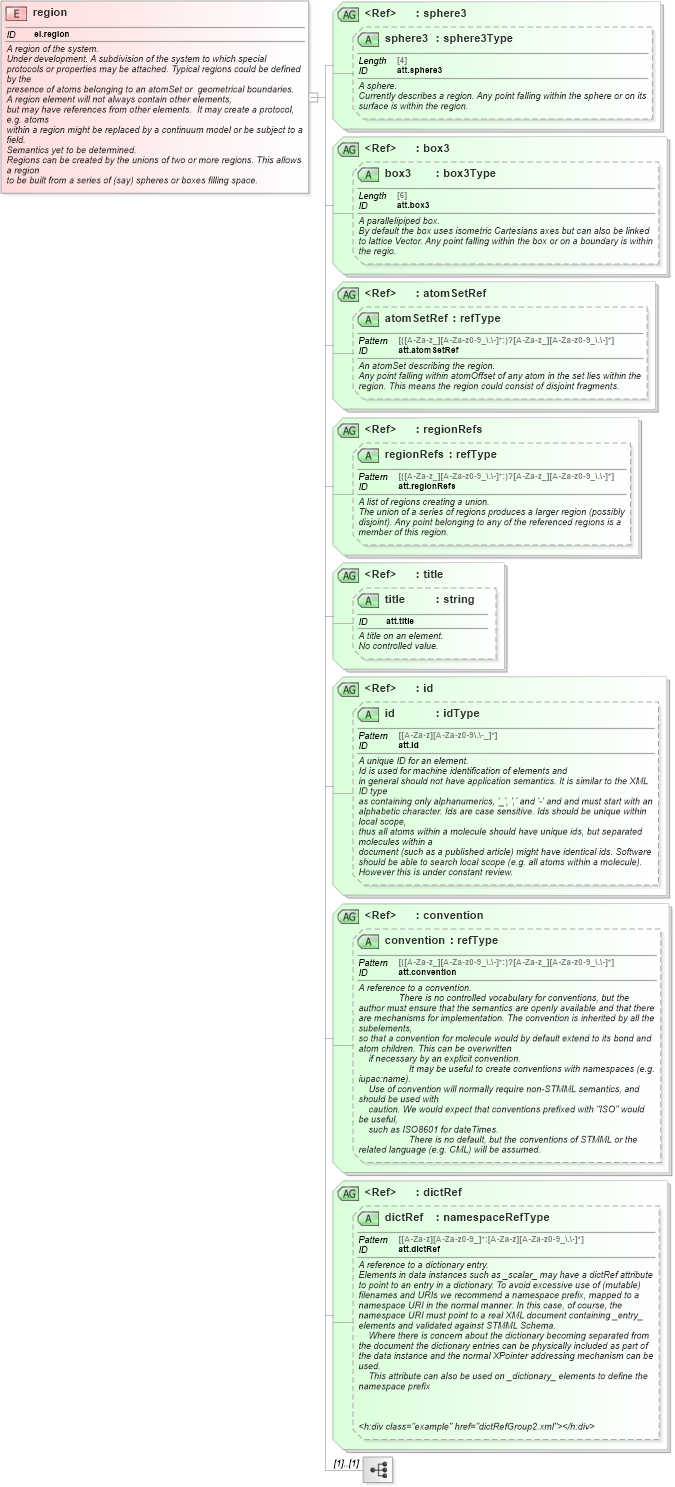
<xsd:element name="region" id="el.region">
    <xsd:annotation>
        <xsd:documentation>
            <h:div class="summary" xmlns:h="http://www.w3.org/1999/xhtml">A region of the system.</h:div>
            <h:div class="description" xmlns:h="http://www.w3.org/1999/xhtml">Under development. A subdivision of the system to which special
            protocols or properties may be attached. Typical regions could be defined by the
            presence of atoms belonging to an atomSet or  geometrical boundaries.</h:div>
            <h:div class="note" xmlns:h="http://www.w3.org/1999/xhtml">A region element will not always contain other elements,
            but may have references from other elements.  It may create a protocol, e.g. atoms
            within a region might be replaced by a continuum model or be subject to a field.
            Semantics yet to be determined.</h:div>
            <h:div xmlns:h="http://www.w3.org/1999/xhtml">Regions can be created by the unions of two or more regions. This allows a region
            to be built from a series of (say) spheres or boxes filling space.</h:div>
            <h:div class="example" href="region1.xml" xmlns:h="http://www.w3.org/1999/xhtml" />
        </xsd:documentation>
    </xsd:annotation>
    <xsd:complexType>
        <xsd:sequence />
        <xsd:attributeGroup ref="sphere3" />
        <xsd:attributeGroup ref="box3" />
        <xsd:attributeGroup ref="atomSetRef" />
        <xsd:attributeGroup ref="regionRefs" />
        <xsd:attributeGroup ref="title" />
        <xsd:attributeGroup ref="id" />
        <xsd:attributeGroup ref="convention" />
        <xsd:attributeGroup ref="dictRef" />
    </xsd:complexType>
</xsd:element>
|
 XSD Schema Diagram: