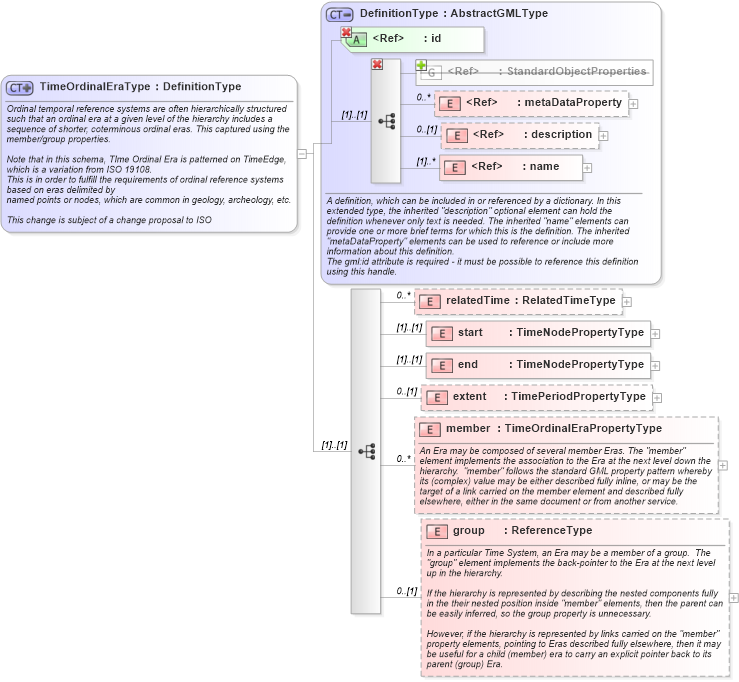
<complexType name="TimeOrdinalEraType">
    <annotation>
        <documentation xml:lang="en">Ordinal temporal reference systems are often hierarchically structured
      such that an ordinal era at a given level of the hierarchy includes a
      sequence of shorter, coterminous ordinal eras. This captured using the member/group properties.

      Note that in this schema, TIme Ordinal Era is patterned on TimeEdge, which is a variation from ISO 19108.
      This is in order to fulfill the requirements of ordinal reference systems based on eras delimited by
      named points or nodes, which are common in geology, archeology, etc.

      This change is subject of a change proposal to ISO</documentation>
    </annotation>
    <complexContent>
        <extension base="gml:DefinitionType">
            <sequence>
                <element name="relatedTime" type="gml:RelatedTimeType" minOccurs="0" maxOccurs="unbounded" />
                <element name="start" type="gml:TimeNodePropertyType" />
                <element name="end" type="gml:TimeNodePropertyType" />
                <element name="extent" type="gml:TimePeriodPropertyType" minOccurs="0" />
                <element name="member" type="gml:TimeOrdinalEraPropertyType" minOccurs="0" maxOccurs="unbounded">
                    <annotation>
                        <documentation>An Era may be composed of several member Eras. The "member" element implements the association to the Era at the next level down the hierarchy.  "member" follows the standard GML property pattern whereby its (complex) value may be either described fully inline, or may be the target of a link carried on the member element and described fully elsewhere, either in the same document or from another service.</documentation>
                    </annotation>
                </element>
                <element name="group" type="gml:ReferenceType" minOccurs="0">
                    <annotation>
                        <documentation>In a particular Time System, an Era may be a member of a group.  The "group" element implements the back-pointer to the Era at the next level up in the hierarchy.

If the hierarchy is represented by describing the nested components fully in the their nested position inside "member" elements, then the parent can be easily inferred, so the group property is unnecessary.

However, if the hierarchy is represented by links carried on the "member" property elements, pointing to Eras described fully elsewhere, then it may be useful for a child (member) era to carry an explicit pointer back to its parent (group) Era.</documentation>
                    </annotation>
                </element>
            </sequence>
        </extension>
    </complexContent>
</complexType>
|
 XSD Schema Diagram: