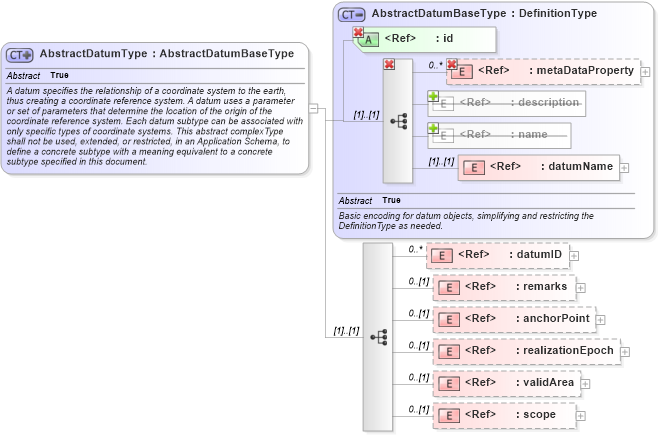
Definition Type: ComplexType
Name: AbstractDatumType
Namespace: http://niem.gov/niem/external/ogc-gml/3.1.1/dhs-gmo/1.0.0
Type: gml:AbstractDatumBaseType
Containing Schema: gml.xsd
Abstract True
Documentation:
A datum specifies the relationship of a coordinate system to the earth, thus creating a coordinate reference system. A datum uses a parameter or set of parameters that determine the location of the origin of the coordinate reference system. Each datum subtype can be associated with only specific types of coordinate systems. This abstract complexType shall not be used, extended, or restricted, in an Application Schema, to define a concrete subtype with a meaning equivalent to a concrete subtype specified in this document.
Collapse XSD Schema Diagram:
Drilldown into scope in schema gml_xsd Drilldown into validArea in schema gml_xsd Drilldown into realizationEpoch in schema gml_xsd Drilldown into anchorPoint in schema gml_xsd Drilldown into remarks in schema gml_xsd Drilldown into datumID in schema gml_xsd Drilldown into datumName in schema gml_xsd Drilldown into name in schema gml_xsd Drilldown into description in schema gml_xsd Drilldown into metaDataProperty in schema gml_xsd Drilldown into id in schema gml_xsd Drilldown into AbstractDatumBaseType in schema gml_xsdXSD Diagram of AbstractDatumType in schema gml_xsd (National Information Exchange Model (NEIM))
Collapse XSD Schema Code:
<complexType name="AbstractDatumType" abstract="true">
    <annotation>
        <documentation>A datum specifies the relationship of a coordinate system to the earth, thus creating a coordinate reference system. A datum uses a parameter or set of parameters that determine the location of the origin of the coordinate reference system. Each datum subtype can be associated with only specific types of coordinate systems. This abstract complexType shall not be used, extended, or restricted, in an Application Schema, to define a concrete subtype with a meaning equivalent to a concrete subtype specified in this document. </documentation>
    </annotation>
    <complexContent>
        <extension base="gml:AbstractDatumBaseType">
            <sequence>
                <element ref="gml:datumID" minOccurs="0" maxOccurs="unbounded">
                    <annotation>
                        <documentation>Set of alternative identifications of this datum. The first datumID, if any, is normally the primary identification code, and any others are aliases. </documentation>
                    </annotation>
                </element>
                <element ref="gml:remarks" minOccurs="0">
                    <annotation>
                        <documentation>Comments on this reference system, including source information. </documentation>
                    </annotation>
                </element>
                <element ref="gml:anchorPoint" minOccurs="0" />
                <element ref="gml:realizationEpoch" minOccurs="0" />
                <element ref="gml:validArea" minOccurs="0" />
                <element ref="gml:scope" minOccurs="0" />
            </sequence>
        </extension>
    </complexContent>
</complexType>
Collapse Child Elements:
Name Type Min Occurs Max Occurs
metaDataProperty gml:metaDataProperty 0 unbounded
description gml:description 0 (1)
name gml:name 0 unbounded
metaDataProperty gml:metaDataProperty 0 unbounded
description gml:description 0 (1)
name gml:name (1) unbounded
metaDataProperty gml:metaDataProperty 0 unbounded
datumName gml:datumName (1) (1)
datumID gml:datumID 0 unbounded
remarks gml:remarks 0 (1)
anchorPoint gml:anchorPoint 0 (1)
realizationEpoch gml:realizationEpoch 0 (1)
validArea gml:validArea 0 (1)
scope gml:scope 0 (1)
<xs:group> gml:StandardObjectProperties (1) (1)
Collapse Child Attributes:
Name Type Default Value Use
id gml:id Required
Collapse Derivation Tree:
Collapse References:
gml:_Datumgmx:DatumAlt_Type, gml:EngineeringDatumType, gml:GeodeticDatumType, gml:ImageDatumType, gml:TemporalDatumBaseType, gml:VerticalDatumType,