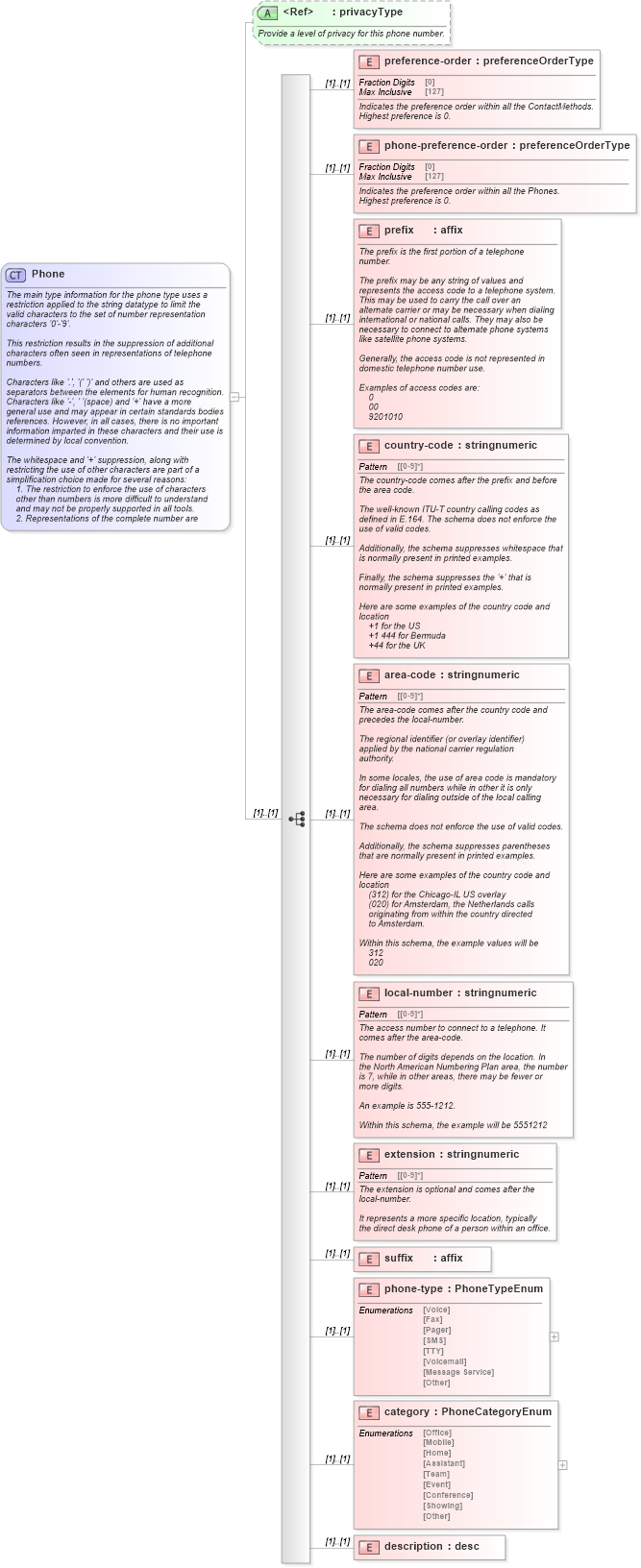
<xs:complexType name="Phone">
    <xs:annotation>
        <xs:documentation>
				The main type information for the phone type uses a
				restriction applied to the string datatype to limit the
				valid characters to the set of number representation
				characters '0'-'9'.

				This restriction results in the suppression of additional
				characters often seen in representations of telephone
				numbers.

				Characters like '.', '(' ')' and others are used as
				separators between the elements for human recognition.
				Characters like '-', ' '(space) and '+' have a more
				general use and may appear in certain standards bodies
				references. However, in all cases, there is no important
				information imparted in these characters and their use is
				determined by local convention.

				The whitespace and '+' suppression, along with
				restricting the use of other characters are part of a
				simplification choice made for several reasons:
					1. The restriction to enforce the use of characters
					other than numbers is more difficult to understand
					and may not be properly supported in all tools.
					2. Representations of the complete number are
					locale specific. A telephone number is presented
					differently based on culture.
					3. Resolution between the stringnumeric and legacy
					systems should be simplified. For string
					representations, it is conversion by restriction. An
					unparsed phone in a legacy system may have the form
					+1 (888) 555-1212. This and other permutations should
					be easily converted to the form presented here
						<country-code>1</country-code>
            <area-code>888</area-code>
            <local-number>5551212</local-number>
        </xs:documentation>
    </xs:annotation>
    <xs:sequence>
        <xs:element name="preference-order" type="commons:preferenceOrderType">
            <xs:annotation>
                <xs:documentation>
						Indicates the preference order within all the ContactMethods.
						Highest preference is 0.
					</xs:documentation>
                <xs:appinfo>
                    <retsid>100049</retsid>
                    <example>
                    </example>
                </xs:appinfo>
            </xs:annotation>
        </xs:element>
        <xs:element name="phone-preference-order" type="commons:preferenceOrderType">
            <xs:annotation>
                <xs:documentation>
						Indicates the preference order within all the Phones.
						Highest preference is 0.
					</xs:documentation>
                <xs:appinfo>
                    <retsid>100050</retsid>
                    <example>
                    </example>
                </xs:appinfo>
            </xs:annotation>
        </xs:element>
        <xs:element name="prefix" type="commons:affix">
            <xs:annotation>
                <xs:documentation>
						The prefix is the first portion of a telephone
						number.

						The prefix may be any string of values and
						represents the access code to a telephone system.
						This may be used to carry the call over an
						alternate carrier or may be necessary when dialing
						international or national calls. They may also be
						necessary to connect to alternate phone systems
						like satellite phone systems.

						Generally, the access code is not represented in
						domestic telephone number use.

						Examples of access codes are:
							0
							00
							9201010
					</xs:documentation>
                <xs:appinfo>
                    <retsid>100051</retsid>
                    <example>
                    </example>
                </xs:appinfo>
            </xs:annotation>
        </xs:element>
        <xs:element name="country-code" type="commons:stringnumeric">
            <xs:annotation>
                <xs:documentation>
						The country-code comes after the prefix and before
						the area code.

						The well-known ITU-T country calling codes as
						defined in E.164. The schema does not enforce the
						use of valid codes.

						Additionally, the schema suppresses whitespace that
						is normally present in printed examples.

						Finally, the schema suppresses the '+' that is
						normally present in printed examples.

						Here are some examples of the country code and
						location
							+1 for the US
							+1 444 for Bermuda
							+44 for the UK
					</xs:documentation>
                <xs:appinfo>
                    <retsid>100052</retsid>
                    <example>1</example>
                </xs:appinfo>
            </xs:annotation>
        </xs:element>
        <xs:element name="area-code" type="commons:stringnumeric">
            <xs:annotation>
                <xs:documentation>
						The area-code comes after the country code and
						precedes the local-number.

						The regional identifier (or overlay identifier)
						applied by the national carrier regulation
						authority.

						In some locales, the use of area code is mandatory
						for dialing all numbers while in other it is only
						necessary for dialing outside of the local calling
						area.

						The schema does not enforce the use of valid codes.

						Additionally, the schema suppresses parentheses
						that are normally present in printed examples.

						Here are some examples of the country code and
						location
							(312) for the Chicago-IL US overlay
							(020) for Amsterdam, the Netherlands calls
							originating from within the country directed
							to Amsterdam.

						Within this schema, the example values will be
							312
							020
					</xs:documentation>
                <xs:appinfo>
                    <retsid>100053</retsid>
                    <example>888</example>
                </xs:appinfo>
            </xs:annotation>
        </xs:element>
        <xs:element name="local-number" type="commons:stringnumeric">
            <xs:annotation>
                <xs:documentation>
						The access number to connect to a telephone. It
						comes after the area-code.

						The number of digits depends on the location. In
						the North American Numbering Plan area, the number
						is 7, while in other areas, there may be fewer or
						more digits.

						An example is 555-1212.

						Within this schema, the example will be 5551212
					</xs:documentation>
                <xs:appinfo>
                    <retsid>100054</retsid>
                    <example>5551212</example>
                </xs:appinfo>
            </xs:annotation>
        </xs:element>
        <xs:element name="extension" type="commons:stringnumeric">
            <xs:annotation>
                <xs:documentation>
						The extension is optional and comes after the
						local-number.

						It represents a more specific location, typically
						the direct desk phone of a person within an office.
					</xs:documentation>
                <xs:appinfo>
                    <retsid>100055</retsid>
                    <example>
                    </example>
                </xs:appinfo>
            </xs:annotation>
        </xs:element>
        <xs:element name="suffix" type="commons:affix" />
        <xs:element name="phone-type" type="commons:PhoneTypeEnum">
            <xs:annotation>
                <xs:appinfo>
                    <retsid>100056</retsid>
                    <example>
                    </example>
                </xs:appinfo>
            </xs:annotation>
        </xs:element>
        <xs:element name="category" type="commons:PhoneCategoryEnum">
            <xs:annotation>
                <xs:appinfo>
                    <retsid>100057</retsid>
                    <example>
                    </example>
                </xs:appinfo>
            </xs:annotation>
        </xs:element>
        <xs:element name="description" type="commons:desc">
            <xs:annotation>
                <xs:appinfo>
                    <retsid>100058</retsid>
                    <example>
                    </example>
                </xs:appinfo>
            </xs:annotation>
        </xs:element>
    </xs:sequence>
    <xs:attribute ref="commons:privacyType" use="optional">
        <xs:annotation>
            <xs:documentation>
					Provide a level of privacy for this phone number.
				</xs:documentation>
        </xs:annotation>
    </xs:attribute>
</xs:complexType>
|
 XSD Schema Diagram: