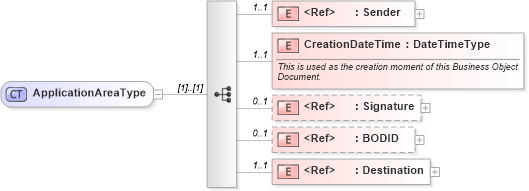
<xsd:complexType name="ApplicationAreaType">
    <xsd:sequence>
        <xsd:element maxOccurs="1" minOccurs="1" ref="Sender">
            <xsd:annotation>
                <xsd:documentation source="http://www.starstandard.org/">This identifies characteristics and control identifiers that
                  relate to the application that created the Business Object Document.</xsd:documentation>
            </xsd:annotation>
        </xsd:element>
        <xsd:element maxOccurs="1" minOccurs="1" name="CreationDateTime" type="udt:DateTimeType">
            <xsd:annotation>
                <xsd:documentation source="http://www.starstandard.org">This is used as the creation moment of this Business Object
                  Document.</xsd:documentation>
            </xsd:annotation>
        </xsd:element>
        <xsd:element maxOccurs="1" minOccurs="0" ref="oagis:Signature">
            <xsd:annotation>
                <xsd:documentation source="http://www.starstandard.org">If the BOD is to be signed the signature element is included,
                  otherwise it is not. Signature supports any digital signature that maybe used by an implementation of
                  OAGIS. The qualifyingAgency identifies the agency that provided the format for the signature.
               </xsd:documentation>
            </xsd:annotation>
        </xsd:element>
        <xsd:element maxOccurs="1" minOccurs="0" ref="BODID">
            <xsd:annotation>
                <xsd:documentation source="http://www.starstandard.org">The BODId provides a place to carry a Globally Unique
                  Identifier (GUID) that will make each Business Object Document instance uniquely identifiable. This is
                  a critical success factor to enable software developers to use the Globally Unique Identifier (GUID)
                  to build services or capabilities:</xsd:documentation>
            </xsd:annotation>
        </xsd:element>
        <xsd:element maxOccurs="1" minOccurs="1" ref="Destination">
            <xsd:annotation>
                <xsd:documentation source="http://www.starstandard.org">This identifies characteristics and control identifiers that
                  relate to the application that receives the Business Object Document.</xsd:documentation>
            </xsd:annotation>
        </xsd:element>
    </xsd:sequence>
</xsd:complexType>
|
 XSD Schema Diagram: