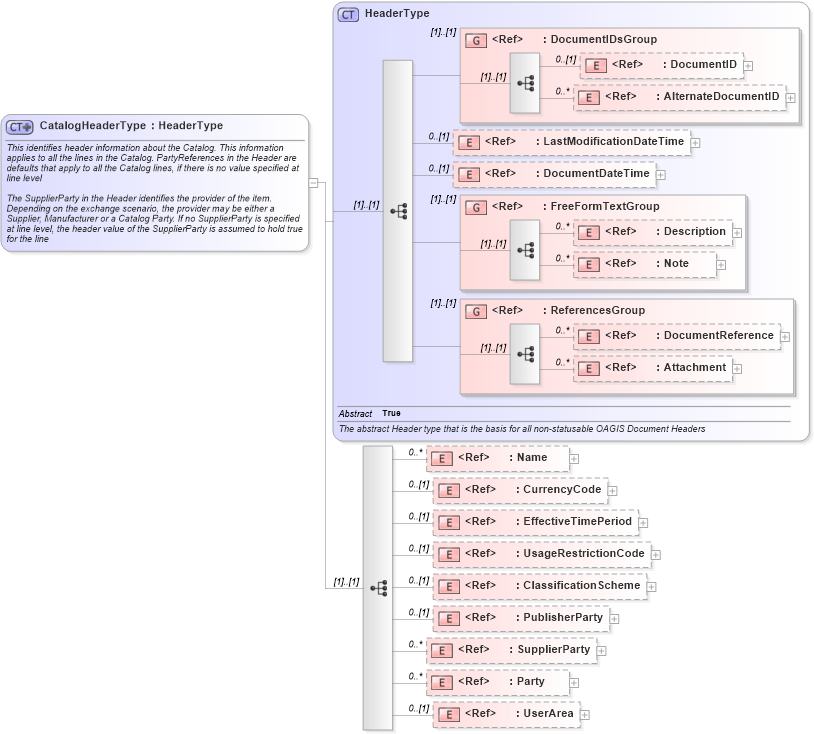
<xsd:complexType name="CatalogHeaderType">
    <xsd:annotation>
        <xsd:documentation source="http://www.openapplications.org/oagis/9">This identifies header information about the Catalog. This information applies to all the lines in the Catalog. PartyReferences in the Header are defaults that apply to all the Catalog lines, if there is no value specified at line level

The SupplierParty in the Header identifies the provider of the item. Depending on the exchange scenario, the provider may be either a Supplier, Manufacturer or a Catalog Party. If no SupplierParty is specified at line level, the header value of the SupplierParty is assumed to hold true for the line </xsd:documentation>
    </xsd:annotation>
    <xsd:complexContent>
        <xsd:extension base="HeaderType">
            <xsd:sequence>
                <xsd:element ref="Name" minOccurs="0" maxOccurs="unbounded">
                    <xsd:annotation>
                        <xsd:documentation source="http://www.openapplications.org/oagis/9">Is the name of the Catalog.</xsd:documentation>
                    </xsd:annotation>
                </xsd:element>
                <xsd:element ref="CurrencyCode" minOccurs="0">
                    <xsd:annotation>
                        <xsd:documentation source="http://www.openapplications.org/oagis/9">Is the default currency of the Catalog. If a Currencey is specified for the Catalog, all the prices in the Catalog are assumed to be in the corresponding currency.</xsd:documentation>
                        <xsd:documentation source="http://www.openapplications.org/oagis/9">Is the default currency of the Catalog. If a Currencey is specified for the Catalog, all the prices in the Catalog are assumed to be in the corresponding currency.</xsd:documentation>
                    </xsd:annotation>
                </xsd:element>
                <xsd:element ref="EffectiveTimePeriod" minOccurs="0">
                    <xsd:annotation>
                        <xsd:documentation source="http://www.openapplications.org/oagis/9">Is the effective period of the Catalog or Catalog revision.

The EffectiveTimePeriod  indicates the effectivity date and the expiration date for the validity of the Catalog. Often times the effectivity of a Catalog Revision is indicated by the release of a new revision of the Catalog. As such the Finish Effectivity date is never specified but assumed to be the Starting Effectivity date on the next revision</xsd:documentation>
                    </xsd:annotation>
                </xsd:element>
                <xsd:element ref="UsageRestrictionCode" minOccurs="0">
                    <xsd:annotation>
                        <xsd:documentation source="http://www.openapplications.org/oagis/9">UsageRestriction is used to indicate additional restrictions on the Catalog usage. The implementation of this is to be agreed upon between trading partners. An example of usage of this is when a supplier has different Catalogs - one for general usage and others for usage by specific customers/ group of customers. In this scenario, the UsageRestriction can be specified as PUBLIC/ PRIVATE</xsd:documentation>
                    </xsd:annotation>
                </xsd:element>
                <xsd:element ref="ClassificationScheme" minOccurs="0" />
                <xsd:element ref="PublisherParty" minOccurs="0" />
                <xsd:element ref="SupplierParty" minOccurs="0" maxOccurs="unbounded" />
                <xsd:element ref="Party" minOccurs="0" maxOccurs="unbounded" />
                <xsd:element ref="UserArea" minOccurs="0" />
            </xsd:sequence>
        </xsd:extension>
    </xsd:complexContent>
</xsd:complexType>
|
 XSD Schema Diagram: