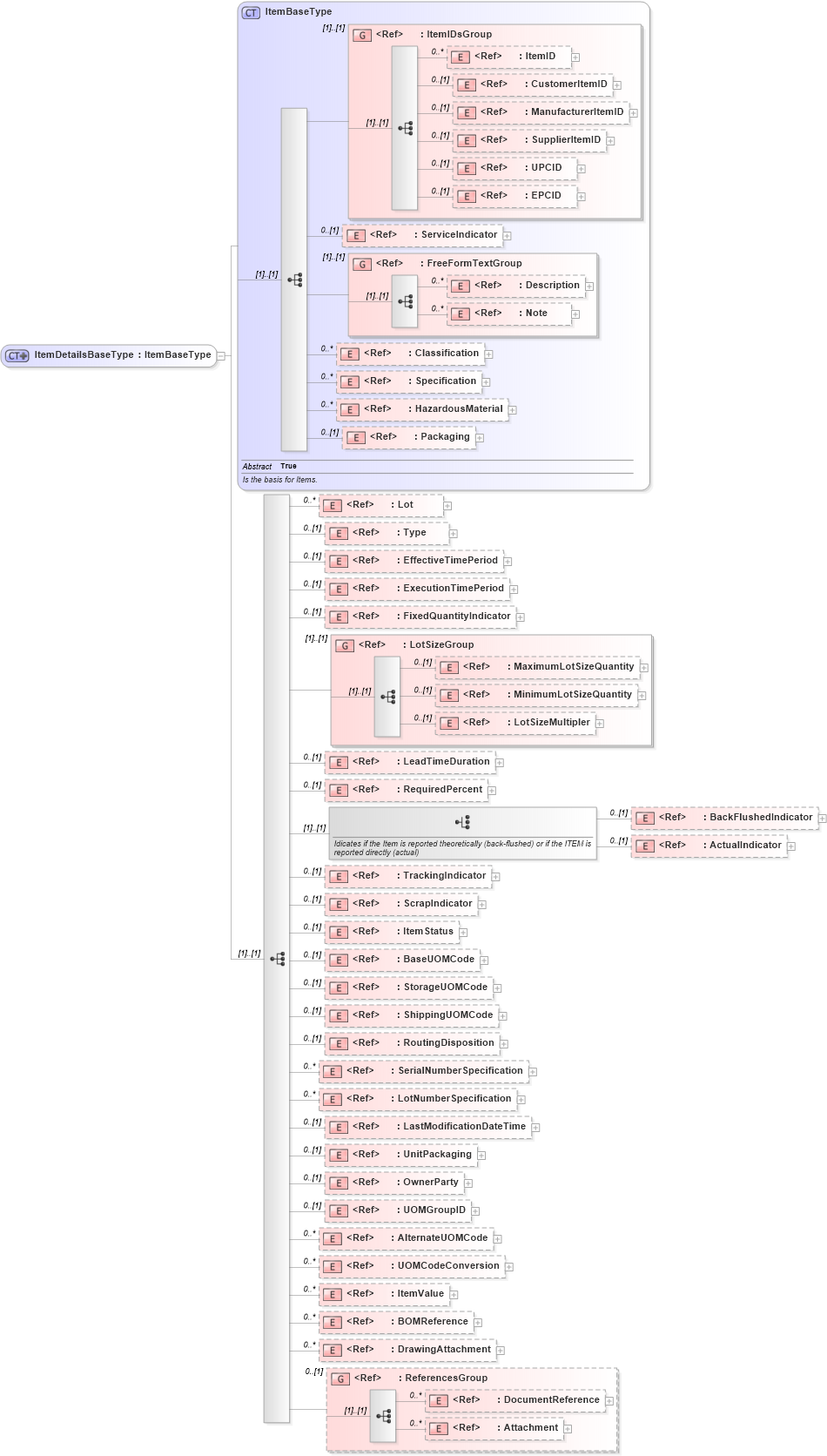
<xsd:complexType name="ItemDetailsBaseType">
    <xsd:complexContent>
        <xsd:extension base="ItemBaseType">
            <xsd:sequence>
                <xsd:element ref="Lot" minOccurs="0" maxOccurs="unbounded" />
                <xsd:element ref="Type" minOccurs="0" />
                <xsd:element ref="EffectiveTimePeriod" minOccurs="0" />
                <xsd:element ref="ExecutionTimePeriod" minOccurs="0" />
                <xsd:element ref="FixedQuantityIndicator" minOccurs="0" />
                <xsd:group ref="LotSizeGroup" />
                <xsd:element ref="LeadTimeDuration" minOccurs="0" />
                <xsd:element ref="RequiredPercent" minOccurs="0" />
                <xsd:choice>
                    <xsd:annotation>
                        <xsd:documentation>Idicates if the Item is reported theoretically (back-flushed) or if the ITEM is reported directly (actual)</xsd:documentation>
                    </xsd:annotation>
                    <xsd:element ref="BackFlushedIndicator" minOccurs="0" />
                    <xsd:element ref="ActualIndicator" minOccurs="0" />
                </xsd:choice>
                <xsd:element ref="TrackingIndicator" minOccurs="0" />
                <xsd:element ref="ScrapIndicator" minOccurs="0" />
                <xsd:element ref="ItemStatus" minOccurs="0" />
                <xsd:element ref="BaseUOMCode" minOccurs="0">
                    <xsd:annotation>
                        <xsd:documentation source="http://www.openapplications.org/oagis/9">Is the default UOM that the business refers to the item in. This is sometimes different from the unit of measure that is used to count a product as it is consumed, sold or accounted for.

EXAMPLES:
Generic Quantity  (Each, Pair, Dozen, Gross, etc);
Weight (Ounce, Pound, Ton, Kilogram, etc);
Volume (Cup, Pint, Gallon, Liter, etc);
Length (Inch, Foot, Yard, Meter, etc)</xsd:documentation>
                    </xsd:annotation>
                </xsd:element>
                <xsd:element ref="StorageUOMCode" minOccurs="0">
                    <xsd:annotation>
                        <xsd:documentation source="http://www.openapplications.org/oagis/9">This describes the unit of measure that a product is stored in inventory.  This is sometimes different from the unit of measure that is used to count a product as it is consumed, sold or accounted for.

Examples are:

- Generic Quantity  (Each, Pair, Dozen, Gross, etc)
- Weight (Ounce, Pound, Ton, Kilogram, etc)
- Volume (Cup, Pint, Gallon, Liter, etc)
- Length (Inch, Foot, Yard, Meter, etc)
- Time (Second, Minute, Hour, Day, Year, etc)</xsd:documentation>
                        <xsd:documentation source="http://www.openapplications.org/oagis/9">This describes the unit of measure that a product is stored in inventory.  This is sometimes different from the unit of measure that is used to count a product as it is consumed, sold or accounted for.

Examples are:

- Generic Quantity  (Each, Pair, Dozen, Gross, etc)
- Weight (Ounce, Pound, Ton, Kilogram, etc)
- Volume (Cup, Pint, Gallon, Liter, etc)
- Length (Inch, Foot, Yard, Meter, etc)
- Time (Second, Minute, Hour, Day, Year, etc)</xsd:documentation>
                    </xsd:annotation>
                </xsd:element>
                <xsd:element ref="ShippingUOMCode" minOccurs="0">
                    <xsd:annotation>
                        <xsd:documentation>This describes the unit of measure that a product is shipped.  This is sometimes different from the unit of measure that is used to count a product as it is consumed, sold or accounted for.

Examples are:

- Generic Quantity  (Each, Pair, Dozen, Gross, etc)
- Weight (Ounce, Pound, Ton, Kilogram, etc)
- Volume (Cup, Pint, Gallon, Liter, etc)
- Length (Inch, Foot, Yard, Meter, etc)
- Time (Second, Minute, Hour, Day, Year, etc)</xsd:documentation>
                    </xsd:annotation>
                </xsd:element>
                <xsd:element ref="RoutingDisposition" minOccurs="0" />
                <xsd:element ref="SerialNumberSpecification" minOccurs="0" maxOccurs="unbounded">
                    <xsd:annotation>
                        <xsd:documentation source="http://www.openapplications.org/oagis/9">Indicates the business rules used to specify what constitutes a serial number</xsd:documentation>
                    </xsd:annotation>
                </xsd:element>
                <xsd:element ref="LotNumberSpecification" minOccurs="0" maxOccurs="unbounded">
                    <xsd:annotation>
                        <xsd:documentation source="http://www.openapplications.org/oagis/9">Indicates the business rules used to specify what constitutes a lot</xsd:documentation>
                    </xsd:annotation>
                </xsd:element>
                <xsd:element ref="LastModificationDateTime" minOccurs="0">
                    <xsd:annotation>
                        <xsd:documentation source="http://www.openapplications.org/oagis/9">Is the timestamp of the last modification to the Item Master for this Item.</xsd:documentation>
                    </xsd:annotation>
                </xsd:element>
                <xsd:element ref="UnitPackaging" minOccurs="0" />
                <xsd:element ref="OwnerParty" minOccurs="0" />
                <xsd:element ref="UOMGroupID" minOccurs="0">
                    <xsd:annotation>
                        <xsd:documentation source="http://www.openapplications.org/oagis/9">This identifies a set of related UOM's and their conversions from the Item's UOM</xsd:documentation>
                        <xsd:documentation source="http://www.openapplications.org/oagis/9">Is a UOMGroup Identifier, that identifies a set of related UOM's and their conversions from the Item's UOM</xsd:documentation>
                    </xsd:annotation>
                </xsd:element>
                <xsd:element ref="AlternateUOMCode" minOccurs="0" maxOccurs="unbounded" />
                <xsd:element ref="UOMCodeConversion" minOccurs="0" maxOccurs="unbounded" />
                <xsd:element ref="ItemValue" minOccurs="0" maxOccurs="unbounded" />
                <xsd:element ref="BOMReference" minOccurs="0" maxOccurs="unbounded" />
                <xsd:element ref="DrawingAttachment" minOccurs="0" maxOccurs="unbounded" />
                <xsd:group ref="ReferencesGroup" minOccurs="0" />
            </xsd:sequence>
        </xsd:extension>
    </xsd:complexContent>
</xsd:complexType>
|
 XSD Schema Diagram: