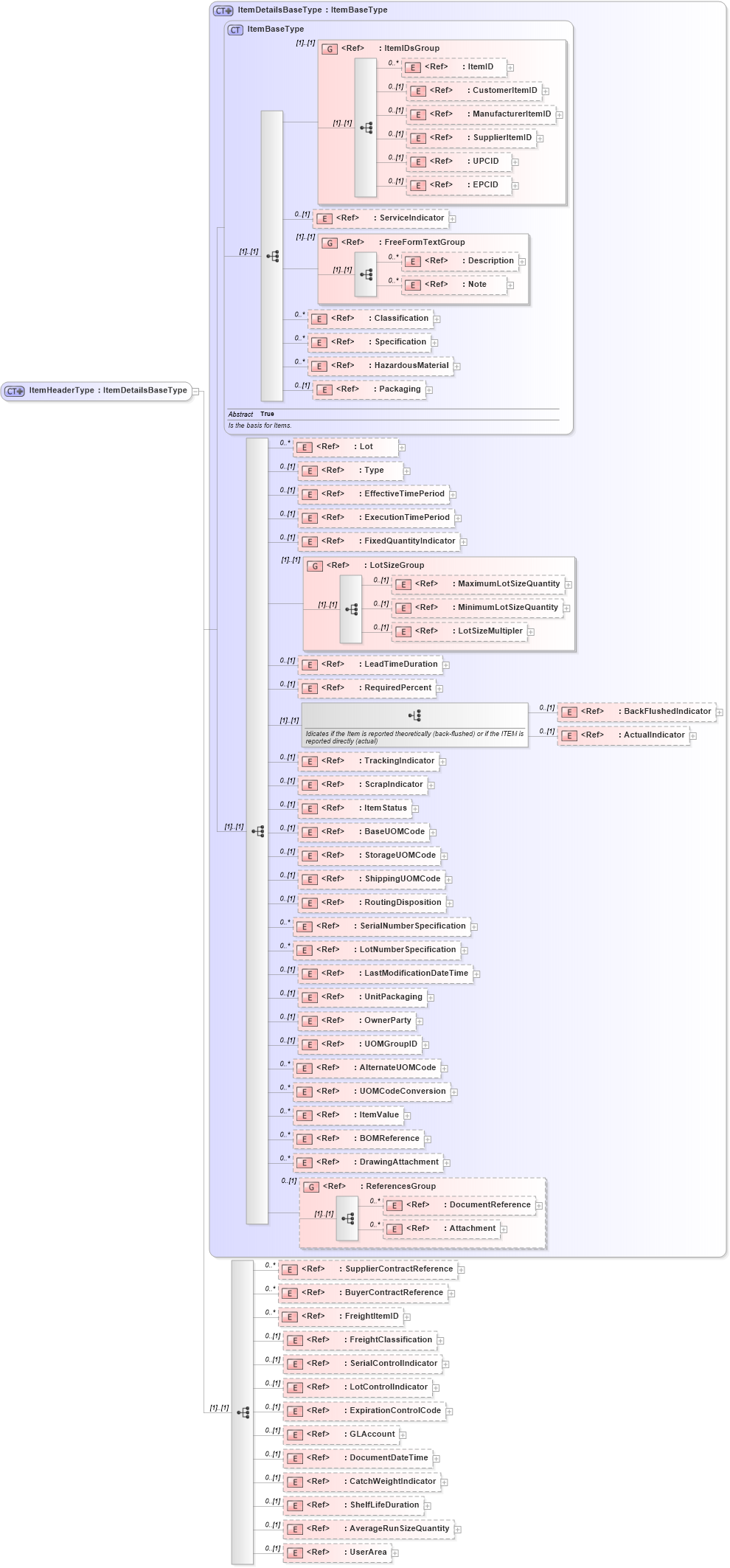
<xsd:complexType name="ItemHeaderType">
    <xsd:complexContent>
        <xsd:extension base="ItemDetailsBaseType">
            <xsd:sequence>
                <xsd:element ref="SupplierContractReference" minOccurs="0" maxOccurs="unbounded" />
                <xsd:element ref="BuyerContractReference" minOccurs="0" maxOccurs="unbounded" />
                <xsd:element ref="FreightItemID" minOccurs="0" maxOccurs="unbounded">
                    <xsd:annotation>
                        <xsd:documentation>This identifies the item number assigned to the type of goods for the purposes of freight classification and cost calculation</xsd:documentation>
                    </xsd:annotation>
                </xsd:element>
                <xsd:element ref="FreightClassification" minOccurs="0">
                    <xsd:annotation>
                        <xsd:documentation source="http://www.openapplications.org/oagis/9">Qualifies goods for purposes of freight cost calculation. An example would the qualifications used by National Motor Freight Carriers.

EXAMPLES	National Motor Freight Carriers (NMFC) Class Code

Based on an evaluation of density, stowability, ease of handling and liability, the commodities are grouped into one of 18 classes.</xsd:documentation>
                    </xsd:annotation>
                </xsd:element>
                <xsd:element ref="SerialControlIndicator" minOccurs="0">
                    <xsd:annotation>
                        <xsd:documentation source="http://www.openapplications.org/oagis/9">Indicates if the item is a serialized item i.e. unique instances of the item are identified by unique serial numbers. Valid values are 0 for no, and 1 for yes</xsd:documentation>
                    </xsd:annotation>
                </xsd:element>
                <xsd:element ref="LotControlIndicator" minOccurs="0">
                    <xsd:annotation>
                        <xsd:documentation source="http://www.openapplications.org/oagis/9">Indicates if the item is a lotted item. Valid values are 0 for no, and 1 for yes</xsd:documentation>
                    </xsd:annotation>
                </xsd:element>
                <xsd:element ref="ExpirationControlCode" minOccurs="0">
                    <xsd:annotation>
                        <xsd:documentation source="http://www.openapplications.org/oagis/9">Indicates the type of control used to determine whether or not an item has expired or is no longer considered good to sell or consume.</xsd:documentation>
                    </xsd:annotation>
                </xsd:element>
                <xsd:element ref="GLAccount" minOccurs="0" />
                <xsd:element ref="DocumentDateTime" minOccurs="0">
                    <xsd:annotation>
                        <xsd:documentation source="http://www.openapplications.org/oagis/9">Identifyies the timestamp that the Item Master record was created.</xsd:documentation>
                    </xsd:annotation>
                </xsd:element>
                <xsd:element ref="CatchWeightIndicator" minOccurs="0">
                    <xsd:annotation>
                        <xsd:documentation source="http://www.openapplications.org/oagis/9">Indicates that an ITEM requires special processing to determine the actual net or gross weight during certain inventory operations.  </xsd:documentation>
                        <xsd:documentation source="http://www.openapplications.org/oagis/9">Indicates that an ITEM requires special processing to determine the actual net or gross weight during certain inventory operations.  </xsd:documentation>
                    </xsd:annotation>
                </xsd:element>
                <xsd:element ref="ShelfLifeDuration" minOccurs="0">
                    <xsd:annotation>
                        <xsd:documentation>This is the period of time in duration that the item is valid for use</xsd:documentation>
                    </xsd:annotation>
                </xsd:element>
                <xsd:element ref="AverageRunSizeQuantity" minOccurs="0">
                    <xsd:annotation>
                        <xsd:documentation>This is the average quantity made during a manufacturing run using a specific Item or Bill of Material.  This is often used during MRP or other forecasting operations</xsd:documentation>
                        <xsd:documentation>This is the average quantity made during a manufacturing run using a specific Item or Bill of Material.  This is often used during MRP or other forecasting operations</xsd:documentation>
                    </xsd:annotation>
                </xsd:element>
                <xsd:element ref="UserArea" minOccurs="0" />
            </xsd:sequence>
        </xsd:extension>
    </xsd:complexContent>
</xsd:complexType>
|
 XSD Schema Diagram: