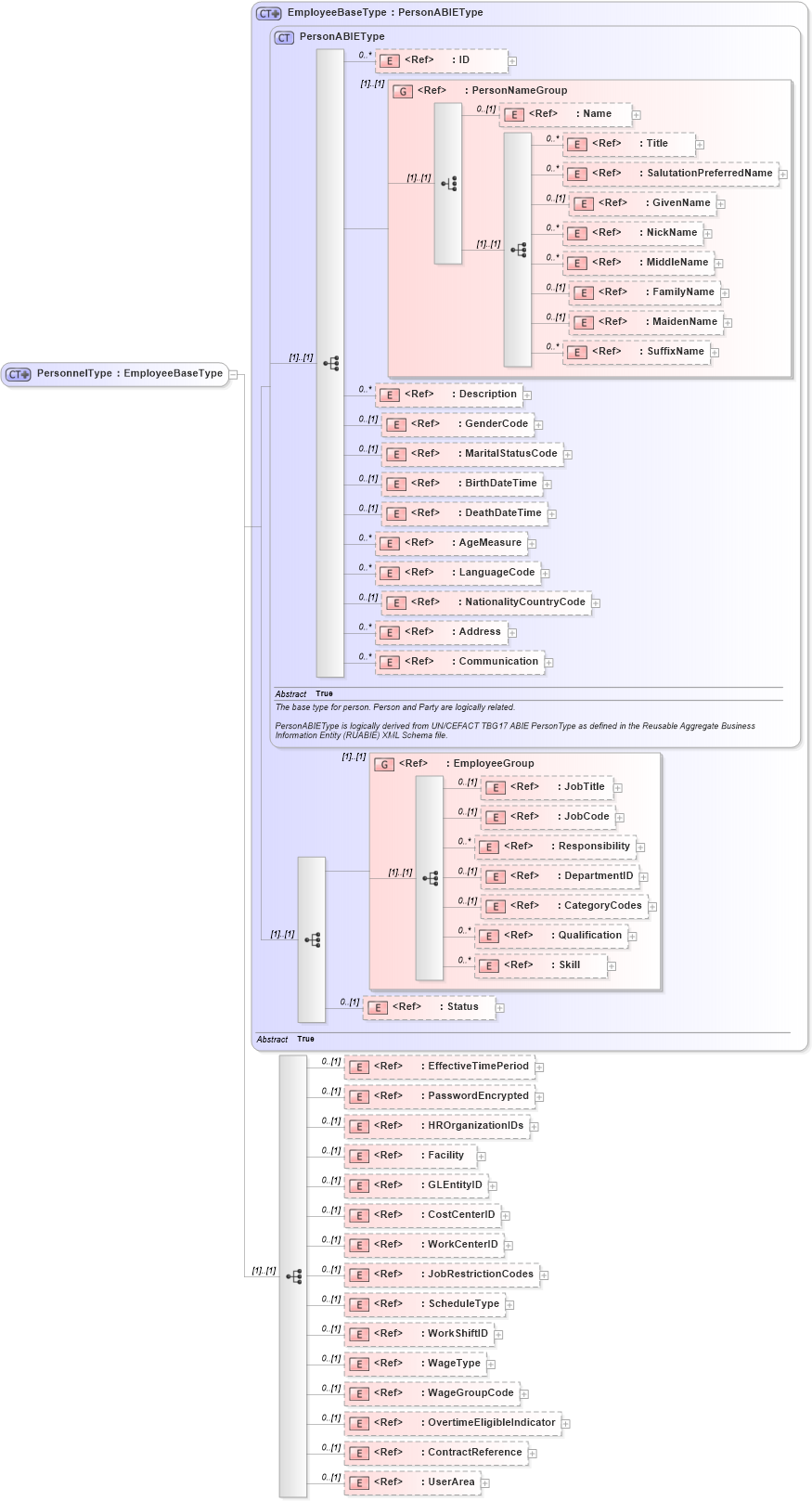
<xsd:complexType name="PersonnelType">
    <xsd:complexContent>
        <xsd:extension base="EmployeeBaseType">
            <xsd:sequence>
                <xsd:element ref="EffectiveTimePeriod" minOccurs="0">
                    <xsd:annotation>
                        <xsd:documentation source="http://www.openapplications.org/oagis/9">Indicates the time in which the person works for the company. Typically the Start date is date in which the persons employment is effective and the Finish date is the the date in which the employee is terminated.</xsd:documentation>
                    </xsd:annotation>
                </xsd:element>
                <xsd:element ref="PasswordEncrypted" minOccurs="0">
                    <xsd:annotation>
                        <xsd:documentation>This is the confidential code entered by an employee to obtain access to a secured resource. An example of the use could be the code entered when entering their time worked on the manufacturing shop floor</xsd:documentation>
                    </xsd:annotation>
                </xsd:element>
                <xsd:element ref="HROrganizationIDs" minOccurs="0" />
                <xsd:element ref="Facility" minOccurs="0" />
                <xsd:element ref="GLEntityID" minOccurs="0" />
                <xsd:element ref="CostCenterID" minOccurs="0">
                    <xsd:annotation>
                        <xsd:documentation>This is an accumulator of cost information that may be an organizational unit or area of responsibility.  It is an organization code that allows a grouping of expenses and costs.

SYNONYMS are Stocking Location, Work Group
</xsd:documentation>
                    </xsd:annotation>
                </xsd:element>
                <xsd:element ref="WorkCenterID" minOccurs="0">
                    <xsd:annotation>
                        <xsd:documentation source="http://www.openapplications.org/oagis/9">This identifies an area consisting of one or more resources where production takes place.  It is used to identify a specific Work Center on a Shop Floor or other manufacturing facility</xsd:documentation>
                    </xsd:annotation>
                </xsd:element>
                <xsd:element ref="JobRestrictionCodes" minOccurs="0">
                    <xsd:annotation>
                        <xsd:documentation>This indicates any limitations to complete a job assignment based on physical, mental, legal or any other conditions</xsd:documentation>
                    </xsd:annotation>
                </xsd:element>
                <xsd:element ref="ScheduleType" minOccurs="0">
                    <xsd:annotation>
                        <xsd:documentation>ScheduleType is a code or identifier that describes the specific schedule and can be used in a variety of contexts. When used in the context of employee, ScheduleType refers to the specific schedule for the employee or worker.

When used in the context of a Schedule, ScheduleType indicates whether the Schedule is a demand schedule from a customer or a supply schedule from a supplier. Valid values for this context are: “Demand”, “Supplier”</xsd:documentation>
                    </xsd:annotation>
                </xsd:element>
                <xsd:element ref="WorkShiftID" minOccurs="0">
                    <xsd:annotation>
                        <xsd:documentation>This is the Employee Shift Identifier. ShiftId describes the regular or standard authorized work time for the employee</xsd:documentation>
                    </xsd:annotation>
                </xsd:element>
                <xsd:element ref="WageType" minOccurs="0">
                    <xsd:annotation>
                        <xsd:documentation>This is a code or identifier that describes the specific type a wage an employee or worker is paid. Examples include: Exempt from Overtime, Non-Exempt from Overtime</xsd:documentation>
                    </xsd:annotation>
                </xsd:element>
                <xsd:element ref="WageGroupCode" minOccurs="0">
                    <xsd:annotation>
                        <xsd:documentation>This is used to classify an employee’s wage</xsd:documentation>
                    </xsd:annotation>
                </xsd:element>
                <xsd:element ref="OvertimeEligibleIndicator" minOccurs="0" />
                <xsd:element ref="ContractReference" minOccurs="0" />
                <xsd:element ref="UserArea" minOccurs="0" />
            </xsd:sequence>
        </xsd:extension>
    </xsd:complexContent>
</xsd:complexType>
|
 XSD Schema Diagram: