<xsd:complexType name="EntityStateRegistryTypeType">
    <xsd:annotation>
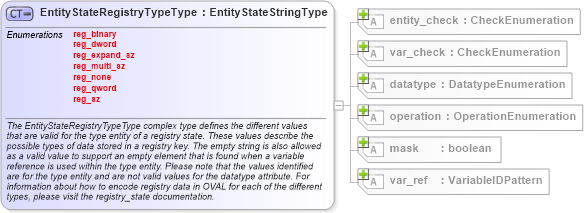
        <xsd:documentation>The EntityStateRegistryTypeType complex type defines the different values that are valid for the type entity of a registry state. These values describe the possible types of data stored in a registry key. The empty string is also allowed as a valid value to support an empty element that is found when a variable reference is used within the type entity. Please note that the values identified are for the type entity and are not valid values for the datatype attribute. For information about how to encode registry data in OVAL for each of the different types, please visit the registry_state documentation.</xsd:documentation>
    </xsd:annotation>
    <xsd:simpleContent>
        <xsd:restriction base="oval-def:EntityStateStringType">
            <xsd:enumeration value="reg_binary">
                <xsd:annotation>
                    <xsd:documentation>The reg_binary type is used by registry keys that specify binary data in any form.</xsd:documentation>
                </xsd:annotation>
            </xsd:enumeration>
            <xsd:enumeration value="reg_dword">
                <xsd:annotation>
                    <xsd:documentation>The reg_dword type is used by registry keys that specify a 32-bit number.</xsd:documentation>
                </xsd:annotation>
            </xsd:enumeration>
            <xsd:enumeration value="reg_expand_sz">
                <xsd:annotation>
                    <xsd:documentation>The reg_expand_sz type is used by registry keys to specify a null-terminated string that contains unexpanded references to environment variables (for example, "%PATH%").</xsd:documentation>
                </xsd:annotation>
            </xsd:enumeration>
            <xsd:enumeration value="reg_multi_sz">
                <xsd:annotation>
                    <xsd:documentation>The reg_multi_sz type is used by registry keys that specify an array of null-terminated strings, terminated by two null characters.</xsd:documentation>
                </xsd:annotation>
            </xsd:enumeration>
            <xsd:enumeration value="reg_none">
                <xsd:annotation>
                    <xsd:documentation>The reg_none type is used by registry keys that have no defined value type.</xsd:documentation>
                </xsd:annotation>
            </xsd:enumeration>
            <xsd:enumeration value="reg_qword">
                <xsd:annotation>
                    <xsd:documentation>The reg_qword type is used by registry keys that specify a 64-bit number.</xsd:documentation>
                </xsd:annotation>
            </xsd:enumeration>
            <xsd:enumeration value="reg_sz">
                <xsd:annotation>
                    <xsd:documentation>The reg_sz type is used by registry keys that specify a single null-terminated string.</xsd:documentation>
                </xsd:annotation>
            </xsd:enumeration>
            <xsd:enumeration value="" />
        </xsd:restriction>
    </xsd:simpleContent>
</xsd:complexType>
|
 XSD Schema Diagram:
 Facets: