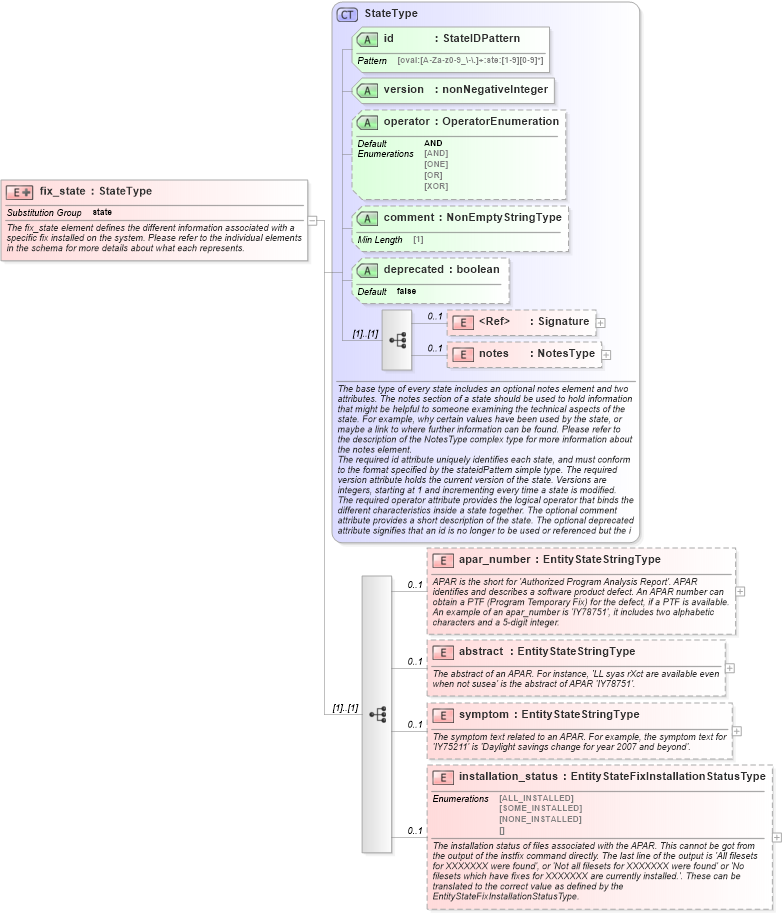
<xsd:element name="fix_state" substitutionGroup="oval-def:state">
    <xsd:annotation>
        <xsd:documentation>The fix_state element defines the different information associated with a specific fix installed on the system. Please refer to the individual elements in the schema for more details about what each represents.</xsd:documentation>
    </xsd:annotation>
    <xsd:complexType>
        <xsd:complexContent>
            <xsd:extension base="oval-def:StateType">
                <xsd:sequence>
                    <xsd:element name="apar_number" type="oval-def:EntityStateStringType" minOccurs="0" maxOccurs="1">
                        <xsd:annotation>
                            <xsd:documentation>APAR is the short for 'Authorized Program Analysis Report'. APAR identifies and describes a software product defect. An APAR number can obtain a PTF (Program Temporary Fix) for the defect, if a PTF is available. An example of an apar_number is 'IY78751', it includes two alphabetic characters and a 5-digit integer.</xsd:documentation>
                            <xsd:appinfo>
                                <sch:pattern id="fixsteapar_number" xmlns:sch="http://purl.oclc.org/dsdl/schematron">
                                    <sch:rule context="aix-def:fix_state/aix-def:apar_number">
                                        <sch:assert test="not(@datatype) or @datatype='string'">
                                            <sch:value-of select="../@id" /> - datatype attribute for the apar_number entity of a fix_state should be 'string'</sch:assert>
                                    </sch:rule>
                                </sch:pattern>
                            </xsd:appinfo>
                        </xsd:annotation>
                    </xsd:element>
                    <xsd:element name="abstract" type="oval-def:EntityStateStringType" minOccurs="0" maxOccurs="1">
                        <xsd:annotation>
                            <xsd:documentation>The abstract of an APAR. For instance, 'LL syas rXct are available even when not susea' is the abstract of APAR 'IY78751'.</xsd:documentation>
                            <xsd:appinfo>
                                <sch:pattern id="fixsteabstract" xmlns:sch="http://purl.oclc.org/dsdl/schematron">
                                    <sch:rule context="aix-def:fix_state/aix-def:abstract">
                                        <sch:assert test="not(@datatype) or @datatype='string'">
                                            <sch:value-of select="../@id" /> - datatype attribute for the abstract entity of a fix_state should be 'string'</sch:assert>
                                    </sch:rule>
                                </sch:pattern>
                            </xsd:appinfo>
                        </xsd:annotation>
                    </xsd:element>
                    <xsd:element name="symptom" type="oval-def:EntityStateStringType" minOccurs="0" maxOccurs="1">
                        <xsd:annotation>
                            <xsd:documentation>The symptom text related to an APAR. For example, the symptom text for 'IY75211' is 'Daylight savings change for year 2007 and beyond'.</xsd:documentation>
                            <xsd:appinfo>
                                <sch:pattern id="fixstesymptom" xmlns:sch="http://purl.oclc.org/dsdl/schematron">
                                    <sch:rule context="aix-def:fix_state/aix-def:symptom">
                                        <sch:assert test="not(@datatype) or @datatype='string'">
                                            <sch:value-of select="../@id" /> - datatype attribute for the symptom entity of a fix_state should be 'string'</sch:assert>
                                    </sch:rule>
                                </sch:pattern>
                            </xsd:appinfo>
                        </xsd:annotation>
                    </xsd:element>
                    <xsd:element name="installation_status" type="aix-def:EntityStateFixInstallationStatusType" minOccurs="0" maxOccurs="1">
                        <xsd:annotation>
                            <xsd:documentation>The installation status of files associated with the APAR. This cannot be got from the output of the instfix command directly. The last line of the output is 'All filesets for XXXXXXX were found', or 'Not all filesets for XXXXXXX were found' or 'No filesets which have fixes for XXXXXXX are currently installed.'. These can be translated to the correct value as defined by the EntityStateFixInstallationStatusType.</xsd:documentation>
                            <xsd:appinfo>
                                <sch:pattern id="fixsteinstallation_status" xmlns:sch="http://purl.oclc.org/dsdl/schematron">
                                    <sch:rule context="aix-def:fix_state/aix-def:installation_status">
                                        <sch:assert test="not(@datatype) or @datatype='string'">
                                            <sch:value-of select="../@id" /> - datatype attribute for the installation_status entity of a fix_state should be 'string'</sch:assert>
                                    </sch:rule>
                                </sch:pattern>
                            </xsd:appinfo>
                        </xsd:annotation>
                    </xsd:element>
                </xsd:sequence>
            </xsd:extension>
        </xsd:complexContent>
    </xsd:complexType>
</xsd:element>
|
 XSD Schema Diagram: