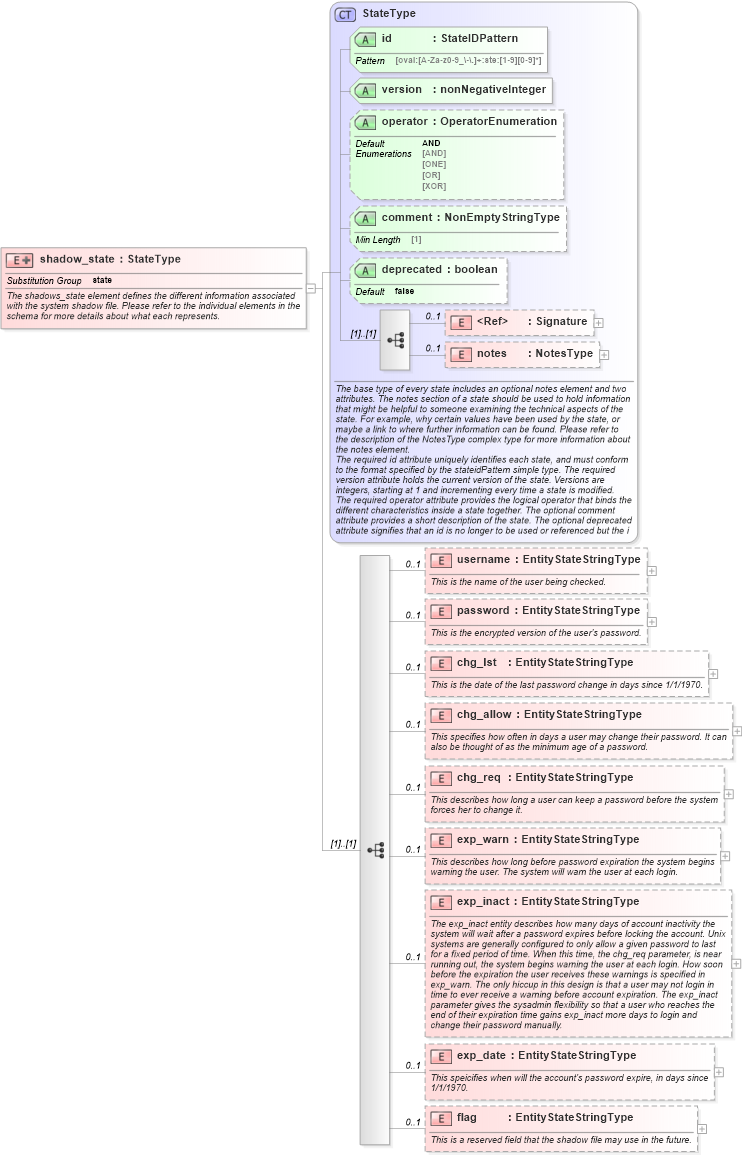
<xsd:element name="shadow_state" substitutionGroup="oval-def:state">
    <xsd:annotation>
        <xsd:documentation>The shadows_state element defines the different information associated with the system shadow file. Please refer to the individual elements in the schema for more details about what each represents.</xsd:documentation>
    </xsd:annotation>
    <xsd:complexType>
        <xsd:complexContent>
            <xsd:extension base="oval-def:StateType">
                <xsd:sequence>
                    <xsd:element name="username" type="oval-def:EntityStateStringType" minOccurs="0" maxOccurs="1">
                        <xsd:annotation>
                            <xsd:documentation>This is the name of the user being checked.</xsd:documentation>
                            <xsd:appinfo>
                                <sch:pattern id="shadowsteusername" xmlns:sch="http://purl.oclc.org/dsdl/schematron">
                                    <sch:rule context="unix-def:shadow_state/unix-def:username">
                                        <sch:assert test="not(@datatype) or @datatype='string'">
                                            <sch:value-of select="../@id" /> - datatype attribute for the username entity of a shadow_state should be 'string'</sch:assert>
                                    </sch:rule>
                                </sch:pattern>
                            </xsd:appinfo>
                        </xsd:annotation>
                    </xsd:element>
                    <xsd:element name="password" type="oval-def:EntityStateStringType" minOccurs="0" maxOccurs="1">
                        <xsd:annotation>
                            <xsd:documentation>This is the encrypted version of the user's password.</xsd:documentation>
                            <xsd:appinfo>
                                <sch:pattern id="shadowstepassword" xmlns:sch="http://purl.oclc.org/dsdl/schematron">
                                    <sch:rule context="unix-def:shadow_state/unix-def:password">
                                        <sch:assert test="not(@datatype) or @datatype='string'">
                                            <sch:value-of select="../@id" /> - datatype attribute for the password entity of a shadow_state should be 'string'</sch:assert>
                                    </sch:rule>
                                </sch:pattern>
                            </xsd:appinfo>
                        </xsd:annotation>
                    </xsd:element>
                    <xsd:element name="chg_lst" type="oval-def:EntityStateStringType" minOccurs="0" maxOccurs="1">
                        <xsd:annotation>
                            <xsd:documentation>This is the date of the last password change in days since 1/1/1970.</xsd:documentation>
                            <xsd:appinfo>
                                <sch:pattern id="shadowstechg_lst" xmlns:sch="http://purl.oclc.org/dsdl/schematron">
                                    <sch:rule context="unix-def:shadow_state/unix-def:chg_lst">
                                        <sch:assert test="not(@datatype) or @datatype='string'">
                                            <sch:value-of select="../@id" /> - datatype attribute for the chg_lst entity of a shadow_state should be 'string'</sch:assert>
                                    </sch:rule>
                                </sch:pattern>
                            </xsd:appinfo>
                        </xsd:annotation>
                    </xsd:element>
                    <xsd:element name="chg_allow" type="oval-def:EntityStateStringType" minOccurs="0" maxOccurs="1">
                        <xsd:annotation>
                            <xsd:documentation>This specifies how often in days a user may change their password. It can also be thought of as the minimum age of a password.</xsd:documentation>
                            <xsd:appinfo>
                                <sch:pattern id="shadowstechg_allow" xmlns:sch="http://purl.oclc.org/dsdl/schematron">
                                    <sch:rule context="unix-def:shadow_state/unix-def:chg_allow">
                                        <sch:assert test="not(@datatype) or @datatype='string'">
                                            <sch:value-of select="../@id" /> - datatype attribute for the chg_allow entity of a shadow_state should be 'string'</sch:assert>
                                    </sch:rule>
                                </sch:pattern>
                            </xsd:appinfo>
                        </xsd:annotation>
                    </xsd:element>
                    <xsd:element name="chg_req" type="oval-def:EntityStateStringType" minOccurs="0" maxOccurs="1">
                        <xsd:annotation>
                            <xsd:documentation>This describes how long a user can keep a password before the system forces her to change it.</xsd:documentation>
                            <xsd:appinfo>
                                <sch:pattern id="shadowstechg_req" xmlns:sch="http://purl.oclc.org/dsdl/schematron">
                                    <sch:rule context="unix-def:shadow_state/unix-def:chg_req">
                                        <sch:assert test="not(@datatype) or @datatype='string'">
                                            <sch:value-of select="../@id" /> - datatype attribute for the chg_req entity of a shadow_state should be 'string'</sch:assert>
                                    </sch:rule>
                                </sch:pattern>
                            </xsd:appinfo>
                        </xsd:annotation>
                    </xsd:element>
                    <xsd:element name="exp_warn" type="oval-def:EntityStateStringType" minOccurs="0" maxOccurs="1">
                        <xsd:annotation>
                            <xsd:documentation>This describes how long before password expiration the system begins warning the user. The system will warn the user at each login.</xsd:documentation>
                            <xsd:appinfo>
                                <sch:pattern id="shadowsteexp_warn" xmlns:sch="http://purl.oclc.org/dsdl/schematron">
                                    <sch:rule context="unix-def:shadow_state/unix-def:exp_warn">
                                        <sch:assert test="not(@datatype) or @datatype='string'">
                                            <sch:value-of select="../@id" /> - datatype attribute for the exp_warn entity of a shadow_state should be 'string'</sch:assert>
                                    </sch:rule>
                                </sch:pattern>
                            </xsd:appinfo>
                        </xsd:annotation>
                    </xsd:element>
                    <xsd:element name="exp_inact" type="oval-def:EntityStateStringType" minOccurs="0" maxOccurs="1">
                        <xsd:annotation>
                            <xsd:documentation>The exp_inact entity describes how many days of account inactivity the system will wait after a password expires before locking the account. Unix systems are generally configured to only allow a given password to last for a fixed period of time. When this time, the chg_req parameter, is near running out, the system begins warning the user at each login. How soon before the expiration the user receives these warnings is specified in exp_warn. The only hiccup in this design is that a user may not login in time to ever receive a warning before account expiration. The exp_inact parameter gives the sysadmin flexibility so that a user who reaches the end of their expiration time gains exp_inact more days to login and change their password manually.</xsd:documentation>
                            <xsd:appinfo>
                                <sch:pattern id="shadowsteexp_inact" xmlns:sch="http://purl.oclc.org/dsdl/schematron">
                                    <sch:rule context="unix-def:shadow_state/unix-def:exp_inact">
                                        <sch:assert test="not(@datatype) or @datatype='string'">
                                            <sch:value-of select="../@id" /> - datatype attribute for the exp_inact entity of a shadow_state should be 'string'</sch:assert>
                                    </sch:rule>
                                </sch:pattern>
                            </xsd:appinfo>
                        </xsd:annotation>
                    </xsd:element>
                    <xsd:element name="exp_date" type="oval-def:EntityStateStringType" minOccurs="0" maxOccurs="1">
                        <xsd:annotation>
                            <xsd:documentation>This speicifies when will the account's password expire, in days since 1/1/1970.</xsd:documentation>
                            <xsd:appinfo>
                                <sch:pattern id="shadowsteexp_date" xmlns:sch="http://purl.oclc.org/dsdl/schematron">
                                    <sch:rule context="unix-def:shadow_state/unix-def:exp_date">
                                        <sch:assert test="not(@datatype) or @datatype='string'">
                                            <sch:value-of select="../@id" /> - datatype attribute for the exp_date entity of a shadow_state should be 'string'</sch:assert>
                                    </sch:rule>
                                </sch:pattern>
                            </xsd:appinfo>
                        </xsd:annotation>
                    </xsd:element>
                    <xsd:element name="flag" type="oval-def:EntityStateStringType" minOccurs="0" maxOccurs="1">
                        <xsd:annotation>
                            <xsd:documentation>This is a reserved field that the shadow file may use in the future.</xsd:documentation>
                            <xsd:appinfo>
                                <sch:pattern id="shadowsteflag" xmlns:sch="http://purl.oclc.org/dsdl/schematron">
                                    <sch:rule context="unix-def:shadow_state/unix-def:flag">
                                        <sch:assert test="not(@datatype) or @datatype='string'">
                                            <sch:value-of select="../@id" /> - datatype attribute for the flag entity of a shadow_state should be 'string'</sch:assert>
                                    </sch:rule>
                                </sch:pattern>
                            </xsd:appinfo>
                        </xsd:annotation>
                    </xsd:element>
                </xsd:sequence>
            </xsd:extension>
        </xsd:complexContent>
    </xsd:complexType>
</xsd:element>
|
 XSD Schema Diagram: