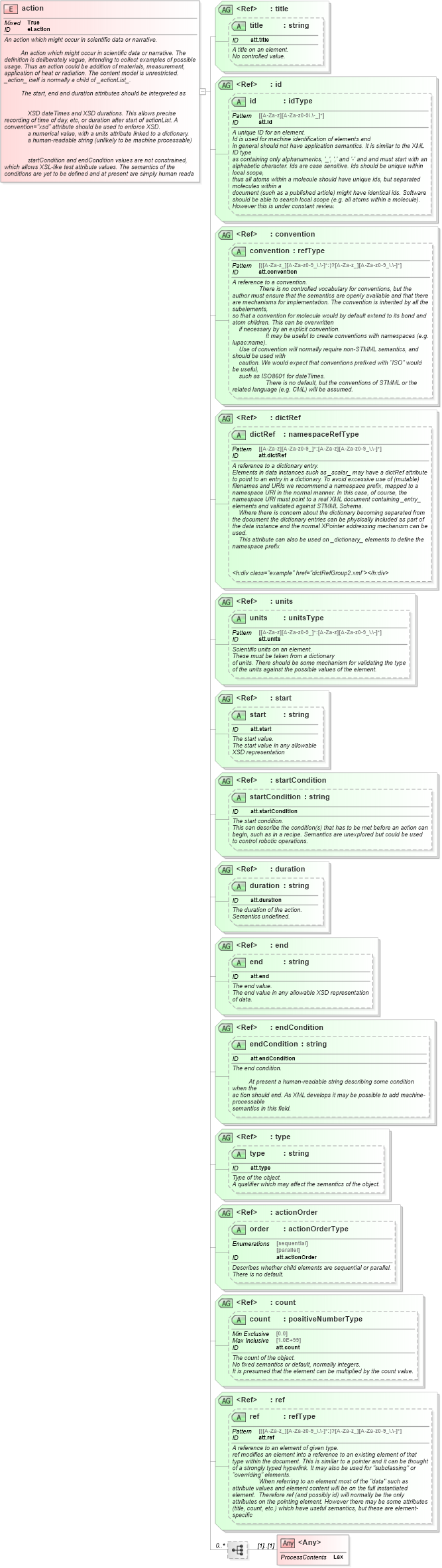
<xsd:element name="action" id="el.action">
    <xsd:annotation>
        <xsd:documentation>
            <h:div class="summary" xmlns:h="http://www.w3.org/1999/xhtml">An action which might occur in scientific data or narrative.</h:div>
            <h:div class="description" xmlns:h="http://www.w3.org/1999/xhtml">
                An action which might occur in scientific data or narrative. The definition is deliberately vague, intending to collect examples of possible usage. Thus an action could be addition of materials, measurement, application of heat or radiation. The content model is unrestricted. _action_ iself is normally a child of _actionList_.

                <h:p>The start, end and duration attributes should be interpreted as
      </h:p>
                <h:ul>
                    <h:li>XSD dateTimes and XSD durations. This allows precise recording of time of day, etc, or duration after start of actionList. A <h:tt>convention="xsd"</h:tt> attribute should be used to enforce XSD.</h:li>
                    <h:li>a numerical value, with a units attribute linked to a dictionary.</h:li>
                    <h:li>a human-readable string (unlikely to be machine processable)</h:li>
                </h:ul>
                <h:p>
                    <h:tt>startCondition</h:tt> and <h:tt>endCondition</h:tt> values are not constrained, which allows XSL-like <h:tt>test</h:tt> attribute values. The semantics of the conditions are yet to be defined and at present are simply human readable.
      </h:p>
                <h:p>The order of the <h:tt>action</h:tt> elements in the document may, but will not always, define
      the order that they actually occur in.</h:p>
                <h:p>A delay can be shown by an <h:tt>action</h:tt> with no content. Repeated actions or
      actionLists are indicated through the count attribute.</h:p>
            </h:div>
            <h:div class="example" href="action1.xml" xmlns:h="http://www.w3.org/1999/xhtml" />
            <!--
            <h:div class="example" href="action2.xml"></h:div>
-->
        </xsd:documentation>
    </xsd:annotation>
    <xsd:complexType mixed="true">
        <xsd:sequence minOccurs="0" maxOccurs="unbounded">
            <xsd:any processContents="lax" />
        </xsd:sequence>
        <xsd:attributeGroup ref="title" />
        <xsd:attributeGroup ref="id" />
        <xsd:attributeGroup ref="convention" />
        <xsd:attributeGroup ref="dictRef" />
        <xsd:attributeGroup ref="units" />
        <xsd:attributeGroup ref="start" />
        <xsd:attributeGroup ref="startCondition" />
        <xsd:attributeGroup ref="duration" />
        <xsd:attributeGroup ref="end" />
        <xsd:attributeGroup ref="endCondition" />
        <xsd:attributeGroup ref="type" />
        <xsd:attributeGroup ref="actionOrder" />
        <xsd:attributeGroup ref="count">
            <xsd:annotation>
                <xsd:documentation>
                    <h:div class="specific" xmlns:h="http://www.w3.org/1999/xhtml">Number of times the action should be repeated.</h:div>
                </xsd:documentation>
            </xsd:annotation>
        </xsd:attributeGroup>
        <xsd:attributeGroup ref="ref" />
    </xsd:complexType>
</xsd:element>
|
 XSD Schema Diagram: