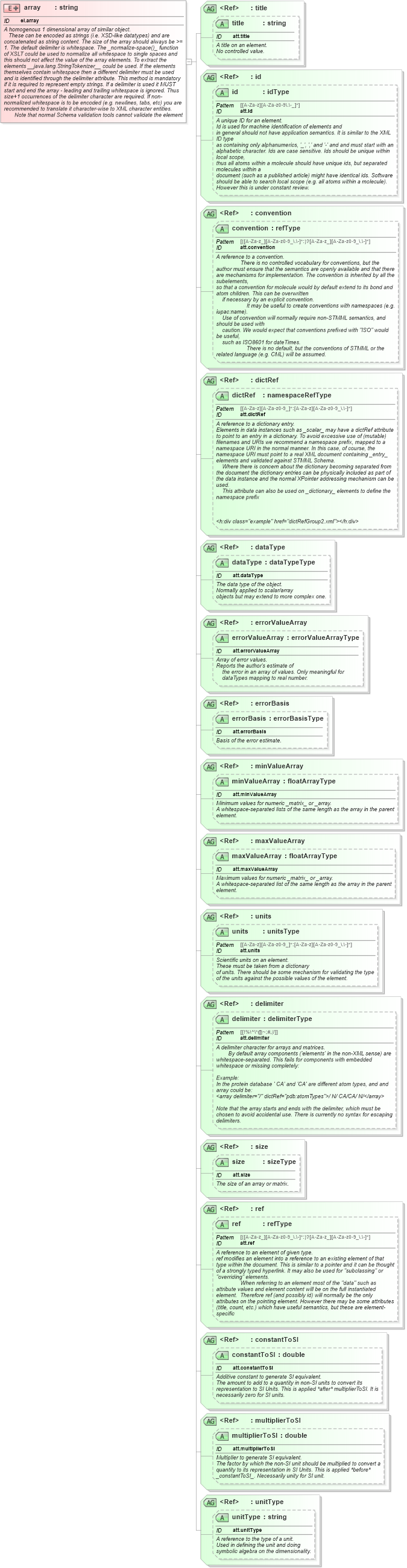
<xsd:element name="array" id="el.array">
<xsd:annotation>
<xsd:documentation>
<h:div class="summary" xmlns:h="http://www.w3.org/1999/xhtml">A homogenous 1 dimensional array of similar object.</h:div>
<h:div class="description" xmlns:h="http://www.w3.org/1999/xhtml">These can be encoded as strings (i.e. XSD-like datatypes) and are concatenated as string content. The size of the array should always be >= 1. The default delimiter is whitespace. The _normalize-space()_ function of XSLT could be used to normalize all whitespace to single spaces and this should not affect the value of the array elements. To extract the elements __java.lang.StringTokenizer__ could be used. If the elements themselves contain whitespace then a different delimiter must be used and is identified through the <h:tt>delimiter</h:tt> attribute. This method is mandatory if it is required to represent empty strings. If a delimiter is used it MUST start and end the array - leading and trailing whitespace is ignored. Thus <h:tt>size+1</h:tt> occurrences of the delimiter character are required. If non-normalized whitespace is to be encoded (e.g. newlines, tabs, etc) you are recommended to translate it character-wise to XML character entities.
<h:p>Note that normal Schema validation tools cannot validate the elements
of <h:b>array</h:b> (they are defined as <h:tt>string</h:tt>) However if the string is
split, a temporary schema
can be constructed from the type and used for validation. Also the type
can be contained in a dictionary and software could decide to retrieve this
and use it for validation.</h:p>
<h:p>When the elements of the <h:tt>array</h:tt> are not simple scalars
(e.g. <h:a href="el.scalar">scalar</h:a>s with a value and an error, the
<h:tt>scalar</h:tt>s should be used as the elements. Although this is
verbose, it is simple to understand. If there is a demand for
more compact representations, it will be possible to define the
syntax in a later version.</h:p>
</h:div>
<h:div class="example" href="array1.xml" xmlns:h="http://www.w3.org/1999/xhtml">
<h:p>the <h:tt>size</h:tt> attribute is not mandatory but provides a useful validity
check): </h:p>
</h:div>
<!--
<h:div class="example" href="array2.xml">
<h:p>Note that the second array-element is the empty string ''.</h:p></h:div>
<h:div class="example" href="array3.xml"></h:div>
-->
</xsd:documentation>
</xsd:annotation>
<xsd:complexType>
<xsd:simpleContent>
<xsd:extension base="xsd:string">
<xsd:attributeGroup ref="title" />
<xsd:attributeGroup ref="id" />
<xsd:attributeGroup ref="convention" />
<xsd:attributeGroup ref="dictRef" />
<xsd:attributeGroup ref="dataType" />
<xsd:attributeGroup ref="errorValueArray" />
<xsd:attributeGroup ref="errorBasis" />
<xsd:attributeGroup ref="minValueArray" />
<xsd:attributeGroup ref="maxValueArray" />
<xsd:attributeGroup ref="units" />
<xsd:attributeGroup ref="delimiter" />
<xsd:attributeGroup ref="size" />
<xsd:attributeGroup ref="ref" />
<xsd:attributeGroup ref="constantToSI">
<xsd:annotation>
<xsd:documentation>
<h:div class="specific" xmlns:h="http://www.w3.org/1999/xhtml">Alternative to units</h:div>
<h:div class="description" xmlns:h="http://www.w3.org/1999/xhtml">Must be used in conjunction with unitType</h:div>
<h:div class="curation" xmlns:h="http://www.w3.org/1999/xhtml">2005-10-26: added</h:div>
</xsd:documentation>
</xsd:annotation>
</xsd:attributeGroup>
<xsd:attributeGroup ref="multiplierToSI">
<xsd:annotation>
<xsd:documentation>
<h:div class="specific" xmlns:h="http://www.w3.org/1999/xhtml">Alternative to units</h:div>
<h:div class="description" xmlns:h="http://www.w3.org/1999/xhtml">Must be used in conjunction with unitType</h:div>
<h:div class="curation" xmlns:h="http://www.w3.org/1999/xhtml">2005-10-26: added</h:div>
</xsd:documentation>
</xsd:annotation>
</xsd:attributeGroup>
<xsd:attributeGroup ref="unitType">
<xsd:annotation>
<xsd:documentation>
<h:div class="specific" xmlns:h="http://www.w3.org/1999/xhtml">Alternative to units</h:div>
<h:div class="description" xmlns:h="http://www.w3.org/1999/xhtml">Must be used in conjunction with multiplierToSI and/or constantToSI</h:div>
<h:div class="curation" xmlns:h="http://www.w3.org/1999/xhtml">2005-10-26: added</h:div>
</xsd:documentation>
</xsd:annotation>
</xsd:attributeGroup>
</xsd:extension>
</xsd:simpleContent>
</xsd:complexType>
</xsd:element>
|
 XSD Schema Diagram: