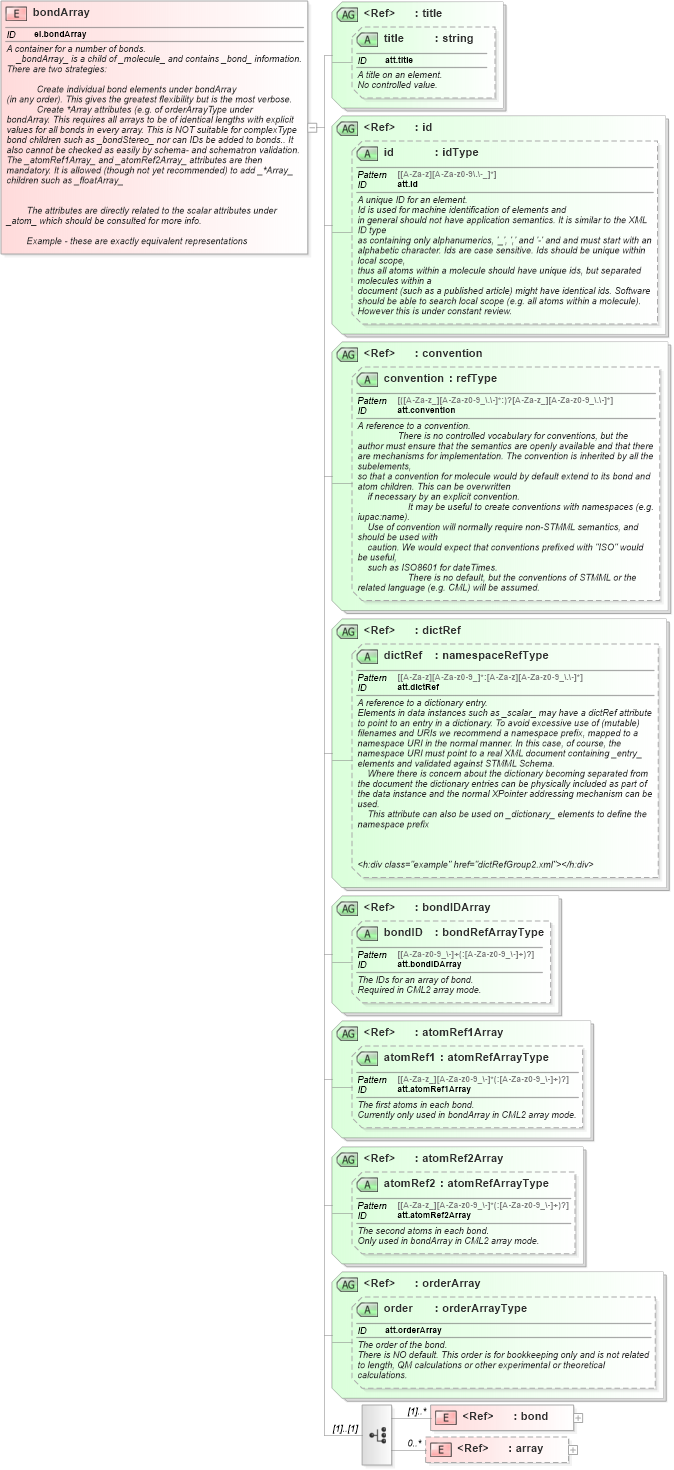
<xsd:element name="bondArray" id="el.bondArray">
    <xsd:annotation>
        <xsd:documentation>
            <h:div class="summary" xmlns:h="http://www.w3.org/1999/xhtml">A container for a number of bonds.</h:div>
            <h:div class="description" xmlns:h="http://www.w3.org/1999/xhtml">_bondArray_ is a child of _molecule_ and contains _bond_ information. There are two strategies:
                <h:ul><h:li>Create individual <h:tt>bond</h:tt> elements under <h:tt>bondArray</h:tt>
        (in any order). This gives the greatest flexibility but is the most verbose.</h:li>
                    <h:li>Create <h:tt>*Array</h:tt> attributes (e.g. of <h:tt>orderArrayType</h:tt> under
        <h:tt>bondArray</h:tt>. This requires all arrays to be of identical lengths with explicit values for all bonds in every array. This is NOT suitable for complexType bond children such as _bondStereo_ nor can IDs be added to bonds.. It also cannot be checked as easily by schema- and schematron validation. The _atomRef1Array_ and _atomRef2Array_ attributes are then mandatory. It is allowed (though not yet recommended) to add _*Array_ children such as _floatArray_
                    </h:li>
                </h:ul>
                <h:p>The attributes are directly related to the scalar attributes under _atom_ which should be consulted for more info.</h:p>
            </h:div>
            <h:div class="example" href="bondArray1.xml" xmlns:h="http://www.w3.org/1999/xhtml">
                <h:p>Example - these are exactly equivalent representations</h:p>
            </h:div>
        </xsd:documentation>
    </xsd:annotation>
    <xsd:complexType>
        <xsd:choice>
            <xsd:element ref="bond" maxOccurs="unbounded" />
            <xsd:element ref="array" minOccurs="0" maxOccurs="unbounded" />
        </xsd:choice>
        <xsd:attributeGroup ref="title" />
        <xsd:attributeGroup ref="id" />
        <xsd:attributeGroup ref="convention" />
        <xsd:attributeGroup ref="dictRef" />
        <xsd:attributeGroup ref="bondIDArray" />
        <xsd:attributeGroup ref="atomRef1Array" />
        <xsd:attributeGroup ref="atomRef2Array" />
        <xsd:attributeGroup ref="orderArray" />
    </xsd:complexType>
</xsd:element>
|
 XSD Schema Diagram: