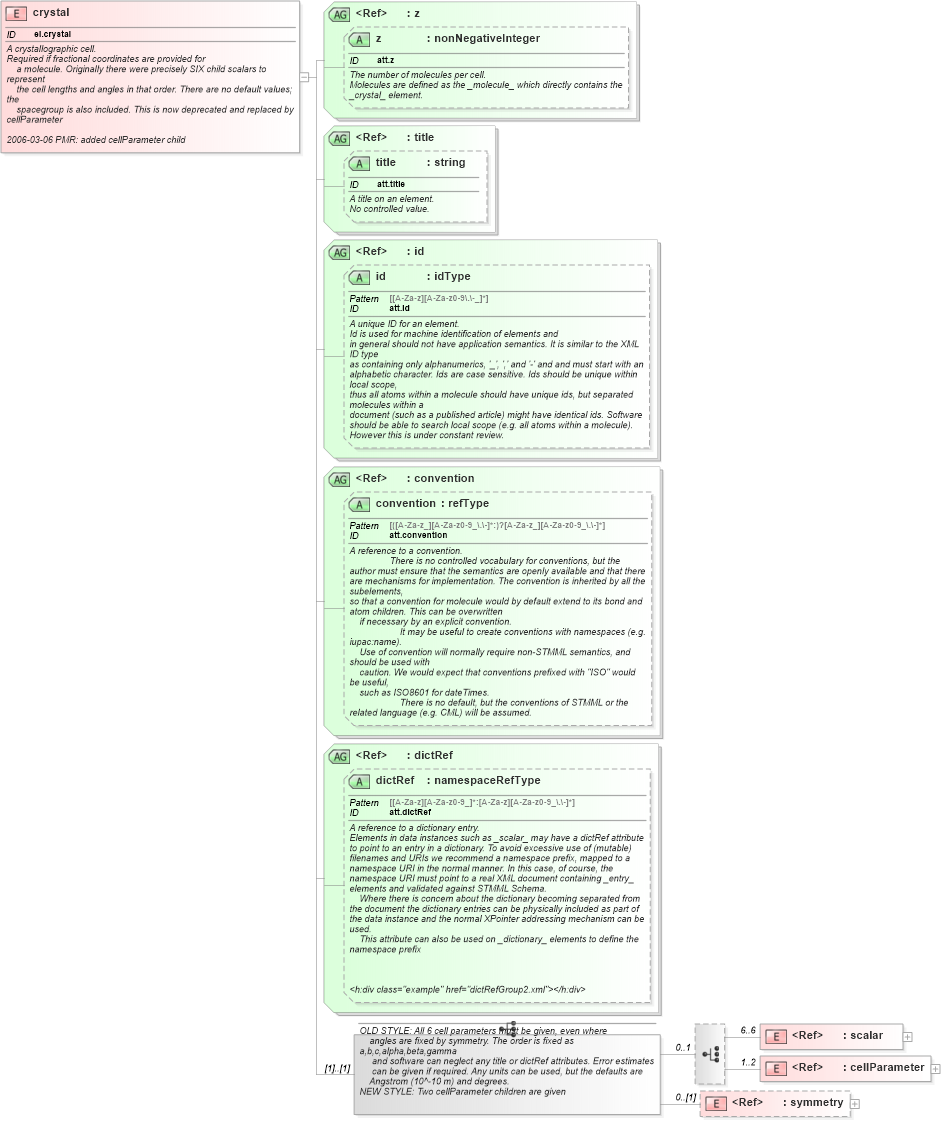
<xsd:element name="crystal" id="el.crystal">
    <xsd:annotation>
        <xsd:documentation>
            <h:div class="summary" xmlns:h="http://www.w3.org/1999/xhtml">A crystallographic cell.</h:div>
            <h:div class="description" xmlns:h="http://www.w3.org/1999/xhtml">Required if fractional coordinates are provided for
				a molecule. Originally there were precisely SIX child <h:tt>scalar</h:tt>s to represent
				the cell lengths and angles in that order. There are no default values; the
				spacegroup is also included. This is now deprecated and replaced by cellParameter
			</h:div>
            <h:div class="curation" xmlns:h="http://www.w3.org/1999/xhtml">2006-03-06 PMR: added cellParameter child</h:div>
            <h:div class="example" href="crystal1.xml" xmlns:h="http://www.w3.org/1999/xhtml" />
        </xsd:documentation>
    </xsd:annotation>
    <xsd:complexType>
        <xsd:sequence>
            <xsd:annotation>
                <xsd:documentation>
                    <h:div class="description" xmlns:h="http://www.w3.org/1999/xhtml">OLD STYLE: All 6 cell parameters must be given, even where
						angles are fixed by symmetry. The order is fixed as a,b,c,alpha,beta,gamma
						 and software can neglect any title or dictRef attributes. Error estimates
						 can be given if required. Any units can be used, but the defaults are
						Angstrom (10^-10 m) and degrees.</h:div>
                    <h:div class="description" xmlns:h="http://www.w3.org/1999/xhtml">NEW STYLE: Two cellParameter children are given</h:div>
                </xsd:documentation>
            </xsd:annotation>
            <xsd:choice minOccurs="0" maxOccurs="1">
                <xsd:element ref="scalar" minOccurs="6" maxOccurs="6" />
                <xsd:element ref="cellParameter" minOccurs="1" maxOccurs="2" />
            </xsd:choice>
            <xsd:element ref="symmetry" minOccurs="0" />
        </xsd:sequence>
        <xsd:attributeGroup ref="z" />
        <xsd:attributeGroup ref="title" />
        <xsd:attributeGroup ref="id" />
        <xsd:attributeGroup ref="convention" />
        <xsd:attributeGroup ref="dictRef" />
    </xsd:complexType>
</xsd:element>
|
 XSD Schema Diagram: