Definition Type: Element
Name: symmetry
Namespace: http://www.xml-cml.org/schema
Containing Schema: schema.xsd
Abstract
Documentation:
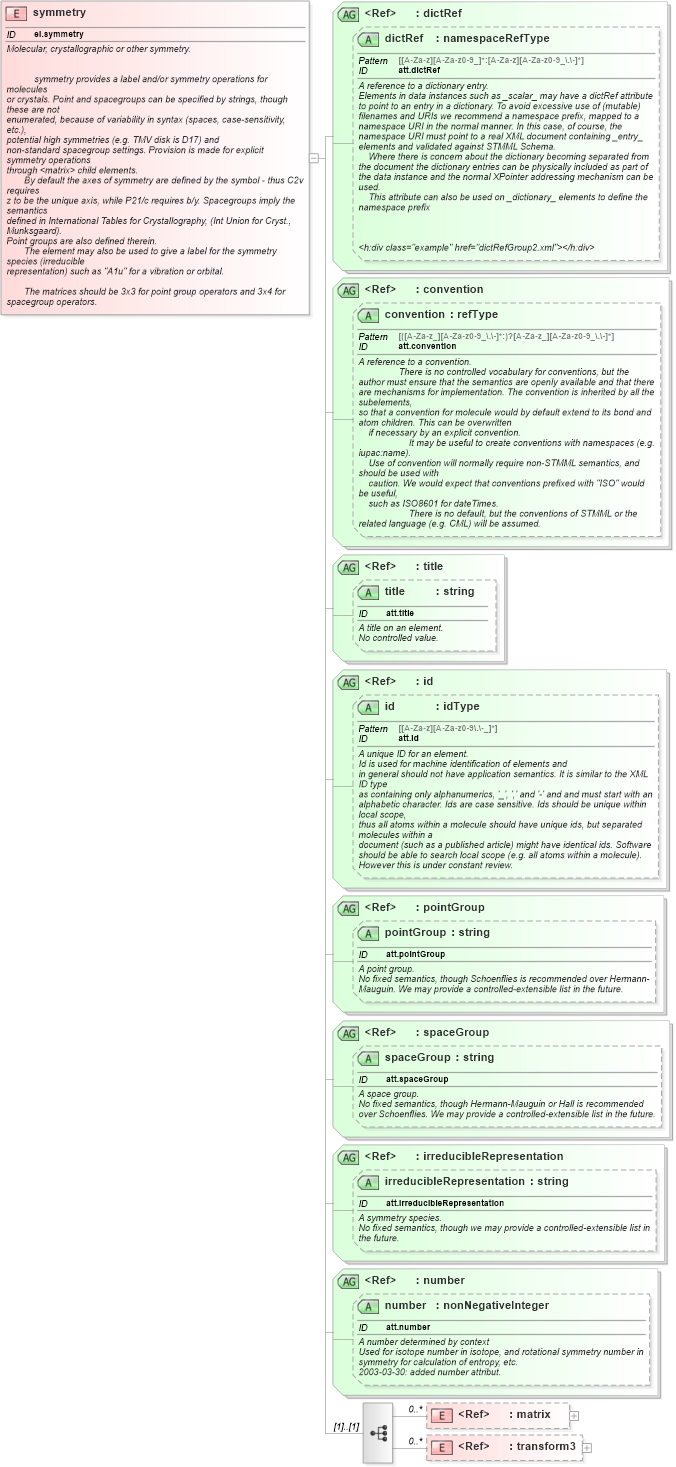
Molecular, crystallographic or other symmetry. symmetry provides a label and/or symmetry operations for molecules or crystals. Point and spacegroups can be specified by strings, though these are not enumerated, because of variability in syntax (spaces, case-sensitivity, etc.), potential high symmetries (e.g. TMV disk is D17) and non-standard spacegroup settings. Provision is made for explicit symmetry operations through <matrix> child elements. By default the axes of symmetry are defined by the symbol - thus C2v requires z to be the unique axis, while P21/c requires b/y. Spacegroups imply the semantics defined in International Tables for Crystallography, (Int Union for Cryst., Munksgaard). Point groups are also defined therein. The element may also be used to give a label for the symmetry species (irreducible representation) such as "A1u" for a vibration or orbital. The matrices should be 3x3 for point group operators and 3x4 for spacegroup operators. The use of crystallographic notation ("x,1/2+y,-z") is not supported - this would be <matrix>1 0 0 0.0 0 1 0 0.5 0 0 1 0.0<matrix>. The default convention for point group symmetry is Schoenflies and for spacegroups is "H-M". Other conventions (e.g. "Hall") must be specfied through the convention attribute. This element implies that the Cartesians or fractional coordinates in a molecule are oriented appropriately. In some cases it may be useful to specify the symmetry of an arbitarily oriented molecule and the <molecule> element has the attribute symmetryOriented for this purpose. It may be better to use transform3 to hold the symmetry as they have fixed shape and have better defined mathematical operators. 2005-11-03 PMR. Added transform3 as children.
Collapse XSD Schema Diagram:
Drilldown into transform3 in schema schema_xsd Drilldown into matrix in schema schema_xsd Drilldown into number in schema schema_xsd Drilldown into number in schema schema_xsd Drilldown into irreducibleRepresentation in schema schema_xsd Drilldown into irreducibleRepresentation in schema schema_xsd Drilldown into spaceGroup in schema schema_xsd Drilldown into spaceGroup in schema schema_xsd Drilldown into pointGroup in schema schema_xsd Drilldown into pointGroup in schema schema_xsd Drilldown into id in schema schema_xsd Drilldown into id in schema schema_xsd Drilldown into title in schema schema_xsd Drilldown into title in schema schema_xsd Drilldown into convention in schema schema_xsd Drilldown into convention in schema schema_xsd Drilldown into dictRef in schema schema_xsd Drilldown into dictRef in schema schema_xsdXSD Diagram of symmetry in schema schema_xsd (Chemical Markup Language (CML))
Collapse XSD Schema Code:
<xsd:element name="symmetry" id="el.symmetry">
    <xsd:annotation>
        <xsd:documentation>
            <h:div class="summary" xmlns:h="http://www.w3.org/1999/xhtml">Molecular, crystallographic or other symmetry.</h:div>
            <h:div class="description" xmlns:h="http://www.w3.org/1999/xhtml">
                <h:p>
                    <h:tt>symmetry</h:tt> provides a label and/or symmetry operations for molecules
         or crystals. Point and spacegroups can be specified by strings, though these are not 
         enumerated, because of variability in syntax (spaces, case-sensitivity, etc.),
         potential high symmetries (e.g. TMV disk is D17) and
         non-standard spacegroup settings. Provision is made for explicit symmetry operations
         through &lt;matrix&gt; child elements.</h:p>
                <h:p>By default the axes of symmetry are defined by the symbol - thus C2v requires
         z to be the unique axis, while P21/c requires b/y. Spacegroups imply the semantics
         defined in International Tables for Crystallography, (Int Union for Cryst., Munksgaard).
         Point groups are also defined therein. </h:p>
                <h:p>The element may also be used to give a label for the symmetry species (irreducible
         representation) such as "A1u" for a vibration or orbital.
         </h:p>
                <h:p>The matrices should be 3x3 for point group operators and 3x4 for spacegroup operators.
         The use of crystallographic notation ("x,1/2+y,-z") is not supported - this would
         be &lt;matrix&gt;1 0 0 0.0   0 1 0 0.5  0 0 1 0.0&lt;matrix&gt;.</h:p>
                <h:p>The default convention for point group symmetry is <h:tt>Schoenflies</h:tt> and for
         spacegroups is "H-M". Other conventions (e.g. "Hall") must be specfied through
         the <h:tt>convention</h:tt> attribute.</h:p>
                <h:p>This element implies that the Cartesians or fractional coordinates in a molecule
         are oriented appropriately. In some cases it may be useful to specify the symmetry of
         an arbitarily oriented molecule and the &lt;molecule&gt; element has the attribute
         <h:tt>symmetryOriented</h:tt> for this purpose.</h:p>
                <h:p>It may be better to use transform3 to hold the symmetry as they have fixed shape and
         have better defined mathematical operators.</h:p>
            </h:div>
            <h:div class="example" href="symmetry1.xml" xmlns:h="http://www.w3.org/1999/xhtml" />
            <h:div class="curation" xmlns:h="http://www.w3.org/1999/xhtml">2005-11-03 PMR. Added transform3 as children. </h:div>
        </xsd:documentation>
    </xsd:annotation>
    <xsd:complexType>
        <xsd:sequence>
            <xsd:element ref="matrix" minOccurs="0" maxOccurs="unbounded" />
            <xsd:element ref="transform3" minOccurs="0" maxOccurs="unbounded" />
        </xsd:sequence>
        <xsd:attributeGroup ref="dictRef" />
        <xsd:attributeGroup ref="convention" />
        <xsd:attributeGroup ref="title" />
        <xsd:attributeGroup ref="id" />
        <xsd:attributeGroup ref="pointGroup" />
        <xsd:attributeGroup ref="spaceGroup" />
        <xsd:attributeGroup ref="irreducibleRepresentation" />
        <xsd:attributeGroup ref="number">
            <xsd:annotation>
                <xsd:documentation>
                    <h:div class="specific" xmlns:h="http://www.w3.org/1999/xhtml">The rotational symmetry number. Used for calculation of entropy, etc.</h:div>
                </xsd:documentation>
            </xsd:annotation>
        </xsd:attributeGroup>
    </xsd:complexType>
</xsd:element>
Collapse Child Elements:
Name Type Min Occurs Max Occurs
matrix nsA:matrix 0 unbounded
transform3 nsA:transform3 0 unbounded
Collapse Child Attributes:
Name Type Default Value Use
dictRef nsA:dictRef (Optional)
convention nsA:convention (Optional)
title nsA:title (Optional)
id nsA:id (Optional)
pointGroup nsA:pointGroup (Optional)
spaceGroup nsA:spaceGroup (Optional)
irreducibleRepresentation nsA:irreducibleRepresentation (Optional)
number nsA:number (Optional)