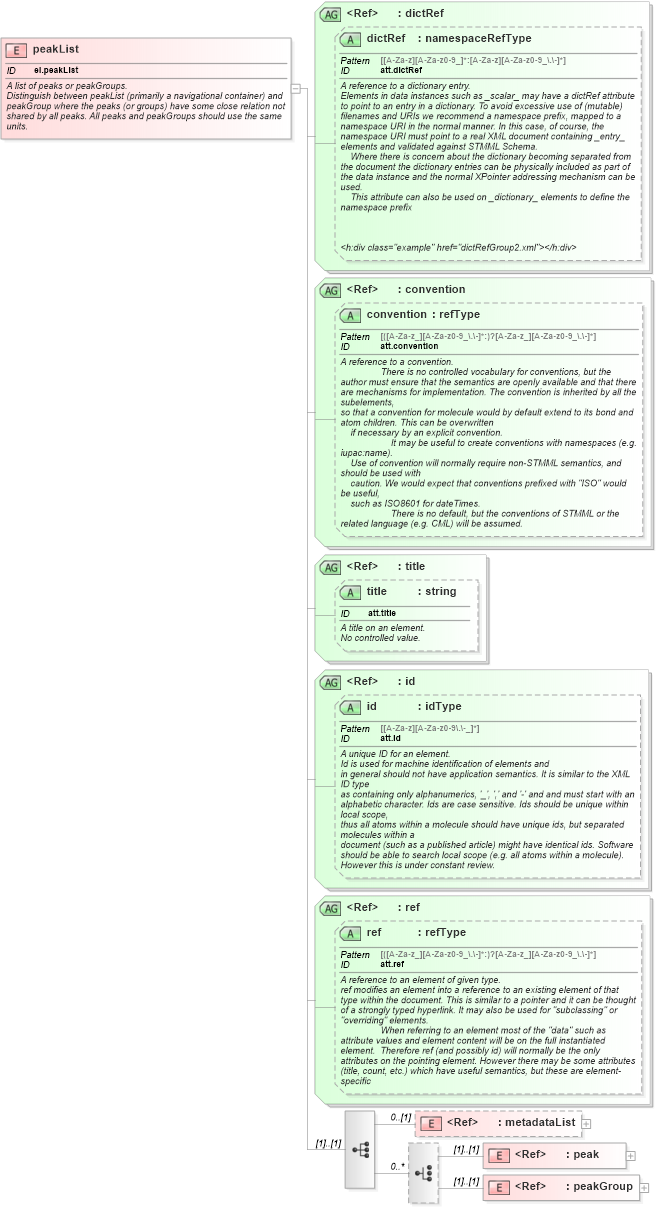
<xsd:element name="peakList" id="el.peakList">
    <xsd:annotation>
        <xsd:documentation>
            <h:div class="summary" xmlns:h="http://www.w3.org/1999/xhtml">A list of peaks or peakGroups.</h:div>
            <h:div class="description" xmlns:h="http://www.w3.org/1999/xhtml">Distinguish between <h:tt>peakList</h:tt> (primarily a navigational container) and <h:tt>peakGroup</h:tt> where the peaks (or groups) have some close relation not shared by all peaks. All peaks and peakGroups should use the same units.</h:div>
            <h:div class="example" href="peakList1.xml" xmlns:h="http://www.w3.org/1999/xhtml" />
        </xsd:documentation>
    </xsd:annotation>
    <xsd:complexType>
        <xsd:sequence>
            <xsd:element ref="metadataList" minOccurs="0">
                <xsd:annotation>
                    <xsd:documentation>
                        <h:div class="summary" xmlns:h="http://www.w3.org/1999/xhtml">Allows <h:i>inter alia</h:i> the provenance of the peak assignment to be recorde.</h:div>
                    </xsd:documentation>
                </xsd:annotation>
            </xsd:element>
            <xsd:choice minOccurs="0" maxOccurs="unbounded">
                <xsd:element ref="peak" />
                <xsd:element ref="peakGroup" />
            </xsd:choice>
        </xsd:sequence>
        <xsd:attributeGroup ref="dictRef" />
        <xsd:attributeGroup ref="convention" />
        <xsd:attributeGroup ref="title" />
        <xsd:attributeGroup ref="id" />
        <xsd:attributeGroup ref="ref" />
    </xsd:complexType>
</xsd:element>
|
 XSD Schema Diagram: