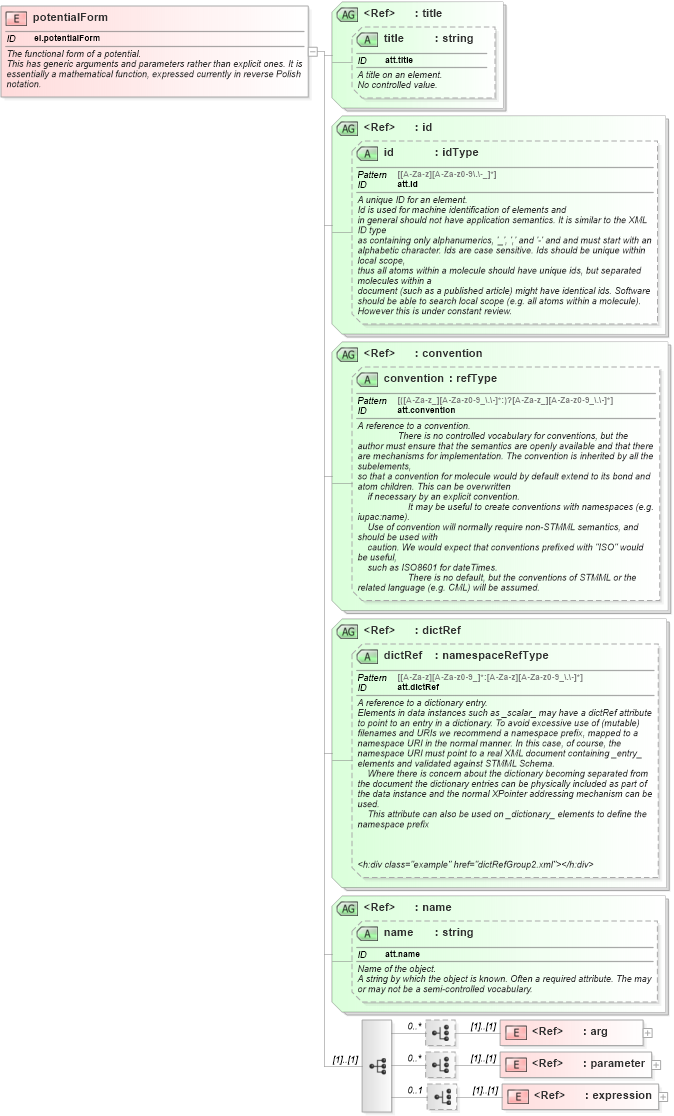
<xsd:element name="potentialForm" id="el.potentialForm">
    <xsd:annotation>
        <xsd:documentation>
            <h:div class="summary" xmlns:h="http://www.w3.org/1999/xhtml">The functional form of a potential.</h:div>
            <h:div class="description" xmlns:h="http://www.w3.org/1999/xhtml">This has generic arguments and parameters rather than explicit ones. It is essentially a mathematical function, expressed currently in reverse Polish notation.</h:div>
            <h:div class="example" href="potential1.xml" xmlns:h="http://www.w3.org/1999/xhtml" />
        </xsd:documentation>
    </xsd:annotation>
    <xsd:complexType>
        <xsd:sequence>
            <!--
       <xsd:choice minOccurs="0" maxOccurs="unbounded">
         <xsd:element ref="annotation"/>
       </xsd:choice>
-->
            <xsd:choice minOccurs="0" maxOccurs="unbounded">
                <xsd:element ref="arg" />
            </xsd:choice>
            <xsd:choice minOccurs="0" maxOccurs="unbounded">
                <xsd:element ref="parameter" />
            </xsd:choice>
            <xsd:choice minOccurs="0" maxOccurs="1">
                <xsd:element ref="expression" />
            </xsd:choice>
        </xsd:sequence>
        <xsd:attributeGroup ref="title" />
        <xsd:attributeGroup ref="id" />
        <xsd:attributeGroup ref="convention" />
        <xsd:attributeGroup ref="dictRef" />
        <xsd:attributeGroup ref="name" />
    </xsd:complexType>
</xsd:element>
|
 XSD Schema Diagram: