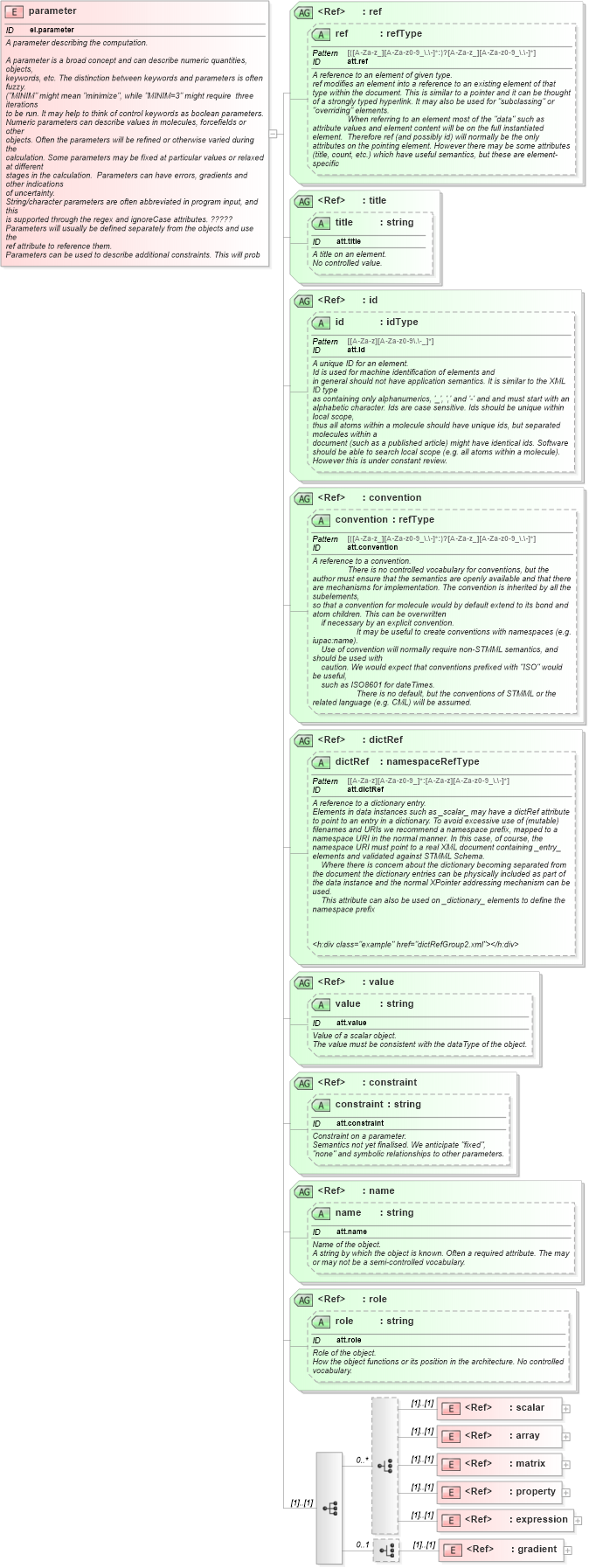
<xsd:element name="parameter" id="el.parameter">
    <xsd:annotation>
        <xsd:documentation>
            <h:div class="summary" xmlns:h="http://www.w3.org/1999/xhtml">A parameter describing the computation.</h:div>
            <h:div class="description" xmlns:h="http://www.w3.org/1999/xhtml">
                <h:p>A parameter is a broad concept and can describe numeric quantities, objects,
                keywords, etc. The distinction between keywords and parameters is often fuzzy.
                ("MINIM" might mean "minimize", while "MINIM=3" might require  three iterations
                to be run. It may help to think of control keywords as boolean parameters. </h:p>
                <h:p>Numeric parameters can describe values in molecules, forcefields or other
                objects. Often the parameters will be refined or otherwise varied during the
                calculation. Some parameters may be fixed at particular values or relaxed at different
                stages in the calculation.  Parameters can have errors, gradients and other indications
                of uncertainty.</h:p>
                <h:p>String/character parameters are often abbreviated in program input, and this
                is supported through the <h:tt>regex</h:tt> and <h:tt>ignoreCase</h:tt> attributes. ?????</h:p>
                <h:p>Parameters will usually be defined separately from the objects and use the
                <h:tt>ref</h:tt> attribute to reference them.</h:p>
                <h:p>Parameters can be used to describe additional constraints. This will probably
                require the development of a microlanguage and until then may use program-specific
                mechanisms. A common approach will be to use an array of values (or objects) to
                represent different input values for (parts of) the calculation. Thus a conformational
                change could be specified by an array of several torsion angles.</h:p>
                <h:p>A parameter will frequently have a <h:tt>dictRef</h:tt> pointing to a dictionary
                which may have more information about how the parameter is to be used or the values
                it can take. </h:p>
                <h:p>The allowable content of <h:tt>parameter</h:tt>s may be shown by a "template"
                in the <h:tt>appinfo</h:tt>; this is stil experimental.</h:p>
            </h:div>
            <h:div class="example" href="parameter1.xml" xmlns:h="http://www.w3.org/1999/xhtml" />
        </xsd:documentation>
    </xsd:annotation>
    <xsd:complexType>
        <xsd:sequence>
            <xsd:choice minOccurs="0" maxOccurs="unbounded">
                <xsd:element ref="scalar" />
                <xsd:element ref="array" />
                <xsd:element ref="matrix" />
                <xsd:element ref="property" />
                <xsd:element ref="expression" />
            </xsd:choice>
            <xsd:choice minOccurs="0" maxOccurs="1">
                <xsd:element ref="gradient" />
            </xsd:choice>
        </xsd:sequence>
        <xsd:attributeGroup ref="ref" />
        <xsd:attributeGroup ref="title" />
        <xsd:attributeGroup ref="id" />
        <xsd:attributeGroup ref="convention" />
        <xsd:attributeGroup ref="dictRef" />
        <xsd:attributeGroup ref="value">
            <xsd:annotation>
                <xsd:documentation>
                    <h:div class="specific" xmlns:h="http://www.w3.org/1999/xhtml">This is a shorthand for a single scalar value of the
                    parameter. It should only be used with the <h:tt>ref</h:tt> attribute as it inherits all the dataTyping of the referenced element. It must not be used for defining new parameters as it has no mechanism for units and dataTyping. [This may change?].</h:div>
                </xsd:documentation>
            </xsd:annotation>
        </xsd:attributeGroup>
        <xsd:attributeGroup ref="constraint" />
        <xsd:attributeGroup ref="name" />
        <xsd:attributeGroup ref="role">
            <xsd:annotation>
                <xsd:documentation>
                    <h:div class="specific" xmlns:h="http://www.w3.org/1999/xhtml">
                        <h:p>Used to define concepts such as independent and dependent
                        variables</h:p>
                    </h:div>
                </xsd:documentation>
            </xsd:annotation>
        </xsd:attributeGroup>
    </xsd:complexType>
</xsd:element>
|
 XSD Schema Diagram: