Definition Type: Element
Name: torsion
Namespace: http://www.xml-cml.org/schema
Type: nsA:torsionAngleType
Containing Schema: schema.xsd
Abstract
Documentation:
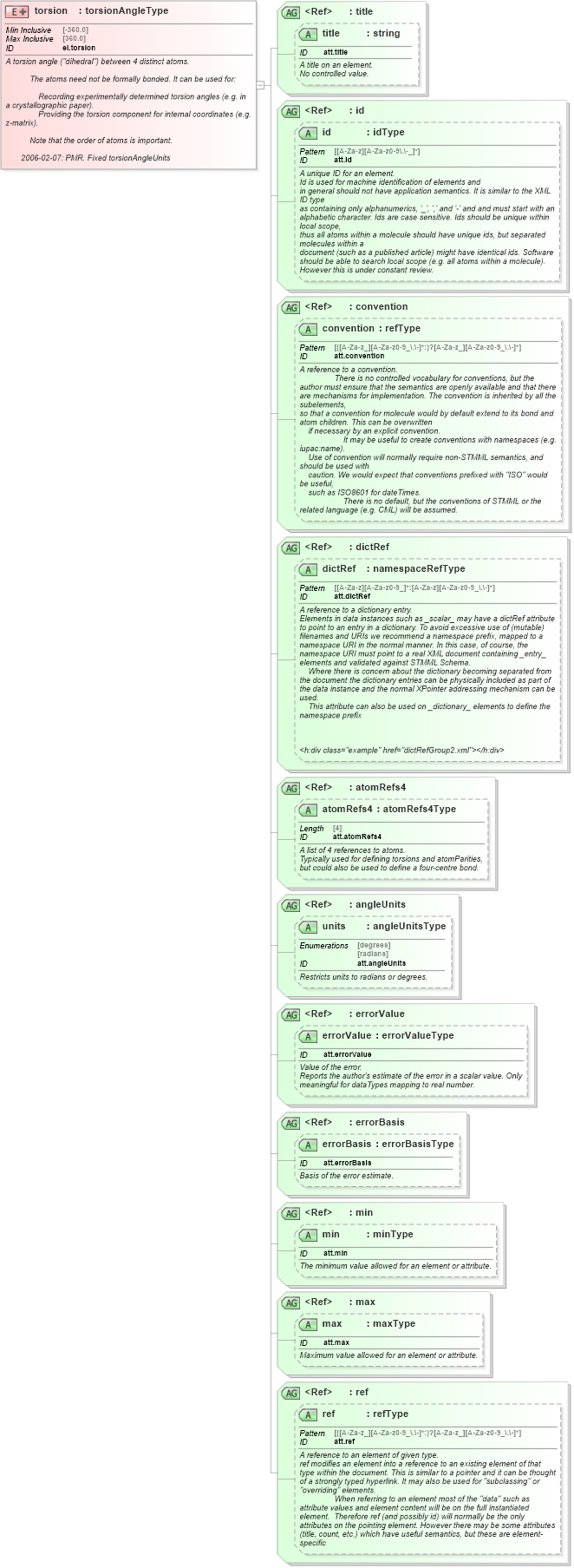
A torsion angle ("dihedral") between 4 distinct atoms. The atoms need not be formally bonded. It can be used for: Recording experimentally determined torsion angles (e.g. in a crystallographic paper). Providing the torsion component for internal coordinates (e.g. z-matrix). Note that the order of atoms is important. 2006-02-07: PMR. Fixed torsionAngleUnits
Collapse XSD Schema Diagram:
Drilldown into ref in schema schema_xsd Drilldown into ref in schema schema_xsd Drilldown into max in schema schema_xsd Drilldown into max in schema schema_xsd Drilldown into min in schema schema_xsd Drilldown into min in schema schema_xsd Drilldown into errorBasis in schema schema_xsd Drilldown into errorBasis in schema schema_xsd Drilldown into errorValue in schema schema_xsd Drilldown into errorValue in schema schema_xsd Drilldown into units in schema schema_xsd Drilldown into angleUnits in schema schema_xsd Drilldown into atomRefs4 in schema schema_xsd Drilldown into atomRefs4 in schema schema_xsd Drilldown into dictRef in schema schema_xsd Drilldown into dictRef in schema schema_xsd Drilldown into convention in schema schema_xsd Drilldown into convention in schema schema_xsd Drilldown into id in schema schema_xsd Drilldown into id in schema schema_xsd Drilldown into title in schema schema_xsd Drilldown into title in schema schema_xsdXSD Diagram of torsion in schema schema_xsd (Chemical Markup Language (CML))
Collapse XSD Schema Code:
<xsd:element name="torsion" id="el.torsion">
    <xsd:annotation>
        <xsd:documentation>
            <h:div class="summary" xmlns:h="http://www.w3.org/1999/xhtml">A torsion angle ("dihedral") between 4 distinct atoms.</h:div>
            <h:div class="description" xmlns:h="http://www.w3.org/1999/xhtml">
                <h:p>The atoms need not be formally bonded. It can be used for:</h:p>
                <h:ul>
                    <h:li>Recording experimentally determined torsion angles (e.g. in
     a crystallographic paper).</h:li>
                    <h:li>Providing the torsion component for internal coordinates (e.g.
     z-matrix).</h:li>
                </h:ul>
                <h:p>Note that the order of atoms is important.</h:p>
            </h:div>
            <h:div class="example" href="torsion1.xml" xmlns:h="http://www.w3.org/1999/xhtml" />
            <h:div class="curation" xmlns:h="http://www.w3.org/1999/xhtml">2006-02-07: PMR. Fixed torsionAngleUnits</h:div>
        </xsd:documentation>
    </xsd:annotation>
    <xsd:complexType>
        <xsd:simpleContent>
            <xsd:extension base="torsionAngleType">
                <xsd:attributeGroup ref="title" />
                <xsd:attributeGroup ref="id" />
                <xsd:attributeGroup ref="convention" />
                <xsd:attributeGroup ref="dictRef" />
                <xsd:attributeGroup ref="atomRefs4" />
                <xsd:attributeGroup ref="angleUnits" />
                <xsd:attributeGroup ref="errorValue" />
                <xsd:attributeGroup ref="errorBasis" />
                <xsd:attributeGroup ref="min" />
                <xsd:attributeGroup ref="max" />
                <xsd:attributeGroup ref="ref" />
            </xsd:extension>
        </xsd:simpleContent>
    </xsd:complexType>
</xsd:element>
Collapse Child Attributes:
Name Type Default Value Use
title nsA:title (Optional)
id nsA:id (Optional)
convention nsA:convention (Optional)
dictRef nsA:dictRef (Optional)
atomRefs4 nsA:atomRefs4 (Optional)
units nsA:units (Optional)
errorValue nsA:errorValue (Optional)
errorBasis nsA:errorBasis (Optional)
min nsA:min (Optional)
max nsA:max (Optional)
ref nsA:ref (Optional)
Collapse Derivation Tree: