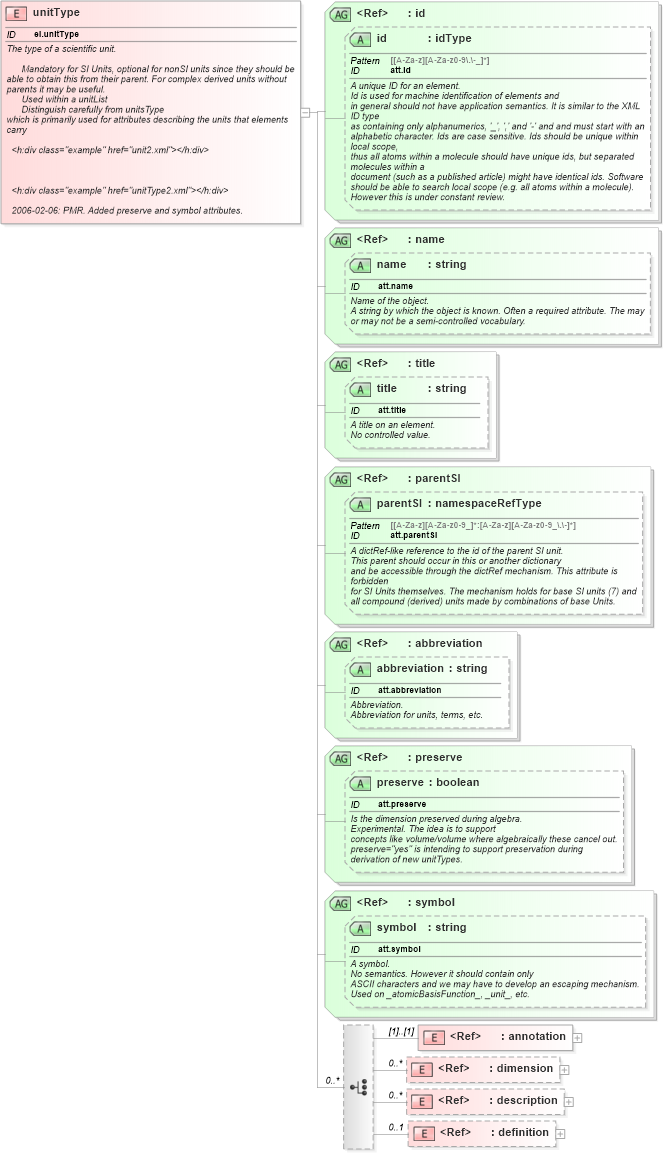
<xsd:element name="unitType" id="el.unitType">
    <xsd:annotation>
        <xsd:documentation>
            <h:div class="summary" xmlns:h="http://www.w3.org/1999/xhtml">The type of a scientific unit.</h:div>
            <h:div class="description" xmlns:h="http://www.w3.org/1999/xhtml">
                <h:p>Mandatory for SI Units, optional for nonSI units since they should be able to obtain this from their parent. For complex derived units without parents it may be useful.</h:p>
                <h:p>Used within a unitList</h:p>
                <h:p>Distinguish carefully from <h:a href="st.unitsType">unitsType</h:a>
          which is primarily used for attributes describing the units that elements
          carry</h:p>
            </h:div>
            <!--
            <h:div class="example" href="unit2.xml"></h:div>
-->
            <h:div class="example" href="unitType1.xml" xmlns:h="http://www.w3.org/1999/xhtml" />
            <!--
            <h:div class="example" href="unitType2.xml"></h:div>
-->
            <h:div class="curation" xmlns:h="http://www.w3.org/1999/xhtml">2006-02-06: PMR. Added preserve and symbol attributes.</h:div>
        </xsd:documentation>
    </xsd:annotation>
    <xsd:complexType>
        <xsd:choice minOccurs="0" maxOccurs="unbounded">
            <xsd:element ref="annotation" />
            <xsd:element ref="dimension" minOccurs="0" maxOccurs="unbounded" />
            <xsd:element ref="description" minOccurs="0" maxOccurs="unbounded" />
            <xsd:element ref="definition" minOccurs="0" maxOccurs="1" />
        </xsd:choice>
        <xsd:attributeGroup ref="id" />
        <xsd:attributeGroup ref="name" />
        <xsd:attributeGroup ref="title" />
        <xsd:attributeGroup ref="parentSI" />
        <xsd:attributeGroup ref="abbreviation" />
        <xsd:attributeGroup ref="preserve" />
        <xsd:attributeGroup ref="symbol" />
    </xsd:complexType>
</xsd:element>
|
 XSD Schema Diagram: