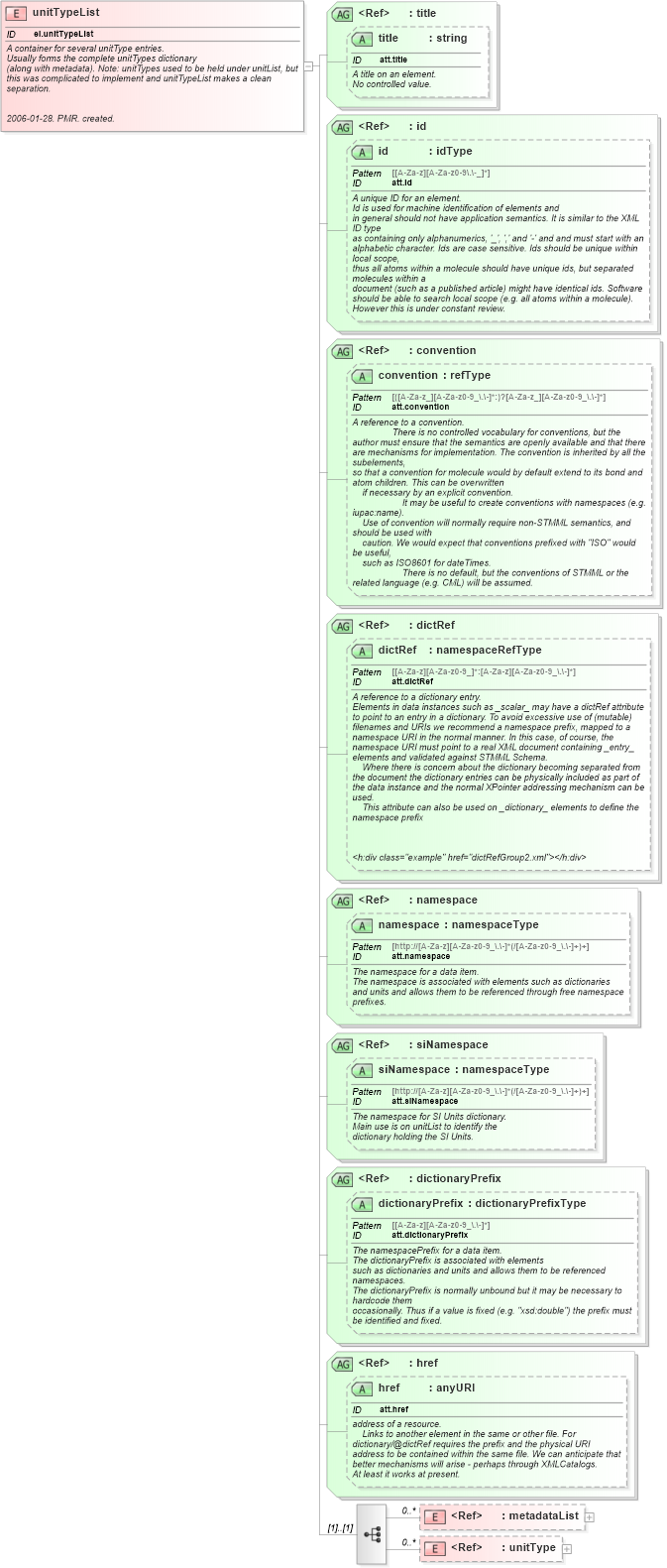
<xsd:element name="unitTypeList" id="el.unitTypeList">
    <xsd:annotation>
        <xsd:documentation>
            <h:div class="summary" xmlns:h="http://www.w3.org/1999/xhtml">A container for several unitType entries.</h:div>
            <h:div class="description" xmlns:h="http://www.w3.org/1999/xhtml">Usually forms the complete unitTypes dictionary
            (along with metadata). Note: unitTypes used to be held under unitList, but
            this was complicated to implement and unitTypeList makes a clean separation.
            </h:div>
            <h:div class="example" href="unitTypeList1.xml" xmlns:h="http://www.w3.org/1999/xhtml" />
            <h:div class="curation" xmlns:h="http://www.w3.org/1999/xhtml">2006-01-28. PMR. created.</h:div>
        </xsd:documentation>
    </xsd:annotation>
    <xsd:complexType>
        <xsd:sequence>
            <xsd:element ref="metadataList" minOccurs="0" maxOccurs="unbounded" />
            <xsd:element ref="unitType" minOccurs="0" maxOccurs="unbounded" />
        </xsd:sequence>
        <xsd:attributeGroup ref="title" />
        <xsd:attributeGroup ref="id" />
        <xsd:attributeGroup ref="convention" />
        <xsd:attributeGroup ref="dictRef" />
        <xsd:attributeGroup ref="namespace" />
        <xsd:attributeGroup ref="siNamespace" />
        <xsd:attributeGroup ref="dictionaryPrefix" />
        <xsd:attributeGroup ref="href">
            <xsd:annotation>
                <xsd:documentation>
                    <h:div class="specific" xmlns:h="http://www.w3.org/1999/xhtml">Maps dictRef prefix to the location of a
                    dictionary. This requires the prefix and the physical URI address
                    to be contained within the same file. We can anticipate that
                    better mechanisms will arise - perhaps through XMLCatalogs. At
                    least it works at present.</h:div>
                </xsd:documentation>
            </xsd:annotation>
        </xsd:attributeGroup>
    </xsd:complexType>
</xsd:element>
|
 XSD Schema Diagram: