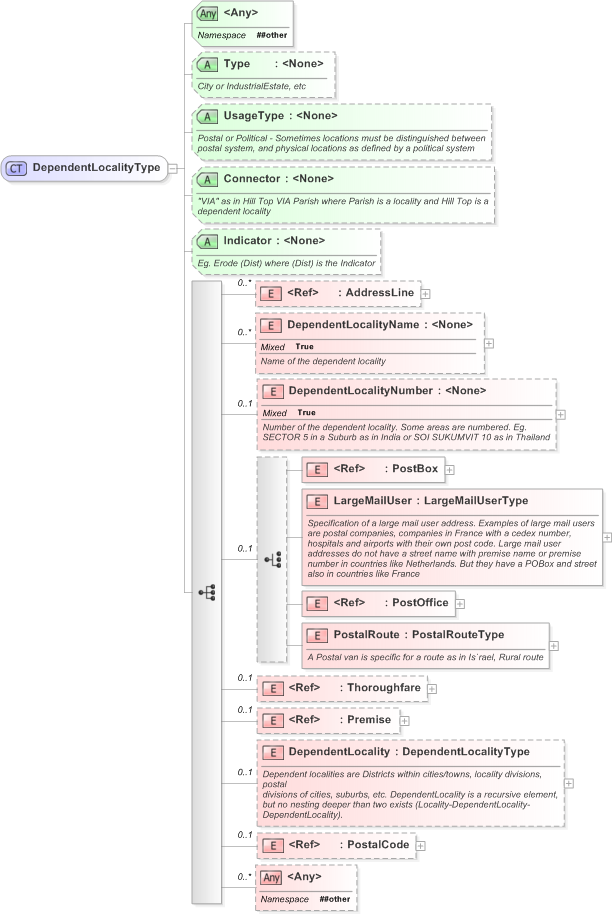
<xs:complexType name="DependentLocalityType">
    <xs:sequence>
        <xs:element ref="AddressLine" minOccurs="0" maxOccurs="unbounded" />
        <xs:element name="DependentLocalityName" minOccurs="0" maxOccurs="unbounded">
            <xs:annotation>
                <xs:documentation>Name of the dependent locality</xs:documentation>
            </xs:annotation>
            <xs:complexType mixed="true">
                <xs:attribute name="Type" />
                <xs:attributeGroup ref="grPostal" />
                <xs:anyAttribute namespace="##other" />
            </xs:complexType>
        </xs:element>
        <xs:element name="DependentLocalityNumber" minOccurs="0">
            <xs:annotation>
                <xs:documentation>Number of the dependent locality. Some areas are numbered. Eg. SECTOR 5 in a Suburb as in India or SOI SUKUMVIT 10 as in Thailand</xs:documentation>
            </xs:annotation>
            <xs:complexType mixed="true">
                <xs:attribute name="NameNumberOccurrence">
                    <xs:annotation>
                        <xs:documentation>Eg. SECTOR occurs before 5 in SECTOR 5</xs:documentation>
                    </xs:annotation>
                    <xs:simpleType>
                        <xs:restriction base="xs:NMTOKEN">
                            <xs:enumeration value="Before" />
                            <xs:enumeration value="After" />
                        </xs:restriction>
                    </xs:simpleType>
                </xs:attribute>
                <xs:attributeGroup ref="grPostal" />
                <xs:anyAttribute namespace="##other" />
            </xs:complexType>
        </xs:element>
        <xs:choice minOccurs="0">
            <xs:element ref="PostBox" />
            <xs:element name="LargeMailUser" type="LargeMailUserType">
                <xs:annotation>
                    <xs:documentation>Specification of a large mail user address. Examples of large mail users are postal companies, companies in France with a cedex number, hospitals and airports with their own post code. Large mail user addresses do not have a street name with premise name or premise number in countries like Netherlands. But they have a POBox and street also in countries like France</xs:documentation>
                </xs:annotation>
            </xs:element>
            <xs:element ref="PostOffice" />
            <xs:element name="PostalRoute" type="PostalRouteType">
                <xs:annotation>
                    <xs:documentation> A Postal van is specific for a route as in Is`rael, Rural route</xs:documentation>
                </xs:annotation>
            </xs:element>
        </xs:choice>
        <xs:element ref="Thoroughfare" minOccurs="0" />
        <xs:element ref="Premise" minOccurs="0" />
        <xs:element name="DependentLocality" type="DependentLocalityType" minOccurs="0">
            <xs:annotation>
                <xs:documentation>Dependent localities are Districts within cities/towns, locality divisions, postal
divisions of cities, suburbs, etc. DependentLocality is a recursive element, but no nesting deeper than two exists (Locality-DependentLocality-DependentLocality).</xs:documentation>
            </xs:annotation>
        </xs:element>
        <xs:element ref="PostalCode" minOccurs="0" />
        <xs:any namespace="##other" minOccurs="0" maxOccurs="unbounded" />
    </xs:sequence>
    <xs:attribute name="Type">
        <xs:annotation>
            <xs:documentation>City or IndustrialEstate, etc</xs:documentation>
        </xs:annotation>
    </xs:attribute>
    <xs:attribute name="UsageType">
        <xs:annotation>
            <xs:documentation>Postal or Political - Sometimes locations must be distinguished between postal system, and physical locations as defined by a political system</xs:documentation>
        </xs:annotation>
    </xs:attribute>
    <xs:attribute name="Connector">
        <xs:annotation>
            <xs:documentation>"VIA" as in Hill Top VIA Parish where Parish is a locality and Hill Top is a dependent locality</xs:documentation>
        </xs:annotation>
    </xs:attribute>
    <xs:attribute name="Indicator">
        <xs:annotation>
            <xs:documentation>Eg. Erode (Dist) where (Dist) is the Indicator</xs:documentation>
        </xs:annotation>
    </xs:attribute>
    <xs:anyAttribute namespace="##other" />
</xs:complexType>
|
 XSD Schema Diagram: