Definition Type: ComplexType
Name: NonpublicExecutionReportRetracted
Namespace: http://www.fpml.org/FpML-5/recordkeeping
Type: nsD:NonCorrectableRequestMessage
Containing Schema: fpml-recordkeeping-processes-5-10.xsd
Abstract
Collapse XSD Schema Diagram:
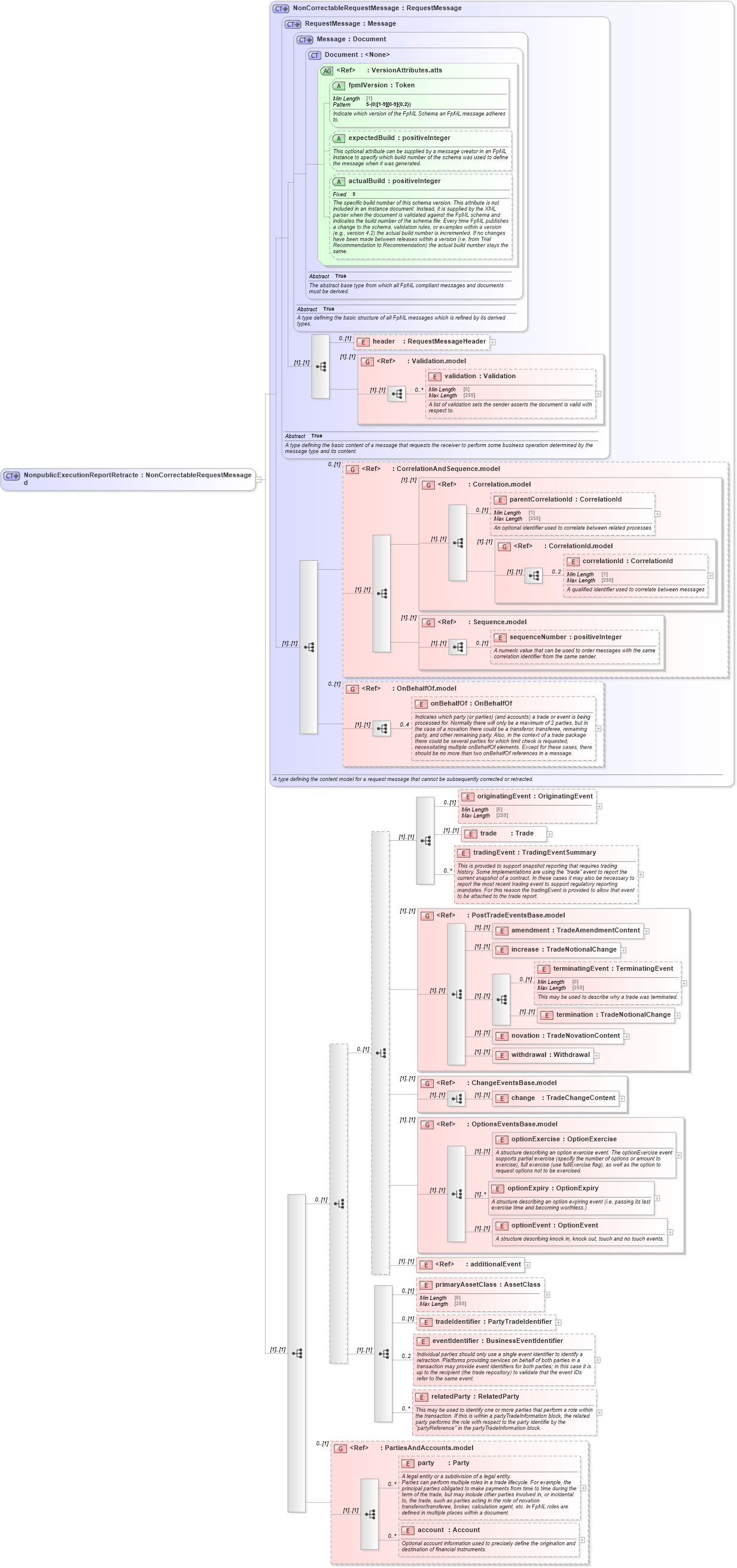
Drilldown into account in schema fpml-shared-5-10_xsd3 Drilldown into party in schema fpml-shared-5-10_xsd3 Drilldown into PartiesAndAccounts.model in schema fpml-shared-5-10_xsd3 Drilldown into relatedParty in schema fpml-recordkeeping-processes-5-10_xsd Drilldown into eventIdentifier in schema fpml-recordkeeping-processes-5-10_xsd Drilldown into tradeIdentifier in schema fpml-recordkeeping-processes-5-10_xsd Drilldown into primaryAssetClass in schema fpml-recordkeeping-processes-5-10_xsd Drilldown into additionalEvent in schema fpml-business-events-5-10_xsd2 Drilldown into optionEvent in schema fpml-business-events-5-10_xsd2 Drilldown into optionExpiry in schema fpml-business-events-5-10_xsd2 Drilldown into optionExercise in schema fpml-business-events-5-10_xsd2 Drilldown into OptionsEventsBase.model in schema fpml-business-events-5-10_xsd2 Drilldown into change in schema fpml-business-events-5-10_xsd2 Drilldown into ChangeEventsBase.model in schema fpml-business-events-5-10_xsd2 Drilldown into withdrawal in schema fpml-business-events-5-10_xsd2 Drilldown into novation in schema fpml-business-events-5-10_xsd2 Drilldown into termination in schema fpml-business-events-5-10_xsd2 Drilldown into terminatingEvent in schema fpml-business-events-5-10_xsd2 Drilldown into increase in schema fpml-business-events-5-10_xsd2 Drilldown into amendment in schema fpml-business-events-5-10_xsd2 Drilldown into PostTradeEventsBase.model in schema fpml-business-events-5-10_xsd2 Drilldown into tradingEvent in schema fpml-recordkeeping-processes-5-10_xsd Drilldown into trade in schema fpml-recordkeeping-processes-5-10_xsd Drilldown into originatingEvent in schema fpml-recordkeeping-processes-5-10_xsd Drilldown into onBehalfOf in schema fpml-shared-5-10_xsd3 Drilldown into OnBehalfOf.model in schema fpml-shared-5-10_xsd3 Drilldown into sequenceNumber in schema fpml-msg-5-10_xsd2 Drilldown into Sequence.model in schema fpml-msg-5-10_xsd2 Drilldown into correlationId in schema fpml-msg-5-10_xsd2 Drilldown into CorrelationId.model in schema fpml-msg-5-10_xsd2 Drilldown into parentCorrelationId in schema fpml-msg-5-10_xsd2 Drilldown into Correlation.model in schema fpml-msg-5-10_xsd2 Drilldown into CorrelationAndSequence.model in schema fpml-msg-5-10_xsd2 Drilldown into validation in schema fpml-doc-5-10_xsd3 Drilldown into Validation.model in schema fpml-doc-5-10_xsd3 Drilldown into header in schema fpml-msg-5-10_xsd2 Drilldown into actualBuild in schema fpml-doc-5-10_xsd3 Drilldown into expectedBuild in schema fpml-doc-5-10_xsd3 Drilldown into fpmlVersion in schema fpml-doc-5-10_xsd3 Drilldown into VersionAttributes.atts in schema fpml-doc-5-10_xsd3 Drilldown into Document in schema fpml-doc-5-10_xsd3 Drilldown into Message in schema fpml-msg-5-10_xsd2 Drilldown into RequestMessage in schema fpml-msg-5-10_xsd2 Drilldown into NonCorrectableRequestMessage in schema fpml-msg-5-10_xsd2XSD Diagram of NonpublicExecutionReportRetracted in schema fpml-recordkeeping-processes-5-10_xsd (Financial products Markup Language (FpML®))
Collapse XSD Schema Code:
<xsd:complexType name="NonpublicExecutionReportRetracted">
    <xsd:complexContent>
        <xsd:extension base="NonCorrectableRequestMessage">
            <xsd:sequence>
                <xsd:choice minOccurs="0">
                    <xsd:choice minOccurs="0">
                        <xsd:sequence>
                            <xsd:element name="originatingEvent" type="OriginatingEvent" minOccurs="0" />
                            <xsd:element name="trade" type="Trade" />
                            <xsd:element name="tradingEvent" type="TradingEventSummary" minOccurs="0" maxOccurs="unbounded">
                                <xsd:annotation>
                                    <xsd:documentation xml:lang="en">This is provided to support snapshot reporting that requires trading history. Some implementations are using the "trade" event to report the current snapshot of a contract. In these cases it may also be necessary to report the most recent trading event to support regulatory reporting mandates. For this reason the tradingEvent is provided to allow that event to be attached to the trade report.</xsd:documentation>
                                </xsd:annotation>
                            </xsd:element>
                        </xsd:sequence>
                        <xsd:group ref="PostTradeEventsBase.model" />
                        <xsd:group ref="ChangeEventsBase.model" />
                        <xsd:group ref="OptionsEventsBase.model" />
                        <xsd:element ref="additionalEvent" />
                    </xsd:choice>
                    <xsd:sequence>
                        <xsd:element name="primaryAssetClass" type="AssetClass" minOccurs="0" />
                        <xsd:element name="tradeIdentifier" type="PartyTradeIdentifier" minOccurs="0" />
                        <xsd:element name="eventIdentifier" type="BusinessEventIdentifier" minOccurs="0" maxOccurs="2">
                            <xsd:annotation>
                                <xsd:documentation xml:lang="en">Individual parties should only use a single event identifier to identify a retraction. Platforms providing services on behalf of both parties in a transaction may provide event identifiers for both parties; in this case it is up to the recipient (the trade repository) to validate that the event IDs refer to the same event.</xsd:documentation>
                            </xsd:annotation>
                        </xsd:element>
                        <xsd:element name="relatedParty" type="RelatedParty" minOccurs="0" maxOccurs="unbounded">
                            <xsd:annotation>
                                <xsd:documentation xml:lang="en">This may be used to identify one or more parties that perform a role within the transaction. If this is within a partyTradeInformation block, the related party performs the role with respect to the party identifie by the "partyReference" in the partyTradeInformation block.</xsd:documentation>
                            </xsd:annotation>
                        </xsd:element>
                    </xsd:sequence>
                </xsd:choice>
                <xsd:group ref="PartiesAndAccounts.model" minOccurs="0" />
            </xsd:sequence>
        </xsd:extension>
    </xsd:complexContent>
</xsd:complexType>
Collapse Child Elements:
Name Type Min Occurs Max Occurs
header nsD:header 0 (1)
validation nsD:validation 0 unbounded
parentCorrelationId nsD:parentCorrelationId 0 (1)
correlationId nsD:correlationId 0 2
sequenceNumber nsD:sequenceNumber 0 (1)
onBehalfOf nsD:onBehalfOf 0 4
originatingEvent nsD:originatingEvent 0 (1)
trade nsD:trade (1) (1)
tradingEvent nsD:tradingEvent 0 unbounded
amendment nsD:amendment (1) (1)
increase nsD:increase (1) (1)
terminatingEvent nsD:terminatingEvent 0 (1)
termination nsD:termination (1) (1)
novation nsD:novation (1) (1)
withdrawal nsD:withdrawal (1) (1)
change nsD:change (1) (1)
optionExercise nsD:optionExercise (1) (1)
optionExpiry nsD:optionExpiry (1) unbounded
optionEvent nsD:optionEvent (1) (1)
additionalEvent nsD:additionalEvent (1) (1)
primaryAssetClass nsD:primaryAssetClass 0 (1)
tradeIdentifier nsD:tradeIdentifier 0 (1)
eventIdentifier nsD:eventIdentifier 0 2
relatedParty nsD:relatedParty 0 unbounded
party nsD:party 0 unbounded
account nsD:account 0 unbounded
<xs:group> nsD:Validation.model (1) (1)
<xs:group> nsD:CorrelationAndSequence.model 0 (1)
<xs:group> nsD:Correlation.model (1) (1)
<xs:group> nsD:CorrelationId.model (1) (1)
<xs:group> nsD:Sequence.model (1) (1)
<xs:group> nsD:OnBehalfOf.model 0 (1)
<xs:group> nsD:PostTradeEventsBase.model (1) (1)
<xs:group> nsD:ChangeEventsBase.model (1) (1)
<xs:group> nsD:OptionsEventsBase.model (1) (1)
<xs:group> nsD:PartiesAndAccounts.model 0 (1)
Collapse Child Attributes:
Name Type Default Value Use
fpmlVersion nsD:fpmlVersion Required
expectedBuild nsD:expectedBuild (Optional)
actualBuild nsD:actualBuild (Optional)
Collapse Derivation Tree:
Collapse References:
nsD:nonpublicExecutionReportRetracted